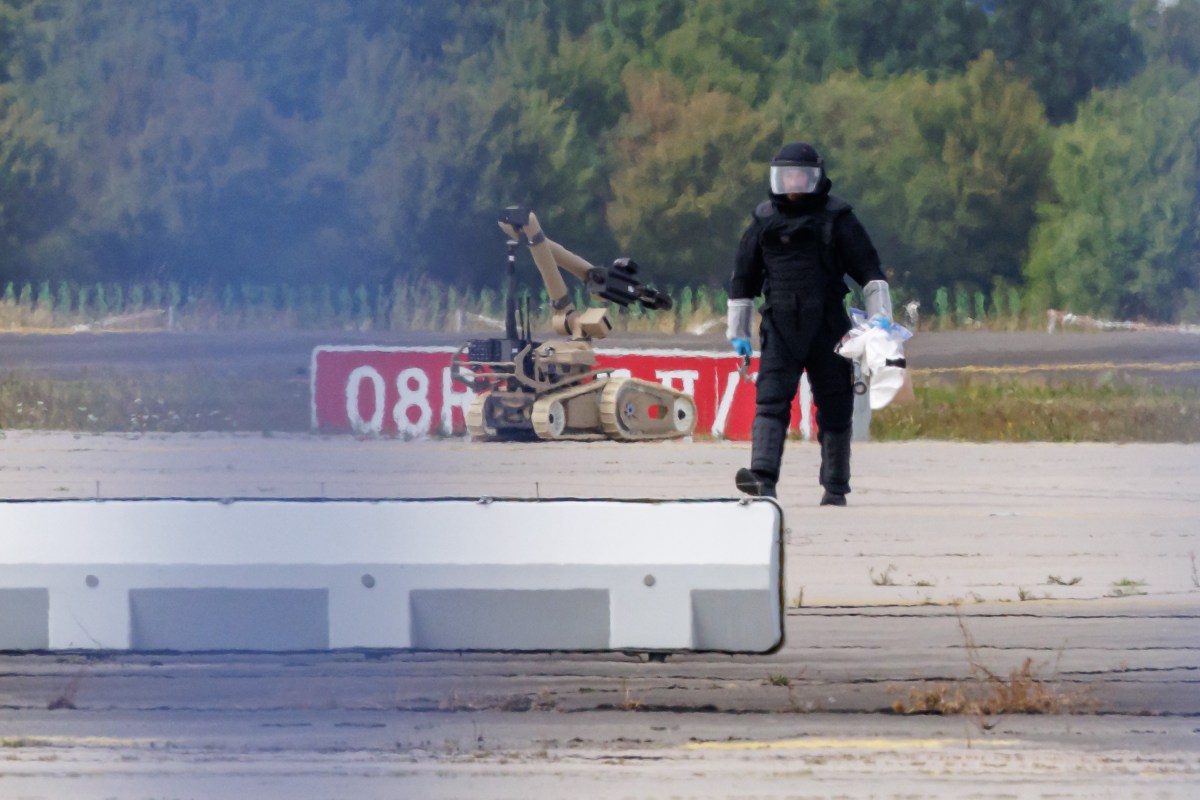
Germany’s Interior Minister has said that the country has experienced “a hybrid attack scenario” after police and security experts discovered and defused a drone that was armed with explosives at Leipzig airport in the eastern state of Saxony.
Speaking to reporters late on Wednesday from Leipzig/Halle airport, looking ashen-faced and surrounded by state and security officials, Interior Minister Alexander Dobrindt did not attribute the attack to any nation in particular but said, “We’re talking about a professional hybrid threat situation.”
“The fact that a drone armed with explosives is here on the grounds of an airport represents a new threat scenario,” Dobrindt said.
Read More on News
The incident has shaken officials and security experts who are starting to ask what was once unthinkable—whether Germany is de facto at war, or at least engaged in a hybrid war—and with whom?
Hybrid warfare is aggression designed to take place just below the threshold of accountability, making it very difficult to issue responses.
Germany recorded more than 1,000 suspicious drone overflights in 2025, according to an interview in Bild newspaper with the President of the Federal Criminal Police Office, Holger Muench.
But the incident at Leipzig appears to have been the most serious. German security and intelligence experts have pointed to Russia as the most likely origin of the threat, with some saying China could also be a possibility, or at least that the country may form part of the threat picture in a very uncomfortable “new normal.”

The drone was discovered just before midnight on Tuesday, flying between two transport planes belonging to the Ukrainian state carrier Antonov, German public television stations reported on Thursday. Airport video footage later showed it had entered the airport territory earlier in the evening, around 7 p.m., from the south. It was armed with a fist-sized ball of explosives, probably Semtex, according to the reports.
In another possible drone incident around the same time that is also being investigated, a DHL aircraft hit an object as it pulled away from Leipzig airport due to the airport’s sudden closure because of the drone incident, suffering damage to its nose, ARD television station said, citing an internal and official report that it said was not public. The aircraft was diverted to Hannover in the west of the country.
Leipzig is a hub for the delivery service DHL and for military support for Ukraine and is a focus of both Russian and Chinese intelligence.
In 2025, a Chinese woman, Yaqi Xiao, was convicted by a German court of collecting and passing sensitive data regarding flight schedules, cargo movements, passenger lists, and military equipment transports of a German arms manufacturer to another Chinese national, Jian Guo, who was sentenced to nearly five years in prison as a spy. Guo was an aide to Maximilian Krah, a politician in the far-right German AfD party.
But experts think the Russia connection is more immediate—and that this latest incident may represent a growing threat linked to Russia’s war on Ukraine, now in its fifth year.
“We are currently experiencing an escalation of the war by Russia…which is now clearly targeting, more and more, the Europeans who are providing military aid to Ukraine,” Joachim Krause, a security expert at the Institute for Security Policy at Kiel University, told Newsweek.
“One risk threshold after another is being crossed,” Krause said.
Germany was struggling to manage the problem, Krause said.
“A lot of people still don’t want to understand that Russia is waging a nonlinear war against us. And in this war, first they try political methods, and then hidden violence, and then at some point they will use open violence to achieve Putin’s aims. And that violence is part of the system of Putin’s power, and of his survival,” Krause said, referring to the Russian president Vladimir Putin.
The Russian embassy in Berlin did not immediately respond to a request for comment from Newsweek.
The incident was “creepy,” said Juergen Kremb, a China intelligence expert at Soochow University in Taiwan and a former correspondent at Der Spiegel, the German news magazine.
“If a foreign power attacks a German airport on German soil with a drone carrying explosives and it’s provable, then it’s a declaration of war by this foreign power,” Kremb told Newsweek.
“Hopefully it will never happen, but that’s what it is. Not using tanks but drones, but on German sovereign territory, in a very security-connected area. It’s not a small thing. It’s pretty much the worst that has happened to us in decades,'” Kremb said.
“It is state terrorism. And the Russians and the Chinese, they do work very closely together. Of course there is always competition and security services only exchange a certain amount of information with each other, but they are very close all right. You can stop tanks, but you can produce thousands of drones,” he said.
Krause said that Germany was badly prepared against such threats.
“We are extremely ill-equipped when it comes to defending against drones,” Krause said, pointing to jurisdictional and coordination issues between the Federal Police, the state police forces, and the Bundeswehr, Germany’s military. Germany also suffered from “a signifiacnt lack of technical capabilities,” Krause said.
“And thirdly, no one dares to shoot down drones because that could cause collateral damage. This creates an impression for the Russians of widespread helplessness,” which was leading to more and more attacks, he said. Krause called on the German government to show more determination and clarity in combating the threat.