August 6, 2026
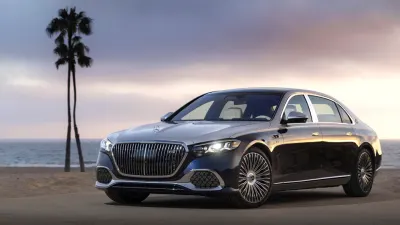
 The Maybach S-Class takes the luxury sedan and kicks it up a notch. (Mercedes)
Luxury, like most things, has tiers.
For many, the Mercedes-Benz S-Class is the pinnacle of comfort and extravagance. Some, though, demand more. Not just a little more, but a lot more, and for those people (and their large bank accounts), there’s the 2027 Mercedes-Maybach S-Class sedan. This is their top tier, and I had a chance to experience it while driving around Los Angeles.
More Cylinders
The Maybach S-Class is available in two trims: The S580 (starting at $210,200) ships with the recently upgraded M 177 Evo 4-L twin-turbo V8 mild hybrid engine. This is the same updated motor found in the regular S580 S-Class. Like that vehicle, the Maybach version has a new firing order, intake camshaft, port injectors, and turbos to help keep power to the wheels while navigating the automaker’s decision to add a flat-plane crankshaft and implement Miller Cycle to improve efficiency.
The hybrid integrated starter generator (ISG) helps with low-end torque and efficiency. It adds 23 hp (17 kW) and 151 lb-ft (205 Nm) to the vehicle’s overall output of 530 hp (410 Nm) and 553 lb-ft (750 kW). According to Mercedes, the S580 will travel from zero to 60 (97 km/h) in 3.9 seconds. Unfortunately, that trim was not available during the drive program. Instead, Mercedes gave us more.
Learn More
Riding With Mercedes and Its in-city Driver Assistance System
First Drive: 2027 Mercedes-Benz S-Class
The Bulletproof Mercedes You Probably Can’t Buy
I drove the top-trim S680 that starts at a very luxurious $247,450. Under the hood sits a 6-L V12 Biturbo engine. This is the only 12-cylinder S-Class available to U.S. customers. The S-Class Guard is outfitted with a V12 but, legally, you can’t buy that armored vehicle in the United States.
The 12-cylinder beast produces 621 hp (463 kW) and 664 lb-ft (900 Nm). But all that extra weight added by those four additional cylinders likely contributes to the vehicle’s slower-than-the-S580 zero-to-60 time of 4.3 seconds. Not that the average driver would notice that slight difference; both of these vehicles are more than capable of blasting off the line and spilling all the champagne being sipped by their passengers. Never fear, though. Mercedes has plans to make sure those passengers remain comfortable.
More Comfort
In addition to the requisite Sport and Comfort modes, the Maybach has an additional “Maybach” mode that smoothes out the ride and reduces the input of the accelerator and brakes. It flattens out the acceleration and braking curves in order to reduce any jarring felt by the passengers.
 Mercedes MBUX infotainment system gets some help from AI agents to deliver answers to the driver. (Mercedes)
On the road, the system can be overridden, to a degree, if you really apply pressure to the accelerator and brake. But it definitely makes for a more placid riding experience for passengers. The vehicle accomplishes its people-pampering feat, in part, with the automaker’s Airmatic air suspension and its new Intelligent Damper Control system. The feature logs road issues (potholes, etc) via other Mercedes-Benz vehicles with the feature installed and shares that information with all other Mercedes vehicles in the area via a cloud connection. If an S-Class hits a pothole, it will note the location, share that information with Mercedes, and the company disseminates that information. So, an hour later, when a Maybach is about to encounter that same pothole, it primes its suspension to swallow it up and not to disturb those inside. The biggest issue with Maybach mode is that the driver needs to take into account the extra distance needed to stop the vehicle. A professional driver would know to ease onto the throttle and brake, but that may not be intuitive for others, at e the rear seats, particularly the rear-right seat, are primed to offer up a first-class experience with a reclining function and an available footrest.
 The rear seats offer unmatched luxury at this rather extravagant price point. (Mercedes)
Between the rear seats sits a center console that houses two removable smartphone-sized controls for the rear seats. The console also supports a single wireless charging pad in addition to the two charging pads in the front of the vehicle. An optional fridge for champagne, white wine, Diet Coke, and Mountain Dew Code Red can be placed between the two rear seats. The tiny refrigerator also has spots for champagne flutes, and the Maybach has special “cup holders” with three tiny clasps that hold the base of the flutes when placed in the holder.
For those who need to actually work, a small platform is available for the rear seats. If that same person needs to jump into a Microsoft Teams meeting, that’s available via the vehicle’s MBUX infotainment system. The vehicle ships with the latest version of MB.OS and MBUX, and each passenger gets their own screen. A 12.3-in front passenger display and 13.1-in rear passenger displays. The main infotainment screen is a landscape-oriented 14.4-in display with Mercedes’ Zero Layer infotainment setup. I’ve noted before that I’m a fan of this system that places a map on the screen and surfaces widgets around the edge of the display for commonly used features.
Mercedes has long been a leader in voice-activated in-car assistants; recently, it’s partnered with tech companies to implement three AI agents – ChatGPT, Microsoft Bing, and Google Gemini – in the vehicle. With concerns about AI hallucinations on the rise, it makes sense that Mercedes says it acts as a gatekeeper for the information the AI agents present when queried by the passengers. When a query or prompt is presented, the three agents return answers that are vetted by Mercedes’ internal system. The best answer (according to Mercedes) is presented to the cabin.
I asked it when SAE International was founded. It returned that it was founded in 1905. For some reason, I thought it was 1906 while behind the wheel. I told the system that, and it replied that I was wrong. I was indeed wrong. SAE International was founded in 1905. Fun bits of trivia aside, the system still does a good job giving the driver voice control over various parts of the vehicle and, more importantly, can help find destinations (really, its main job) and begin route planning.
More Driving (Itself, Sort Of)
Mercedes is proud of its accomplishments in hands-free driving progress. It’s twice given me a ride in a vehicle with point-to-point directions inside the city of San Francisco where the vehicle’s hands-free system accomplished a large majority of the driving in the notoriously chaotic city streets.
 The Maybach S680 is the only S-Class with a V12 you can legally buy in the United States. (Mercedes)
That system has not yet been implemented in the Maybach S-Class (it’s coming via a software update), but the Mercedes hands-free highway driving system does deliver an experience that one of the best in the business. On the freeways around Los Angeles, it centered itself without issue and could change lanes without inducing stress. The goal for these systems is to be boring while the driver is still in control and responsible for what the vehicle is doing. What I appreciate is that during take over (when I “wrestle” control from the robot) the transition was smooth without the usual yank against robo-steering torque.
The Maybach S-Class takes everything Mercedes can throw at it, engineering- and luxury-wise, and amps it up for a more sophisticated audience. The S680 V12 is showy, but the entire premise of the vehicle is the ultimate flex for drivers and passengers. If you can swing nearly a quarter of a million dollars for one, you’ll be satisfied with the results of the ride and the reactions of those outside the vehicle when you pull up.
More From SAE Media Group