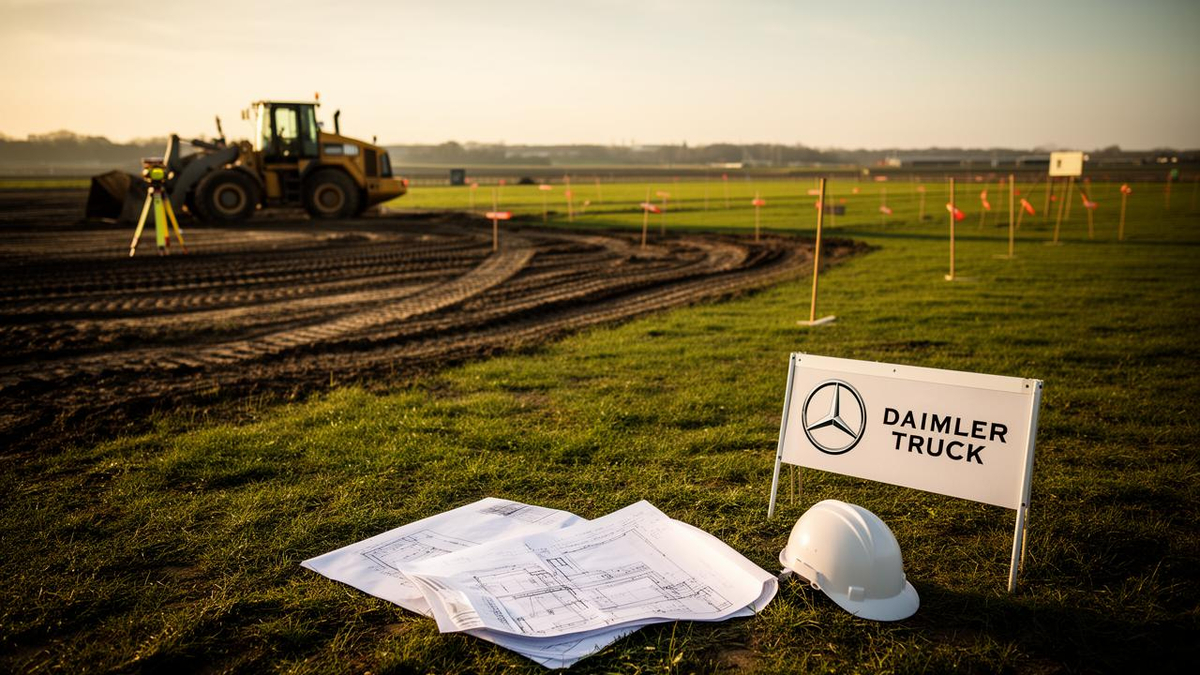
Daimler Truck has approved plans for what will become its largest truck manufacturing plant in the United States, a greenfield facility designed to shift more production capacity onto American soil and slash delivery times for commercial fleets.
The decision, unveiled Thursday by the German parent’s Portland-based North American subsidiary, does not yet include a specific location. Site selection is ongoing and the company declined to name finalist states. Construction is expected to begin late this year, with operations targeted for 2029. The workforce is projected to reach several thousand employees.
“We had our quarter-end supervisory board meeting and I’m proud to announce that we got the approval for the plans to build a new truck manufacturing plant in the U.S.,” John O’Leary, president and CEO of Daimler Truck North America, told reporters during a press conference. “It will be our largest manufacturing plant in the U.S. for trucks.”
The project sits within the parent company’s broader regional growth strategy. “This new manufacturing facility supports our long-term growth plans for North America,” said Karin Rådström, CEO of Daimler Truck.
For fleet customers, the business case hinges less on square footage and more on delivery precision. O’Leary stressed that even a two-week delay can disrupt a carrier’s operations when a driver has already completed training and is waiting to be seated.
“Customers, if they order a truck, they need it at a certain date, and if you deliver it two weeks later, for them that’s not a good thing because they had a driver waiting to be seated in that truck, probably just completed their training, and now they have to wait,” O’Leary said. “So even things like delivery are super important.”
The internal push for the facility predates the board vote by years. Jeff Allen, senior vice president of operations at DTNA, said he had been making the case to O’Leary for some time, and that the current environment—shaped by technology shifts and supply-chain considerations—made the timing right to prepare for the future.
A majority of DTNA’s assembly currently runs through Mexico. The new plant aims to rebalance that footprint.
“When it is completed, it would definitely give us the ability to flex back and forth and improve that percentage in the U.S.,” O’Leary said. “It’s no mystery to anybody that at this point in time the majority of our build is in Mexico, although it’s not a giant majority, but still some majority, and that’s fine. However, as you know, it’s also nice to be able to have U.S.-built products as well, especially these days.”
Asked directly whether trade tariffs drove the decision, O’Leary pointed at the calendar rather than at trade policy, suggesting the investment reflects long-term planning rather than a short-term reaction to duties.
The plant announcement came against a mixed financial backdrop. Daimler Truck reported an 18% year-on-year decline in second-quarter adjusted earnings before interest and tax to 838 million euros, even as overall revenue rose 6% and incoming orders surged 27%, driven by a rebound in North American demand. Margins were compressed largely by US trade tariffs, which offset stronger sales in the key North America segment.
Despite that headwind, the company raised its full-year 2026 guidance. Adjusted EBIT is now expected between 3.6 billion euros and 4.1 billion euros, up from a prior forecast of 3.2 billion euros to 3.7 billion euros. Unit sales are projected at 340,000 to 370,000 vehicles, compared with an earlier range of 330,000 to 360,000.
The North American trucks segment, which will house the new plant, is expected to deliver an adjusted return on sales of 9% to 11%, a significant upgrade from the previous expectation of 6% to 8%.
Daimler Truck also said it will launch the second tranche of its share buyback program by mid-September. The repurchase plan, which runs through the end of June 2027, has a volume of up to 1.1 billion euros, or roughly $1.3 billion. The company expects its tariff burden to ease substantially in the coming quarters following a regulatory breakthrough earlier this year.
The dual announcements—a major factory investment and an upgraded profit outlook—paint a picture of a company betting on North American demand while navigating near-term tariff friction. By adding US-based capacity, Daimler Truck aims to shorten supply chains, improve delivery reliability, and give commercial customers a domestically built option at a time when political and trade dynamics continue to evolve.