
Caravan-salon.com
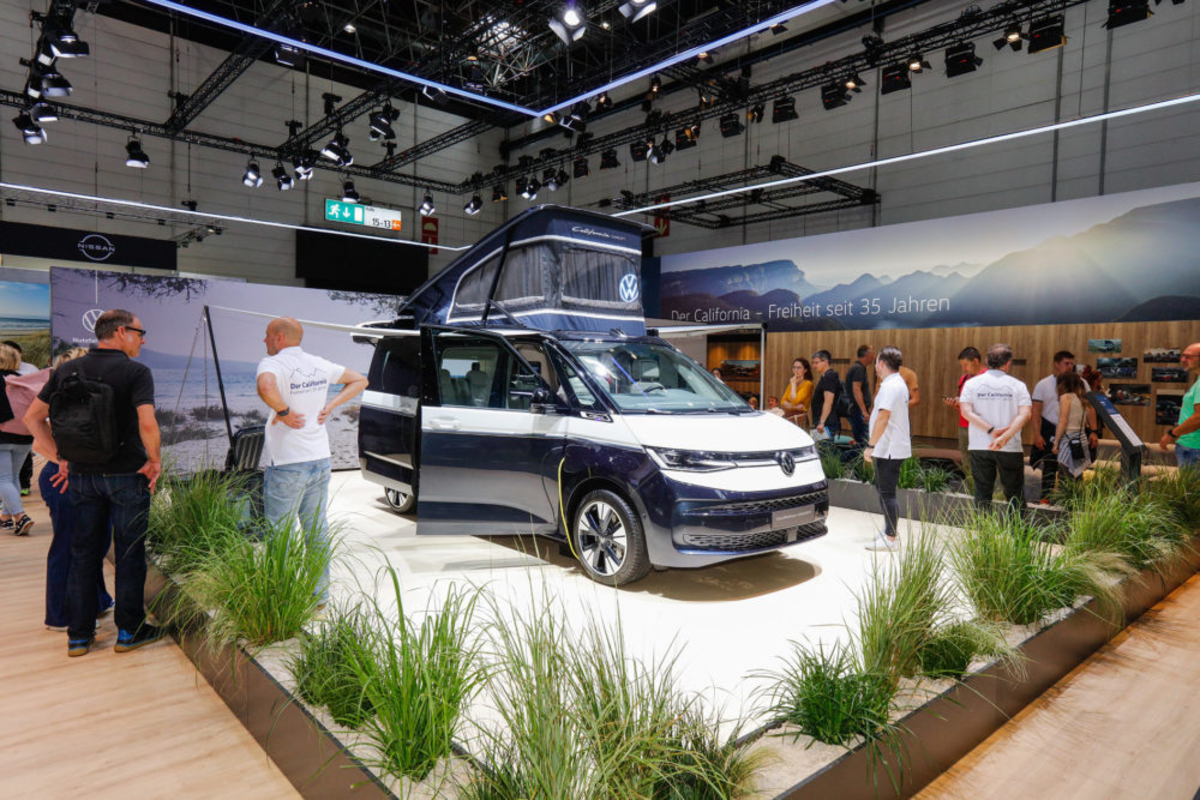
Three years ago, TechTimes reported that Volkswagen’s electric camper van was not coming — killed by a weight problem so fundamental that buyers would have needed a commercial truck license to drive it. On August 11, 2026, VW reversed that verdict entirely: the ID. California Cruise, the first fully factory-built electric member of the legendary California camper van family, is confirmed for a world premiere at the Caravan Salon in Düsseldorf, Germany, running from August 28 through September 6. VW’s official August 2026 announcement
This is not a concept teaser or a vague promise of future intent. VW says the ID. California Cruise “lays the foundation for a new family of electric campervans set to arrive step by step through 2028” — a multi-vehicle roadmap, not a one-off. Full specifications, photos, pricing, and production details remain under embargo until the show opens its doors on August 28. Whatever VW solved to get here — and there is a real engineering story behind that — the public gets the answer in 16 days.
California’s Nameplate and What’s at Stake
Few vehicle nameplates carry the cultural weight of the California. The California nameplate has existed since 1988, but its spirit traces back to the 1960s-era Volkswagen Type 2 campervan that became shorthand for freedom, surf culture, and life lived outside a cubicle. California nameplate history since 1988 Over four generations, Volkswagen has sold more than 260,000 California units, making it the most successful compact camper van of its kind in Europe.
That heritage created a specific expectation when the ID. Buzz arrived in 2022: if VW was electrifying its iconic van, the California version had to be next. For more than 35 years, the California has been one of the most successful camping vehicles in Europe. The question was never whether the company wanted to build an electric California — it was whether the physics would cooperate.
Why This Was Nearly Impossible in 2023
The weight problem that killed the project three years ago was not a bureaucratic stumbling block. It was an engineering constraint with real legal consequences for European buyers.
Volkswagen confirmed in August 2023 that with standard camper van equipment — a kitchen, bed, water tank, solar panel, inverter — an electric California on the ID. Buzz platform would weigh at least 3,000 kg (6,614 lbs) before adding a driver, passengers, or luggage. ID. Buzz weight concerns in 2023
That figure matters because of a specific provision in EU driver licensing law: a Category B license — the standard passenger car license most Europeans hold — authorizes driving vehicles up to a maximum authorized mass of 3,500 kg (7,716 lbs). Add driver, passengers, and gear to a vehicle that already weighs 3,000 kg unladen, and you are uncomfortably close to the limit. Push past it, and every buyer would need a Category C1 commercial truck license just to drive their camper van. That is not a theoretical concern; it is a market-killing constraint, because most California buyers do not hold C1 licenses.
The ID. Buzz long-wheelbase variant — the base from which any California conversion would be derived — has a curb weight of approximately 2,636 kg (5,809 lbs). Conventional camper van fitments (wooden cabinetry, fixed kitchen, bed frame, water systems) typically add another 100 kg or more (220+ lbs) to that baseline. weight comparison analysis The math was blunt: the project could not proceed without either a lighter platform or radically lighter interior fitments.
The Engineering Approach VW Is Now Taking
VW has not yet published the ID. California Cruise’s weight or interior specification. Those details are under embargo until August 28. But the direction the company is signaling — through its parallel California Beach concept — offers a revealing preview of its thinking.
Alongside the ID. California Cruise announcement, VW revealed a “world-first concept” for the California Beach (a T7 Multivan-based model, separate from the electric Cruise) developed with German startup Stuff Bubble. Instead of the permanently mounted wooden cabinets and metal framing that define traditional camper van interiors — and that drove the Cruise’s predecessor over the weight limit — VW and Stuff Bubble drew on construction techniques from kitesurfing, paragliding, and inflatable tent engineering to produce a fully functional camper kit that weighs under 22 kg (48.5 lbs) in total.
The inflatable kitchen module measures 120 x 44 x 47.5 cm (47.2 x 17.3 x 18.7 in), weighs under 10 kg (22 lbs), and clips directly into the California Beach’s existing luggage shelf mounting rails. The inflatable bed system — a breathable multi-layer construction measuring 200 x 134 cm (78.7 x 52.8 in) — weighs 6 kg (13.2 lbs) as a single or 12 kg (26.5 lbs) as a double. The complete kitchen and bed set is a saving of roughly 68 kg (150 lbs) compared to the conventional fixed fitments they replace.
Volkswagen Commercial Vehicles CEO Stefan Mecha put the company’s direction plainly: “Our strategic approach is to free the classic camper van from heavy materials and rigid installations, replacing them with flexible, modular solutions.” Stefan Mecha on modular solutions
That logic applies directly to the Cruise. Whether VW has achieved a similar lightweight approach in the fully electric model will be known on August 28.
What Is Already Confirmed
The confirmed facts about the ID. California Cruise are limited by design — VW is saving the full reveal for the show floor. What is established:
Platform: Based on the ID. Buzz, sharing the MEB (Modular Electric Drive Matrix) architecture. The MEB places the battery pack in a flat “skateboard” configuration between the axles, keeping the center of gravity low and maximizing interior space — a structurally favorable foundation for a camper conversion.Range baseline: The ID. Buzz long-wheelbase platform offers between 281 and 293 WLTP-rated miles of range depending on the powertrain. How the Cruise’s interior fitments affect that range is unconfirmed.Charging: The MEB platform supports up to 200 kW DC fast charging, with 11 kW AC capability. From 10 to 80 percent takes approximately 26 to 29 minutes at a 200 kW DC fast charger.Family roadmap: The Cruise is described as the first of “a new family of electric campervans” arriving step by step through 2028. This is not a one-off model.Existing camper kit: VW already sells a “Good Night Package” for the standard ID. Buzz — a €2,600 (approximately $3,003 USD) add-on that includes a folding bed, window blinds, and a 48-hour climate control mode capable of running the van’s air conditioning for two days without the engine. Good Night Package details The Cruise is expected to offer significantly more complete camper functionality than this kit.A Second Reveal: Inflatable Camping for the California Beach
The ID. California Cruise will share the Caravan Salon spotlight with an equally inventive announcement for the existing, non-electric California family. VW and Stuff Bubble have developed a pair of inflatable interior modules for the T7-based California Beach, consisting of an inflatable kitchen and a flexible bed system that can be installed or removed by a single person in minutes.
The design goal is dual-purpose usability: a California Beach owner can drive to work Monday through Friday as a six-seat family van, load the inflatable modules on a Friday evening, and arrive at a campsite with a functioning kitchen and sleeping quarters without having permanently surrendered cargo flexibility or added hundreds of pounds to the vehicle’s curb weight. VW will gather customer feedback on the inflatable concept during the Caravan Salon before committing to production.
Before the ID. California Cruise was confirmed, one of the few ways to get a fully fitted electric camper on the ID. Buzz platform was to pay a third-party converter. The Netherlands-based company Ventje offered its “eVentje” conversion — complete with induction cooktop, pop-up tent, 2,200W inverter, and solar panel — starting at €95,000 (approximately $109,725 USD) with a nine-month wait. The ID. California Cruise, when it reaches production, should offer factory-backed reliability, warranty coverage, and significantly different pricing — though VW has not confirmed what that price will be.
What the US Debut Timeline Looks Like
American buyers interested in the ID. California Cruise should approach the announcement with some caution about timing. VW paused the ID. Buzz for the US market in December 2025, skipping the 2026 model year. The reasons were primarily commercial: 25 percent US import tariffs on German-made vehicles made the business case difficult, and US ID. Buzz sales halted — well short of expectations for a vehicle priced from around $60,000.
The ID. California Cruise, if and when it enters production, would face the same tariff environment. VW has not announced any US-specific plans for the Cruise. European buyers, where the California nameplate has its strongest following and where 260,000 units have been sold, are the primary audience for this product.
Full specifications, pricing, and production timeline will be revealed when the Caravan Salon opens in Düsseldorf on August 28, 2026.
Exchange rate as of August 12, 2026; USD conversions are approximate.
Frequently Asked QuestionsHas Volkswagen actually solved the weight problem that killed the electric camper van in 2023?
Not confirmed yet. The core engineering challenge — keeping a fully fitted electric camper van below the 3,500 kg (7,716 lbs) maximum authorized mass for a standard European Category B driver’s license — has not been publicly addressed in VW’s August 11, 2026 announcement. The company has not released any weight data, interior specifications, or photos for the ID. California Cruise. What VW has demonstrated, in its parallel inflatable California Beach concept with Stuff Bubble, is a strategic direction: replacing permanently installed heavy furniture with lightweight, removable modules. Whether the same philosophy applies to the Cruise’s interior, and whether it resolves the weight math, will be answered when full specs are released at the Caravan Salon on August 28.
What does the MEB platform actually enable for a camper van that combustion-powered platforms did not?
The MEB platform’s defining structural feature is its flat-floor skateboard architecture: the battery pack is mounted low, between the axles, with no transmission tunnel running through the cabin. For a camper van conversion, this matters because it creates a genuinely flat floor from front to rear without the hump that forces awkward furniture compromises in ICE-based designs. Combined with the platform’s relatively short front and rear overhangs, the MEB ID. Buzz provides more usable interior volume per exterior foot than the T6 Transporter-based California it effectively replaces. The trade-off is that the battery itself — 86 kWh in the LWB configuration — is heavy, and that mass must be managed within the EU license weight threshold.
Will the VW ID. California Cruise be available in the United States?
No announcement has been made. VW paused the standard ID. Buzz for the US market in December 2025 due to 25 percent import tariffs and modest US sales. The ID. California Cruise, as a higher-spec and presumably more expensive derivative, faces the same tariff headwind. VW’s stated focus for the Cruise and its 2028 electric campervan family is the European market, where the California nameplate has its strongest cultural and commercial foothold.
What is the difference between the ID. California Cruise and the California Beach inflatable concept?
They are different vehicles addressing different markets. The ID. California Cruise is based on the all-electric ID. Buzz platform and is intended as a full factory camper van — the successor concept to the California that was canceled in 2023. The California Beach is a separate product based on the T7 Multivan, which uses a conventional combustion or plug-in hybrid drivetrain; the inflatable Stuff Bubble concept is an accessory kit for that existing vehicle. Both will be shown at the Caravan Salon, but they represent two distinct paths VW is exploring in the camper van segment.