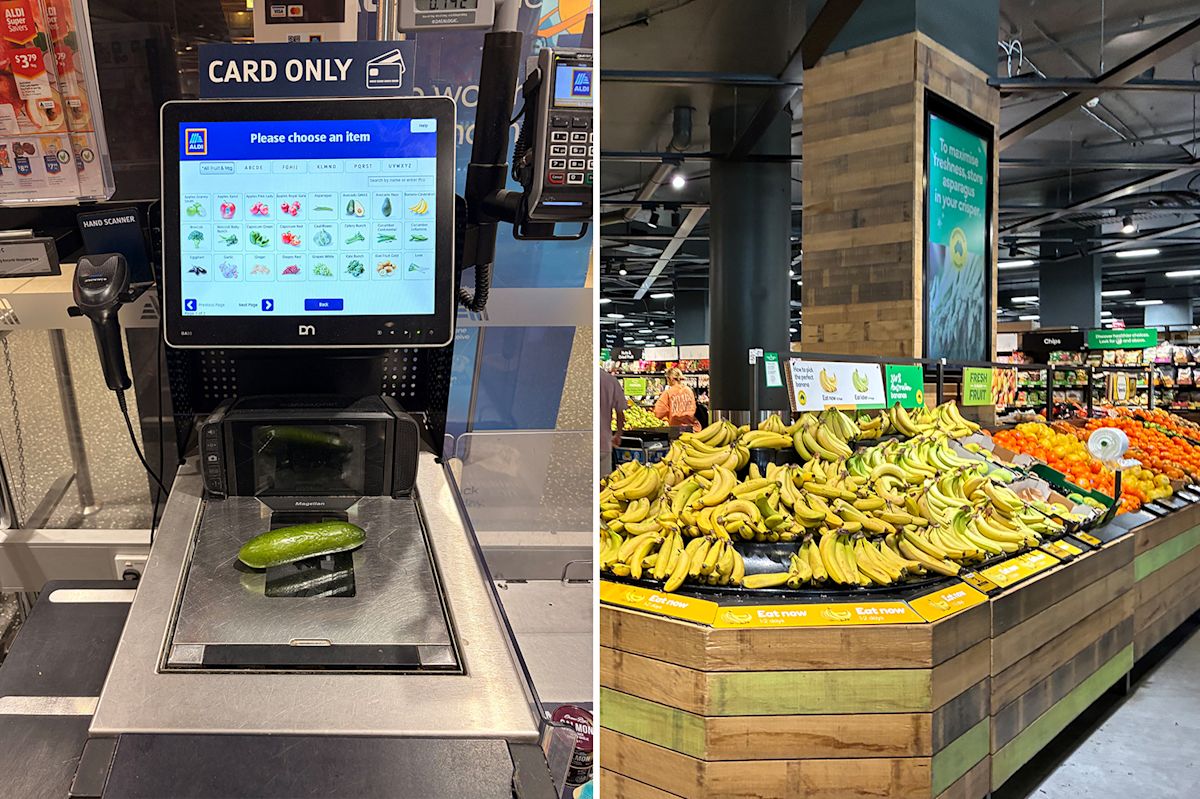
Eagle-eyed Australians are once again being called upon to spy on their local supermarkets as part of a new nationwide audit of plastic use.
The leading conservation group, the Australian Marine Conservation Society, has been keeping a close eye on the amount plastic used in supermarkets for the past few years, and the results have been damning.
Last year, hundreds of volunteer shoppers participated in the audit which delivered a scathing assessment of the nation’s major supermarkets — Woolworths, Coles, Aldi and IGA.
Supermarkets were accused of falling short on promised plastic cuts. And even slugging shoppers significantly more for loose produce than for items wrapped in plastic.
“Last year, our investigators discovered that, in 73 per cent of cases, loose fresh produce was more expensive than plastic-wrapped produce,” the organisation said.
Now, they are calling upon shoppers to “hold these massive corporations accountable”.
“We need eyes in every store around Australia to find out the truth.”
Do you have a story about supermarket plastic use? Contact newsroomau@yahoonews.com

Items wrapped in plastic are generally cheaper than those that aren’t, AMCS report revealed in November. Source: Yahoo News
What will I be asked about in the investigation?
Shoppers will be asked to report the differences they see at the shop.
In a survey, shoppers will be asked to state which supermarket they are at and which packaging options are available for fresh produce such as apples, carrots, avocados, mushrooms, tomatoes, onions, potatoes, oranges and more.
“We’re interested in comparing fresh produce wrapped in plastic with produce sold without packaging (loose),” the AMCS said.
Shoppers can find out more about the investigation here.
Shoppers pay more for loose fruit and vegetables
The 2025 report found that in nearly three-quarters of cases, loose fruit and vegetables cost more than their plastic-wrapped equivalents, effectively punishing shoppers who try to make environmentally friendly choices.
It also revealed that at times, supermarkets are refusing to disclose how much single-use plastic they actually use, making it impossible to track real progress.
Yahoo News spoke to Woolworths, Coles and Aldi at the time the report came out, and each defended their plastic consumption, citing what they claimed were significant reductions in recent years.
AMCS Program Manager Tara Jones warned in November that they continue to “sweep the plastic pollution crisis under the shelf” while packaging “piles up in our ocean and on our beaches”.
“Plastic-free loose fresh produce was more expensive in 73 per cent of cases,” she said.
“Disappointingly, this remains consistent with what our volunteer investigators found in 2024.
“Oranges, for example, averaged $4.24 per kilogram loose, compared to $2.49 per kilogram pre-packaged.”

A damning audit has claimed Australia’s supermarkets are still using far too much plastic. Source: Yahoo News
The audit measures how well the major supermarkets manage plastic packaging, assessing transparency, reduction, reuse, recycling, and governance.
It combines survey responses, public data, and mystery shopping to score performance across these areas.

The audit measures how well the major supermarkets manage plastic packaging, assessing transparency, reduction, reuse, recycling, and governance. Source: AMCS
Woolworths edges ahead, Coles lags, ALDI last
Woolworths’ score “remained stable” with progress described as “slow in key areas, including the removal of unnecessary packaging and transitioning to reusable and refillable packaging for customers”.
But it still claimed the top spot.
The retailer was criticised for “limited reporting and no reuse targets”, though it did improve in plastic reduction by setting “deadlines to replace some plastic packaging, and removing some problematic plastics,” and boosting recycling with “expanding its soft plastic collection scheme”.
Woolworths also cut virgin plastic use by 3,200 tonnes, although the report cautioned that “without reporting on overall plastic use, it’s impossible to assess whether this represents an overall reduction”.
Coles stumbled on transparency and engagement.
Its 2024–25 sustainability report named AMCS as a partner, yet the 2025 interaction “was limited”.
Coles gained some credit for soft plastic collection, but lost points for a “lack of evidence of staff training, supplier support, and policies to reduce plastic packaging.”
ALDI fared worst, placing last again.
The report highlighted that “ALDI Australia is not listed on the ASX and therefore has fewer public reporting requirements”.
“Almost 12 months after its reporting period, ALDI Australia has not yet released its 2024 sustainability report,” the report said.
Like Coles, ALDI skipped the audit survey, meaning results rely on public data.
Metcash, which supplies IGA and other independent grocers, acts differently from the majors.
The report noted its structure “differs from the other major supermarkets, acting as a wholesale and support for independently owned stores.”
It controls packaging for own-brand products but is “slow to make significant improvements to packaging on grocery items”.
Positively, the company “made significant reductions in its use of disposable pallet wrap, a major source of disposable plastic packaging”.
The report warned that, overall, Australia was nowhere near on track to meet its 2025 packaging reduction targets, blaming the nation’s biggest grocery retailers for prioritising convenience and profit over genuine environmental reform.

Aldi ranked last in the 2025 audit. Source: Facebook
Supermarkets respond to plastics report
When Yahoo contacted Woolworths in November last year, the supermarket said was proud of progress on Own Brand products.
“We’ve removed more than 20,000 tonnes of virgin plastic from our Own Brand packaging since 2018, and achieved an average recycled content for packaging of 52 per cent, meeting the National Packaging Target set by the Federal government,” a spokesperson said.
“Much of our fruit and veg range is sold loose, however, we do sell some packaged items to offer produce in bulk, and that is easier to carry, or to extend shelf life.
Woolworths said bulk packs of fruit or vegetables give the supermarket opportunity to “provide a lower price per kilo by selling a larger volume”.
The supermarket acknowledged there is still more to do” and said it will “continue to publish our packaging data to hold ourselves accountable for our progress”.

Aldi once led Australia’s supermarkets in reducing plastic packaging. Source: Yahoo News
Coles said it is working to cut unnecessary plastic while ensuring packaging still protects produce, maintains hygiene, extends shelf life, and reduces food waste.
Since 2021, it has removed over 600 million pieces of conventional plastic from Own Brand products, including seals, soaker pads, clips, and lidding films.
An ALDI spokesperson said the company is focused on sustainable packaging and works with suppliers to improve circularity.
As of 2024, 87.1 per cent of ALDI’s exclusive brand packaging is recyclable, reusable, or compostable, 4,222 tonnes of plastic have been avoided since 2019, and recycled content and Australasian Recycling Label use have both increased.
The full audit is available here.
You can also follow us on Facebook, Instagram, TikTok, X and YouTube.