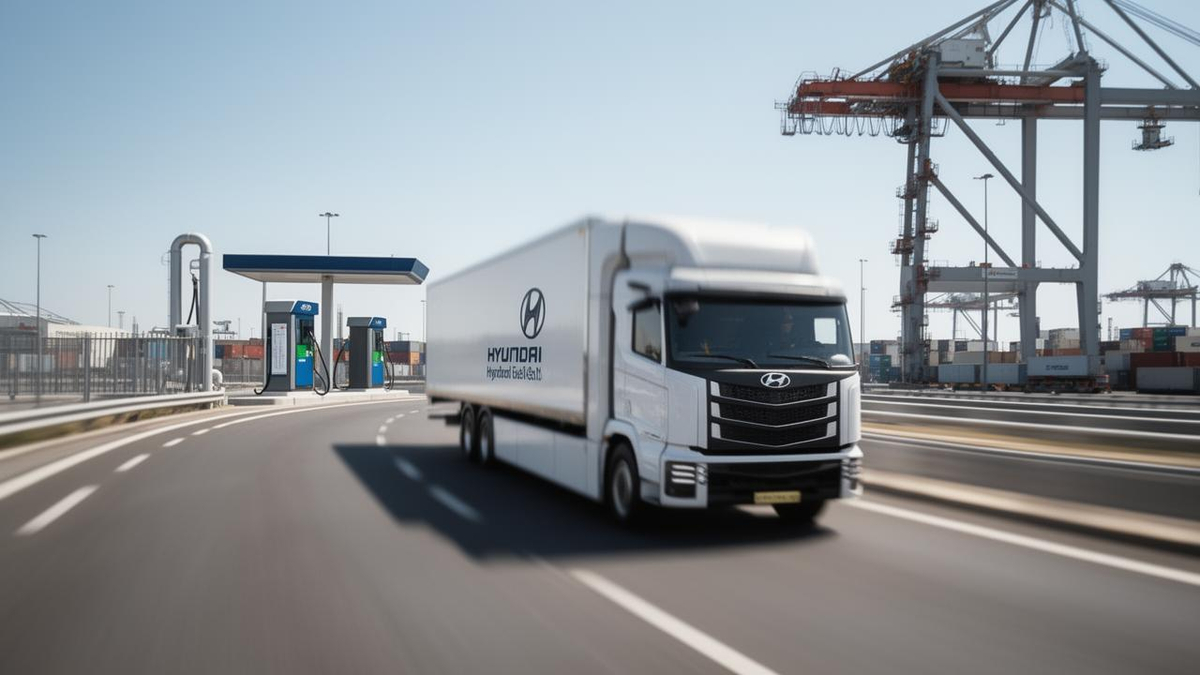
Competition for leadership in the global hydrogen commercial vehicle market has entered a new phase. With Toyota Motor joining Cellcentric, the hydrogen fuel cell joint venture between Daimler Truck and Volvo Group, a massive competitive landscape is taking shape in the heavy-duty hydrogen electric truck market that Hyundai Motor has pioneered.
According to industry sources on the 18th, Toyota signed a binding agreement in July with Daimler Truck and Volvo Group to take a stake in Cellcentric. Once the transaction is completed following regulatory approval, the three companies will each hold a 33.3% stake in Cellcentric.
Cellcentric is a hydrogen fuel cell specialist established in 2021 with Daimler Truck and Volvo Group each contributing 50%. The company has been developing and producing hydrogen fuel cells for heavy-duty trucks. Under the new agreement, Toyota will provide core fuel cell technologies—including cells, materials, and stacks—to Cellcentric.
The combination of Daimler Truck and Volvo Group, which represent the heavy-duty commercial vehicle market, with Toyota’s accumulated hydrogen fuel cell technology is expected to significantly accelerate the development and mass production of hydrogen commercial vehicles. Analysts suggest that investment will expand beyond vehicle development into components, charging infrastructure, and related industries, intensifying the race for market dominance.
Hydrogen electric trucks offer advantages over battery electric trucks in medium- and long-haul logistics, with shorter refueling times and longer driving ranges. The industry anticipates that battery and hydrogen power sources will be deployed complementarily based on driving distance and use case.
Governments accelerate hydrogen commercial vehicle deployment policies
Major governments are also speeding up policies and infrastructure development for hydrogen commercial vehicle adoption.
China secured approximately 8.5 billion yuan (approximately $1.3 billion) in performance-linked support funding across five regions through its first demonstration city cluster program from 2021 to 2025. Through fuel subsidies and toll reductions, the country has deployed approximately 40,000 cumulative hydrogen electric vehicles and 574 hydrogen refueling stations. In March, China announced a target of deploying 100,000 hydrogen electric vehicles by 2030 through a comprehensive hydrogen application demonstration program. The plan includes building hydrogen highways centered on heavy-duty trucks and long-haul logistics, and reducing the final hydrogen sales price to below 25 yuan (approximately $3.7) per kilogram by 2030.
Japan is pursuing a “Hydrogen Artery” initiative to deploy 1,500 hydrogen commercial vehicles along major east-west trunk routes over the next decade. The goal is to generate annual hydrogen demand of 7,500 tons along these routes. Japan’s Ministry of Economy, Trade and Industry is also reviewing deregulation and cost support measures to expand hydrogen commercial mobility.
The European Union (EU) is pairing regulation with infrastructure development. The bloc is implementing standards requiring manufacturers of newly registered heavy-duty vehicles such as trucks and buses to reduce average CO₂ emissions by 45% by 2030, 65% by 2035, and 90% by 2040 compared to 2019 levels. Under the Alternative Fuels Infrastructure Regulation (AFIR), member states must build hydrogen refueling stations at 200-kilometer intervals along the Trans-European Transport Network (TEN-T) core network by 2030, and establish at least one public hydrogen refueling station in every urban node.
Hyundai counters with 27 million kilometers of cumulative driving distance
As competitors accelerate their pursuit, Hyundai Motor is working to secure competitiveness based on its accumulated experience in mass-producing and operating hydrogen electric trucks.
Hyundai Motor became the world’s first to mass-produce a heavy-duty hydrogen electric truck with the Xcient in 2020. Since then, the company has deployed vehicles to global logistics sites in Switzerland, Germany, France, the United States, Canada, and Uruguay. As of July this year, the Xcient hydrogen electric truck’s global cumulative driving distance surpassed 27 million kilometers. The accumulation of long-term operational data in real-world logistics environments is considered Hyundai’s core competitive advantage.
However, the center of gravity in global hydrogen commercial vehicle competition is shifting beyond vehicle development toward ecosystem building, including refueling, maintenance, and operations. China, Japan, and the EU are pairing infrastructure development with policy support precisely because vehicle deployment alone has limits in expanding the hydrogen commercial vehicle market. This is why observers note that Hyundai’s first-mover experience alone is no longer sufficient to guarantee market leadership.
Industry voices argue that South Korea should designate government-led “hydrogen logistics corridors” centered on major logistics arteries, and use these as a foundation for mid- to long-term hydrogen commercial vehicle deployment strategies and refueling infrastructure plans. The aim is to create demand for heavy-duty hydrogen trucks while establishing stable operating conditions.
Support measures to lower the total cost of ownership (TCO) of hydrogen trucks are also cited as a key task. Beyond currently implemented fuel subsidies and highway toll reductions, support measures that can incentivize shippers and transport operators to transition to eco-friendly vehicles are being discussed.
Expanding hydrogen commercial vehicle adoption is also directly linked to carbon reduction in the transportation sector. Approximately 42.7% of South Korea’s transportation sector greenhouse gas emissions come from commercial vehicles, including buses, trucks, and special-purpose vehicles. The South Korean government is pursuing a target of reducing greenhouse gas emissions by 53-61% by 2035 compared to 2018 levels, and achieving carbon neutrality by 2050.
An industry official said, “The collaboration between Toyota, Daimler Truck, and Volvo Group will serve as an opportunity to once again highlight the growth potential of the hydrogen commercial vehicle market.” The official added, “South Korea also needs policies that create demand and infrastructure together, so that Hyundai Motor’s accumulated technology and operational experience can translate into actual market leadership.”