This story is part of The Athletic’s coverage of SailGP, an international sailing competition that has been likened to Formula 1 on water. Follow SailGP here.
No one predicted the sleepy backwater of Sassnitz would be rebranded ‘Crashnitz’ or ‘Smashnitz’ by the end of the first edition of the German Sail Grand Prix last year.
After a weekend of carnage, as well as some exciting racing, this small, picturesque seaside town in northeastern Germany, which not many around the world will have heard of, was put on the sailing map.
As Germany’s driver Erik Kosegarten-Heil builds up to another weekend of competition on home waters this weekend, he is reminded of the drama from last August, when the moniker ‘Crashnitz’ entered the SailGP lexicon.
“It was amazing, right? Luckily, no one got hurt, but for the media, it was so impressive — the big picture we created from that first crash-filled day of practice racing,” he told The Athletic.

Friday’s practice should have been straightforward. There was nothing dramatic about the conditions. But on a standard bear-away maneuver at the windward end of the course (a high-speed turn out of Mark 1), French driver Quentin Delapierre turned his F50 downwind at close to 60 mph (100 km/h) and suffered a nosedive and sudden stop.
The starboard-side (the right side of the boat as you stand forward) T-foil rudder ripped off the back of the boat and flew into the air.
Fortunately, the large chunk of fly-away carbon-fiber foil tomahawked past the boat and was nowhere close to the French crew.
But Delapierre was flung forwards violently by the rapid deceleration and suffered a nasty face-plant into the cockpit. He was taken to hospital and later signed off as fit to race, leading his team to the unlikeliest of victories on the Sunday.
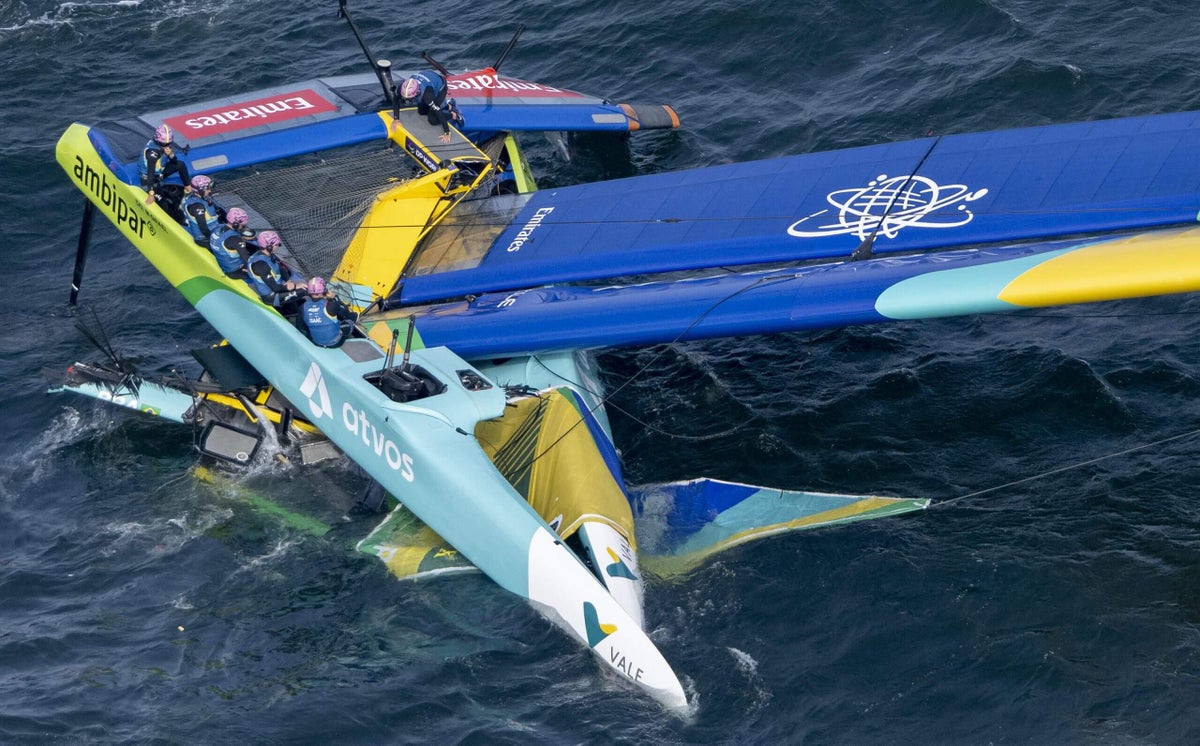
Just seconds later, in a separate incident, the Brazilian F50 was about to go into a standard jibe maneuver (turning the boat through the wind to change direction) but disintegrated in the blink of an eye.
The front cross-beam (a structure that links the hulls at the front of the boat) snapped and the catamaran collapsed into its constituent pieces, with the wingsail falling to the water. Subsequent analysis would show it was operator error by the team that led to the breakage, although the reasons were far from anyone’s mind at the time.
Simon Nuding, the head of safety for SailGP at the time, recalled that moment of mayhem. “We were staring down the barrel,” he said. “We were positioned on the boundary opposite Mark 1, watching the whole fleet come toward us. We saw there was an issue with France. At that distance, you can’t instantly see if a rudder is broken, but one of our spotters or divers on the boat said that France had lost their rudder.
“As we were getting into position to make our way around the fleet — having to wait for the fleet to pass us before we could go back up that one-way system — Brazil, one of the last boats coming around, disintegrated right in front of us. We were probably a maximum of 60 to 70 meters away from Brazil when she had that catastrophic failure, so we were on scene pretty quick.”
Nuding and his team had no time to dwell on anything other than getting into rapid response mode. While the French incident would normally have been a major priority for Nuding’s team, Brazil had to take precedence.
“We had two rescue boats heading to Brazil. One came from the start line, passed France, because with what we saw with Brazil, there was a real risk of someone being trapped underwater, which meant prioritizing our assets.
“Once we got a headcount and understood every sailor was accounted for, we split the assets back up.”
There was also a racing incident on Saturday, a major collision between the United States and Great Britain, where Taylor Canfield’s American team failed to keep clear in time.
Again, there was major damage to the F50s but no injuries to the sailors. But this season, sailors have been seriously injured. Louis Sinclair, for example, suffered fractures to both legs when New Zealand and France collided at the New Zealand Grand Prix in Auckland in February.
The most recent event in Portsmouth was the first time all 13 teams started and finished a Grand Prix weekend without major incident, the closest being a dramatic almost-but-not-quite capsize by the German team.
When The Athletic put it to Nuding that an incident-free weekend has become unusual, he disagreed. “Unusual? No, if you go back to the 10- or 11-boat seasons, there was a long period where we were incident-free,” said Nuding, who first joined the safety as rescue co-ordinator in 2022.
Uneventful is a good thing in Nuding’s world. “It’s a good thing in everyone’s world,” he said. “These sailors are our friends and colleagues; we see them every day. It’s not good for us, for SailGP, or for the industry.”
While sailors don’t wish for major incidents, they also know drama sells.
“It’s perfect if you want to set attention up for something,” said Kosegarten-Heil. “On the other side, everyone is concerned about the safety of sailing these boats. So you would never wish for it. But last year was really great, having this build-up and level of excitement.”

Germany was close to capsizing while racing alongside France in the opening race in Portsmouth last month. (Ricardo Pinto for SailGP)
With that in mind, perhaps it’s not all bad that the German team came closest to calamity at the end of July in Portsmouth, without quite tipping the wrong side of a fine line.
After leading at Mark 1 following an unusually good start, things swiftly went from great to bad to worse in a short space of time. Looking back at the data from that incident, Kosegarten-Heil has learned that the maximum angle of lean was 58 degrees, as the F50 came alarmingly close to tipping over.
The mighty, looming presence of Spitbank Fort, a Napoleonic-era structure in the middle of the race course, wasn’t helping. The jibe (the triangular sail) was rushed, and wing trimmer Kevin Peponnet was struggling to run across the boat in time, while Kosegarten-Heil and his strategist, Anna Barth, had a misunderstanding about which side of the fort they were aiming to pass. “We had a couple of things go wrong,” Kosegarten-Heil said.
With a strong tide running in the Solent, and the proximity of that unyielding Napoleonic fort, there might not have been much to salvage from the boat if the Germans had capsized. Even after bringing the F50 flat back to the water, the uncertainty wasn’t over. “We now had maybe 10,000 liters of water in the hull,” Kosegarten-Heil said. “I was wondering if the structure of the hull is strong enough to carry on with the race.”

Germany nearly capsizes as the boat turns near the Napoleonic fort in Portsmouth. (Ricardo Pinto for SailGP)
Did he hold back from racing? “We still had the chance for one point at least in that race and we had to continue. We sent Anna over to the other side of the boat to open the (draining) flaps manually and to make sure we’re losing the water as quickly as possible.”
So, apart from losing a race-winning lead, there was no real harm done from that near-capsize. And now the Germans have a home event.
It’s not been a stellar season so far for Kosegarten-Heil and the crew, who sit in eighth place on the leaderboard.
“We had an amazing event last year. Sassnitz was a big turning point for our 2025 season and gave us a lot of strength. We were better around the race course for the remainder of the season and our starts were better. This year we’re also lacking this skill on the start line a bit. We discuss a lot and we debrief a lot, and I hope Sassnitz is again the turning point this season for our starting average.”
As to whether Sassnitz shakes off its nicknames from last year, that partly depends on what happens this weekend. The funny thing is, Nuding and the safety team never had Sassnitz down as one of the riskier venues.
“As a safety team, you enter venues like Perth or San Francisco expecting the worst,” he said. “But we went into Sassnitz looking at it as a medium-risk venue, nowhere near as extreme as San Francisco, Sydney, or Auckland. It should be nice, flat water, close to the tech base.
“Then all these incidents happen. It’s a reminder that in boating, the biggest problems normally start with the smallest things. These F50s are there to bite you if you let them off the leash or aren’t looking out for them.”
How to watch
The Germany Sail Grand Prix takes place on August 22 and August 23 from 8 a.m. ET (1 p.m. BST). Fans in the U.S. can watch live online via BeIN Connect, while in the UK, racing will be on TNT Sports. For a list of broadcasters elsewhere in the world, click here.