Mercedes-Benz’s flagship sedan, the S-Class, has added driving pleasure to its traditional image as a “rear-seat car” through its facelift. During a test drive around Yeongwol in South Korea’s Gangwon Province, the new S-Class maintained its position as a premier space for rear passengers while delivering unexpected satisfaction to those behind the wheel.
On the 20th, we test-drove “The New S 500 4MATIC Long” around Yeongwol. With an overall length of 5,305mm and a wheelbase of 3,216mm, the numbers alone suggest the car would feel cumbersome in tight corners, but turning the steering wheel revealed the body following far more eagerly than expected. The rear axle steering, which moves up to 10 degrees, turns the rear wheels in the opposite direction to the front wheels at low speeds to enhance maneuverability, while improving stability at higher speeds.
Switching between Comfort and Sport modes via Dynamic Select produced distinctly different personalities. In Comfort mode, the S-Class’s signature ride quality—smoothly filtering out road imperfections—was prominent, while Sport mode transmitted body movements and road feel more directly. Rather than a car that blankets every sensation in softness, it felt like one that leaves room for the driver to get closer to the road when desired.
The S 500’s inline six-cylinder gasoline engine produces 449 horsepower and 61.2 kg·m of maximum torque. It accelerates from standstill to 100 km/h in 4.5 seconds. What impressed was the characteristic of power flowing naturally in proportion to throttle input, rather than the massive body being forcibly dragged forward.
The Evolution of the Digital Experience
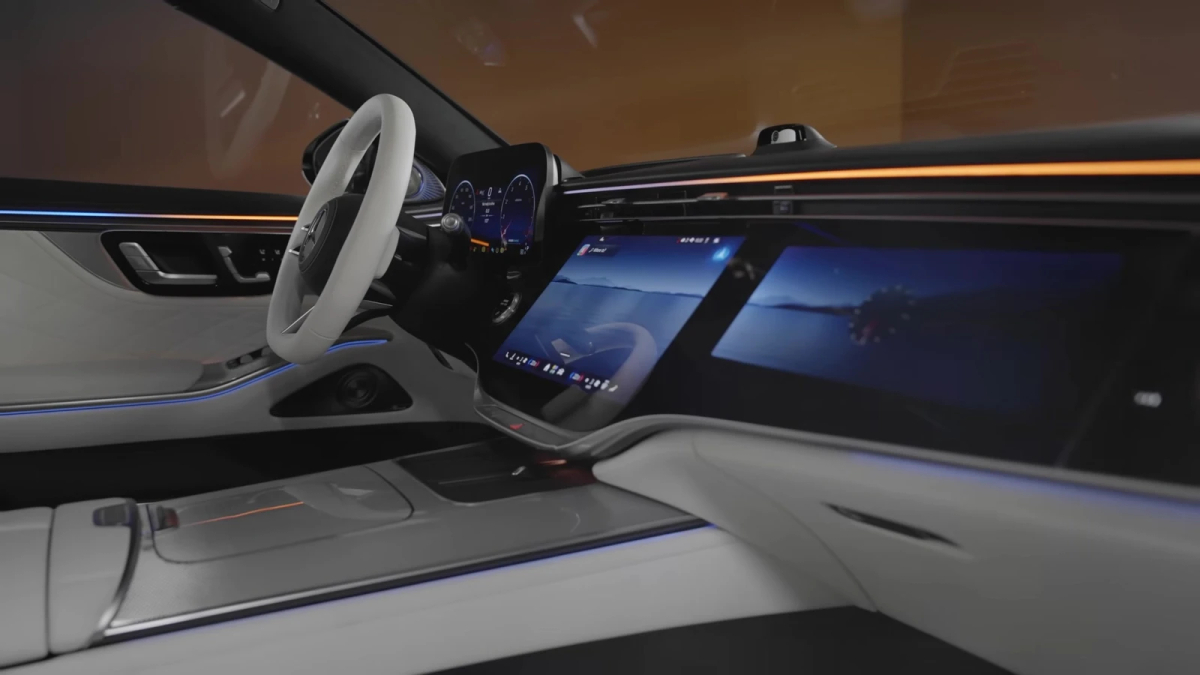
The core of this facelift is a substantial enhancement of the in-cabin digital experience. The latest MBUX, based on Mercedes-Benz’s in-house vehicle operating system MB.OS, has been applied. The architecture connects infotainment, driver assistance systems, and vehicle functions into one, with over-the-air (OTA) updates enabling continuous feature improvements.
The voice assistant uses ChatGPT and search technology to respond to natural language queries. During the test drive, the voice assistant proactively engaged the driver with natural expressions like “How are you feeling today?” and “Where shall we drive?” However, there were instances where the voice assistant activated unintentionally during conversations with passengers, suggesting that recognition accuracy improvements through future software updates would be welcome.
Localization targeting the South Korean market is also notable. Tmap Auto is standard, and LiveTV+ provides access to news and golf broadcasts, while content familiar to South Korean users—including Genie Music, Millie’s Library audiobooks, Wavve, Melon, and SBS Gorilla—is loaded extensively.
The MBUX Superscreen, which connects multiple displays beneath a single glass surface, extends the digital experience beyond the driver’s seat to the front passenger. Traditionally, the front passenger seat of a chauffeur-driven sedan carries a strong image of being a space yielded for rear-seat occupants, but in this S-Class, the front passenger can enjoy various infotainment through a dedicated screen, reinforcing the sense of a seat for enjoying the journey together beside the driver.
The Rear Seat’s Core Mission Remains
The S-Class’s “core mission”—the rear seat—continued to demonstrate its competitive edge. The S 500 features an Executive Seat with a backrest that reclines up to 43.5 degrees behind the front passenger. Heating and ventilation functions are included, along with a dedicated touch display for video conferencing and entertainment.
The S 580 4MATIC Long Body pairs a V8 gasoline engine with a 48V mild hybrid system. Pressing the accelerator deeply builds speed seemingly without effort, with RPMs rising smoothly rather than spiking. Even at higher speeds, engine and wind noise remained subdued—at times the speedometer revealed a pace that felt faster than the sensations suggested.
The S 580 features E-Active Body Control. This system, which controls damping force and ride height at each wheel, suppressed body movements even on undulating road surfaces. Particularly when crossing tall speed bumps at speed, the impact felt less like a sharp “thud” and more like the body gently oscillating once before quickly settling.
Key Differences Between the Two Models
The key specifications of the two models confirmed during this test drive are as follows:
CategoryS 500 4MATIC LongS 580 4MATIC Long BodyEngineInline 6-cylinder gasolineV8 gasoline + 48V mild hybridMax Output449 hpNot disclosedMax Torque61.2 kg·mNot disclosed0-100 km/h4.5 secondsNot disclosedSuspensionAirmatic air suspensionE-Active Body ControlRear Axle SteeringUp to 10 degreesEquipped
Note: Detailed output figures for the S 580 were not disclosed in the test drive article.
Mercedes-Benz newly developed or redesigned approximately 2,700 vehicle components for this facelift—more than half of the total component count. Externally, the S-Class features an illuminated grille for the first time in its history, along with twin-star design digital lights and new star-shaped taillamps. Heated seat belts providing warmth up to 44 degrees Celsius have also been newly applied to the front seats.
Kim Eun-jung, Vice President and Head of Product and Sales at Mercedes-Benz Korea, emphasized at the launch event that the car “satisfies both chauffeur-driven comfort and driving pleasure” while explaining the suspension technology. That statement felt quite convincing once behind the wheel.
The New S-Class remains an “executive’s car” that is still wonderful to sit in the back of. But this time, it’s an S-Class that makes you want to suggest that executive try taking the wheel themselves at least once. Since the rear seat’s refinement has long been regarded as the benchmark for flagship sedans, the real changes of this facelift were felt more distinctly in the driver’s and front passenger’s seats.