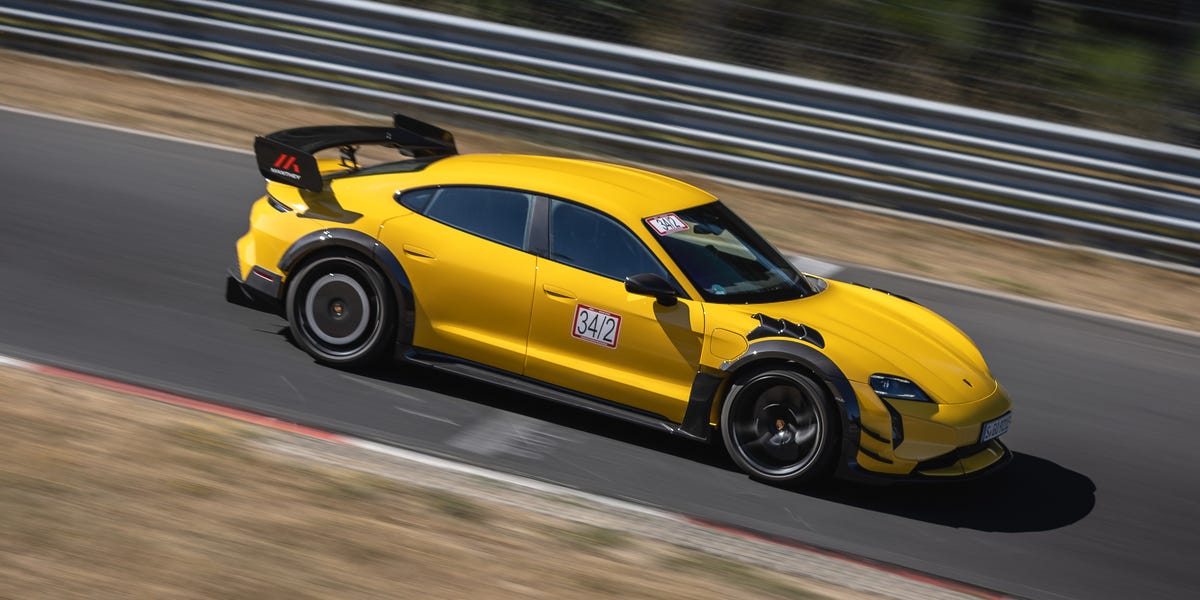
Porsche didn’t take it lightly when the China-made Xiaomi SU7 Ultra invaded its home turf, dethroning the Taycan Turbo GT Weissach as king of production electric sedans around the Nürburgring Nordschleife circuit. The response was heavy: the 2027 Turbo GT Weissach with its new track-focused Manthey Racing kit, which vaulted the Taycan back atop the leaderboard with a blistering 6:55.553-second lap—some 12 seconds quicker than its lesser sibling.
That’s impressive by itself, and it’s also a bigger lap-time improvement than Manthey kits have made on other Porsche models, such as the 911 GT3 and the Cayman GT4 RS. Not too shabby for what the German brand admits is somewhat of an experiment for its Manthey-enhanced cars. To suss out what that could mean going forward, we jumped at the chance to turn a few ’Ring laps of our own in the ultimate Taycan.
The Foundation
To recap, the Taycan Turbo GT starts as a $246,050, all-wheel-drive missile that can hit 60 mph in 1.9 seconds and go an EPA-rated 276 miles between charges (although we estimate closer to 230 miles in Manthey guise). Its wild side comes out when you select the no-cost Weissach package, which deletes the rear seats, removes around 200 pounds of mass, and adds a fixed rear wing and other aero addenda for increased downforce.
The optional Manthey kit, however, is for when you want a truly bonkers Taycan—just look at it. For $125,510, this comprehensive upgrade builds on the Turbo GT Weissach with an even bigger adjustable rear wing, a larger front splitter and rear diffuser, revised underbody ground effects, standard Pirelli P Zero Trofeo RS track-oriented tires, and carbon-fiber aero discs that shroud the rear wheels. With this kit, Porsche says downforce at 124 mph increases from 209 to 683 pounds, with the aerodynamic load climbing to 1631 pounds at the car’s 192-mph top speed, up from the Weissach’s claimed 485 pounds at 189 mph.
Yet unlike Porsche’s other Manthey kits that focus solely on manipulating the wind, the Taycan gets 1.9-inch broader bodywork to cover wider 21-inch tires, sized 305/30ZR-21 in front and 335/30ZR-21 in the back, versus the standard 265s and 305s, respectively. Interestingly, like the Ford Mustang GTD, the super-Taycan’s track-oriented status means it doesn’t need additional exterior marker lights to be street-legal, despite being more than 80.0 inches wide (80.6, to be exact).
To better exploit its enhanced grip, the car also receives a bump in output via a new 1300-amp pulse inverter, up from the Weissach’s 1100-amp unit. While the car’s full 1019-hp tally remains when launch control is engaged, the package adds 22 pound-feet of maximum torque, now 936. More important for track work, the system’s baseline power has swelled from 777 to 804 horses, with Attack mode boosting that figure to 978 in 10-second spurts, a gain of 40 ponies.
The Results
Several introductory laps in a regular Turbo GT on Pirelli P Zero R summer tires helped your humble (and ultimately humbled) author come to terms with his first run on this legendary guardrail-lined roller coaster of a track. Despite hundreds of virtual laps in simulators and video games, nothing prepared me for how dauntingly narrow and undulating the 12.9-mile Nordschleife is in person. The Taycan proved to be an excellent learning tool—wickedly quick yet eminently stable and predictable, as we had learned from the Turbo GT’s outing at our Lightning Lap event at Virginia International Raceway.
Although the Turbo GT’s available Trofeo RS rubber (optional with or without the Weissach package) would make for a better comparison with the grippier Manthey, Porsche kept with the standard footwear out of caution for the ’Ring’s notoriously unpredictable weather. Still, the wingless car was more prone to move around at high speed even before its street-oriented tires grew hot and greasy. Though the stopping power of its huge carbon-ceramic brakes never faltered, the feel through its left pedal also weakened over my stint, growing long in travel and inconsistent in action. The Manthey-spec Taycan was a revelation in comparison, so pronounced was its stronger adhesion and the resulting boost to confidence. With its wider stance, revised rear-axle steering, and a slightly firmer tune for its magic-carpet-like Porsche Active Ride suspension, it felt utterly unflappable, lap after lap.
Whereas I rarely felt comfortable engaging Attack mode in the standard car, the stability of the Manthey setup eventually had me reflexively activating the boost via the right steering-wheel paddle as the track opened. Through the intimidatingly fast right-hand sweeper of Flugplatz, the car’s downforce could be felt pressing it into the tarmac, which, combined with the more reassuring firmness of its brake pedal, made it easier to push deeper into the braking zone for the following tight Aremberg corner. The car’s roughly 2.5 tons remained composed as it soaked up the pounding bumps of the brutal Karussell hairpin. And the occasional wiggles from the standard GT’s tail, such as in the tricky right-left-right transitions around the Adenauer Forst section, were gone.
Turn-in for corners requires a fair amount of steering lock. But the Manthey’s tenacious front-end bite lets you dive harder into apexes and rocket out of the other side with greater momentum. Porsche says it designed the Turbo GT to give its all for a full lap of the ’Ring with no drop-off in output, and there was no apparent degradation in power over the four to six suboptimal laps we got out of a full charge of the car’s 97-kWh battery. Opinions vary on the Taycan’s new driver-selectable E-Shift feature that vaguely (if loudly) simulates an internal-combustion powertrain. But I appreciated the deeper immersion brought by the added noise, and the fake “shifts” helped give a sense of speed for corner setups.
The Takeaway
With Porsche development driver and record-lap pilot Lars Kern at the wheel, what impressed us most is how sorted the Manthey-spec Taycan felt even under the duress of a professional racing driver’s aggressive braking and steering inputs. Porsche’s hope is that those willing to splurge for the upgrade will value that the Turbo GT is the first Manthey model to come fully assembled from the factory, unlike other examples that arise as retrofit kits or dealer add-ons. It’s doubtful that a mob of takers exists for a hardcore four-door EV that has only two seats, starts at nearly $400,000, and requires a robust, track-based charging infrastructure to use properly. But depending on how this gloriously unhinged experiment is received, Porsche hints that other models potentially could follow suit. We’re all for it.
➡️ Skip the lot. Let Car and Driver help you find your next car.
 Specifications
Specifications
2027 Porsche Taycan Turbo GT with Weissach Package and Manthey Kit
Vehicle Type: front- and rear-motor, all-wheel-drive, 2-passenger, 4-door sedan
PRICE
Base: $371,560
POWERTRAIN
Front Motor: permanent-magnet synchronous AC
Rear Motor: permanent-magnet synchronous AC
Combined Power: 1019 hp
Combined Torque: 936 lb-ft
Battery Pack: liquid-cooled lithium-ion, 97 kWh
Peak Charge Rate, AC/DC: 11.0/320 kW
Transmissions, F/R: direct-drive, 2-speed automatic
DIMENSIONS
Wheelbase: 114.2 in
Length: 197.4 in
Width: 80.6 in
Height: 54.3 in
Cargo Volume, F/R: 3/13 ft3
Curb Weight (C/D est): 4950 lb
PERFORMANCE (C/D EST)
60 mph: 1.9 sec
100 mph: 4.1 sec
1/4-Mile: 9.2 sec
Top Speed: 192 mph
EPA FUEL ECONOMY (C/D EST)
Combined/City/Highway: 78/83/74 MPGe
Range: 229 mi

Mike Sutton is an editor, writer, test driver, and general car nerd who has contributed to Car and Driver’s reverent and irreverent passion for the automobile since 2008. A native Michigander from suburban Detroit, he enjoys the outdoors and complaining about the weather, has an affection for off-road vehicles, and believes in federal protection for naturally aspirated engines.