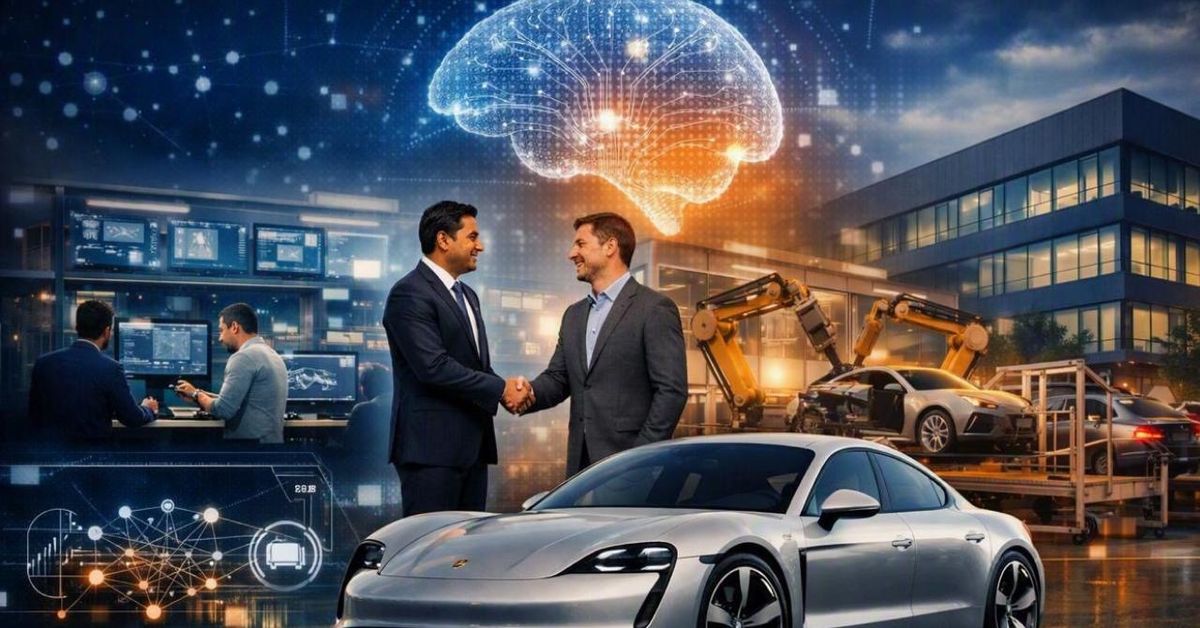
Tata Consultancy Services (TCS) and Porsche AG have entered into a five-year strategic partnership that brings together automotive expertise, technology services, and AI execution.
The deal also includes TCS’ proposed acquisition of 100% of MHP Management- und IT-Beratung GmbH (MHP), Porsche’s Germany-based management and IT consulting subsidiary. The transaction is subject to regulatory approvals.
Moving AI from pilots to operations
For Porsche, the partnership is centred on creating a dedicated AI Mobility Centre of Excellence (CoE). The aim is to take AI use cases beyond experimentation and apply them across areas such as manufacturing, engineering, operations, and customer experience.
That shift is important as automotive companies increasingly have to manage AI alongside existing enterprise systems, manufacturing platforms, connected vehicles, and software development environments. The challenge is not simply finding new AI applications, but making them secure, scalable, and useful within established business processes.
TCS CEO and Managing Director K. Krithivasan said the partnership combines the companies’ respective capabilities as the automotive industry changes.
“TCS is pleased to partner Porsche in its transformation journey. As AI, software, and data redefine the automotive industry, this partnership brings together TCS’ capabilities in AI, engineering, technology and business transformation with MHP’s strong automotive consulting expertise. Together, we will industrialize AI at scale for Porsche, accelerating innovation across the value chain to deliver intelligent, software-defined mobility experiences of the future.”
The emphasis on industrialising AI points to the larger business question facing automotive companies: how to move from individual use cases to repeatable AI deployment across the enterprise.
MHP gives TCS a stronger automotive foothold
The proposed MHP acquisition adds another layer to the deal. MHP has experience in automotive and industrial consulting, business transformation, AI, SAP, manufacturing digitalisation, and connected mobility.
For TCS, bringing MHP into the business would strengthen its presence in Germany and its relationships with European automotive and industrial customers. It also gives TCS access to an organisation that already understands the operational and technology requirements of the automotive sector.
That matters because automotive transformation is rarely limited to one technology platform. AI projects often sit alongside enterprise resource planning, manufacturing systems, engineering platforms, connected mobility infrastructure, and data environments. Sector knowledge can therefore be as important as the underlying technology capability.
Porsche is also changing how it approaches technology
The partnership comes as Porsche looks to focus more closely on its core automotive business while using an external technology partner for parts of its digital transformation.
Dr. Michael Leiters, CEO of Porsche AG, said the move is intended to combine Porsche’s automotive expertise with TCS’ technology and AI capabilities.
“Porsche is taking another important step in its strategy to focus resolutely on its core business with the transfer of MHP to Tata Consultancy Services. At the same time, we are gaining a strategic partner in TCS. By combining Porsche’s automotive expertise with TCS’ digital technology and AI capabilities, we will further strengthen our innovative power, increase efficiency, and boost our competitiveness in an increasingly data and software-driven world of mobility.”
The transfer of MHP is therefore more than a standalone acquisition. It sits alongside the five-year strategic agreement and the planned AI CoE, creating a broader technology relationship between the two companies.
The bigger bet is scale
The three elements of the agreement are closely connected. The AI CoE is intended to provide the execution layer, the five-year deal provides a longer-term framework, and MHP brings automotive consulting and implementation expertise.
For TCS, the combination could help it deepen its position in the European automotive market while building on its existing AI and engineering capabilities.
For Porsche, the arrangement provides access to a large technology services organisation while retaining its automotive expertise at the centre of product and business decisions.
The more difficult part will be execution. Moving AI into manufacturing, engineering, and customer operations requires more than models and computing capacity. It also involves data quality, integration with existing systems, security, governance, and the ability to scale successful use cases across business units.
Automotive enters a more practical AI phase
The Porsche-TCS partnership reflects a broader change in enterprise AI. The conversation is increasingly moving away from whether companies should experiment with AI and towards how they can integrate it into core operations.
In automotive, that transition is particularly significant. Software is becoming increasingly important to vehicles and the processes around them, while manufacturers also have to modernise factories, engineering workflows, supply chains, and customer interactions.
The real test for partnerships such as this one will ultimately be whether AI can move from individual projects into repeatable business processes at scale. For Porsche and TCS, the next phase will be about turning the structure announced today into measurable operational outcomes.