Stay up to speed with stories written by drivers, for drivers.
Get automotive news, DIY tips, market trends, in-depth car profiles, and more right in your email inbox.
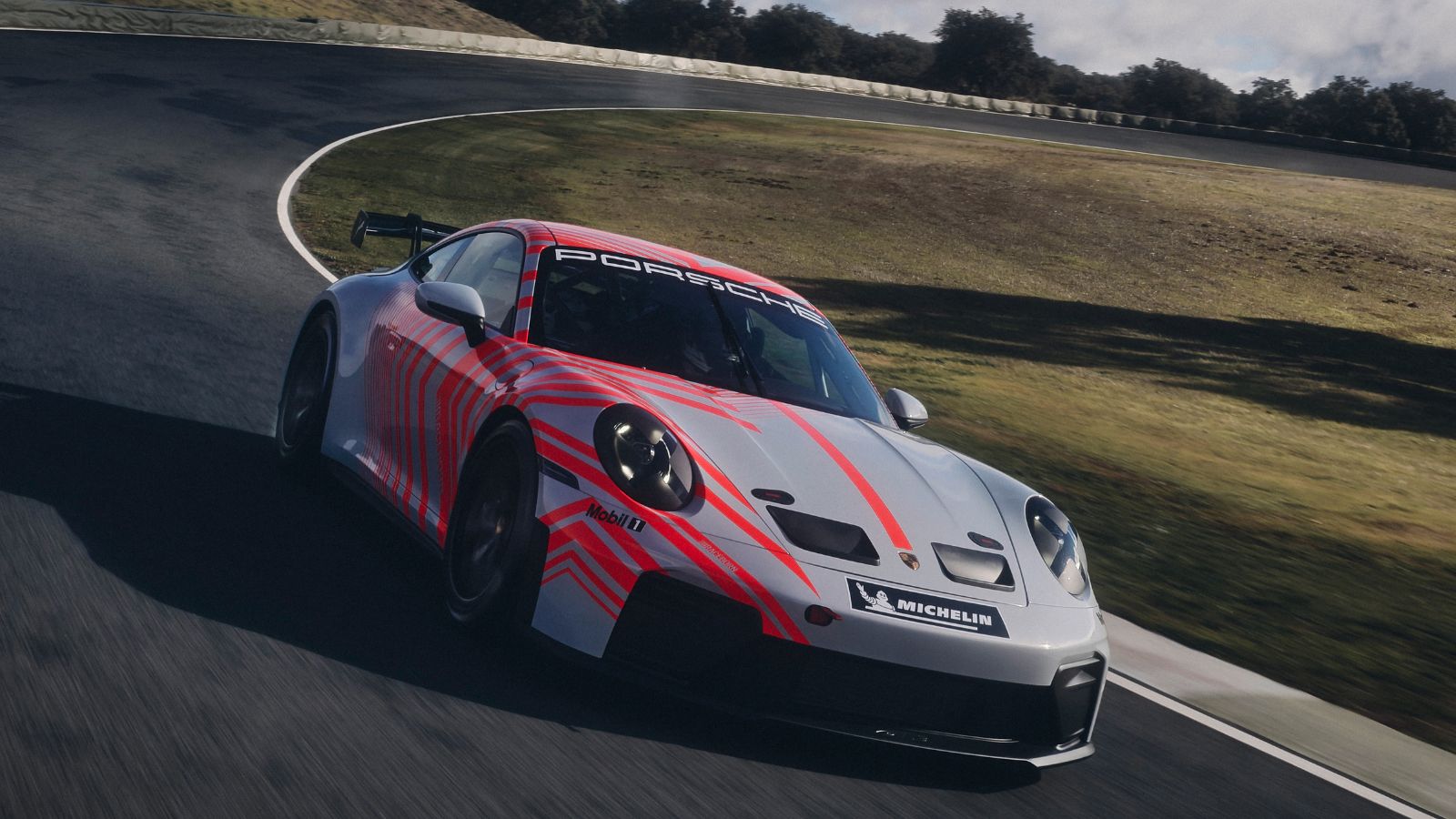
Production of the Porsche 718 ended in late 2025, which temporarily leaves the brand without an entry-level sports car on the road and on the track. We’re still waiting for the next-gen 718, which could land as an EV, but in the meantime Porsche is replacing the track-only Cayman GT4 Clubsport with a 911-based race car. The new Porsche 911 Challenge is the brand’s most affordable racer.
Eligible to race in four Porsche-sanctioned one-make series, the 911 Challenge is closely related to the street-legal 911 GT3 under the body. Porsche explains that developing a race car that’s derived from a production model allowed it to keep costs in check, and it’s passing these savings onto buyers. The brand also notes that the GT3 bits will make the Challenge more affordable to repair.
Power comes from the GT3’s naturally aspirated, 4.0-liter flat-six, which delivers 508 horsepower at 8500 rpm in this application. It spins the rear wheels via a seven-speed dual-clutch automatic transmission (the street car’s six-speed stick isn’t available). The exhaust system is specific to the 911 Challenge because it doesn’t need a particulate filter, though it does feature catalytic converters.
While the 911 Challenge was developed exclusively for track use, it offers several driving aids added to make the car accessible to a wide selection of drivers regardless of their skill level. Porsche included ABS, traction and stability control systems, and Torque Vectoring Plus technology. All of these features are adjustable, so the driver can manually dial in the level of intervention needed.
 Porsche
 Porsche
 Porsche
 Porsche
 Porsche
The 911 Challenge shares its steel braking system with the 911 GT4 R and the 911 Cup, and it’s fitted with racing-specific shock absorbers as well as a roll bar with three levels of adjustment. Slick tires wrapped around 18-inch five-bolt wheels come standard.
Visually, the 911 Challenge looks like a 911 GT3 in full race regalia—and that’s pretty much what it is. Its exterior dimensions are identical to the GT3’s, and the two cars share their main body panels, but the Challenge gets a quick-release hood, a rear wing that can be set to four different angles, and a rain light on the rear end. Porsche also fitted an air-jack system with three jacks.
It’s a similar story inside, where Porsche kept the GT3’s basic interior layout as well as some parts, including the steering wheel, and removed the components not needed for racing to save weight. The sound-deadening material, the carpet, the trim pieces, and the passenger-side seat were sent back to the parts bin. They were replaced with a welded-in roll cage, a 29-gallon FIA-approved fuel cell, and an adjustable racing bucket seat with a six-point harness for the driver. There’s a fire-extinguishing system as well.
All told, the 911 Challenge weighs a Porsche-estimated 3196 pounds with transport tires and an additional ballast mounting plate on the passenger’s side. For context, the street-legal 911 GT3 tips the scale at 3,126 pounds with the six-speed manual gearbox.
The new Porsche 911 Challenge can compete in the 2027 seasons of the Porsche Sprint Challenge North America, the Porsche Endurance Challenge North America, the Porsche Sprint Trophy Porsche Club of America, and the Porsche Sprint Trophy Porsche Owners Club. One-make series entrants can order the 911 Challenge now for $275,000, including the cost of import and delivery.
Racing has been a part of Porsche’s DNA since the beginning, and the lessons learned on the track have often permeated its street-legal models. Forced induction made its debut on the 917 before it found its way into the first-generation 911 Turbo, for example. With this in mind, it will be interesting to keep an eye on how the 911 Challenge influences the regular 911 in the coming years.