This story was first published in Vicarious magazine and has been adapted for Vicariousmag.com.
The new BMW iX3 50 xDrive all-electric SUV is coming to Canada in the summer of 2026 as a 2027 model. It marks the first production vehicle developed on BMW’s Neue Klasse architecture and represents a major milestone for the Bavarian automaker.
 2027 BMW iX3 50 xDrive
What’s new here? Essentially everything. The architecture underpinning the iX3 was developed from a blank sheet of paper and will form the foundation for a wide range of future BMW models, including high-performance offerings from the M division.
The iX3 rides on an all-new 800-volt platform and is powered by sixth-generation electric motors paired with a 108.7-kWh battery that also serves as a structural component of the vehicle. BMW engineers quote a WLTP range of up to 805 kilometres, which should translate to approximately 645 kilometres under the more conservative EPA testing cycle.
Our first drive took place in southern Spain’s Costa del Sol region, offering a diverse mix of twisty mountain roads, coastal highways, and several laps of the Ascari circuit near Ronda.
 2027 BMW iX3 50 xDrive
Does it drive like a BMW? The answer is a resounding yes.
Despite tipping the scales at roughly 2,300 kilograms, the iX3 never feels heavy or sluggish.
Combined output from its dual electric motors is 463 horsepower, with maximum torque rated at 476 pound-feet. Acceleration to 100 km/h takes just 4.7 seconds; not neck-snapping, but impressively smooth and effortlessly delivered.
We drove the iX3 harder than most owners likely will, yet energy consumption still averaged 23.6 kWh per 100 kilometres. Maximum DC fast-charging capability is rated at up to 400 kW, provided you can find a charger capable of delivering that level of output.
What truly stands out is how composed the iX3 feels under braking and through corners.
Regenerative braking handles approximately 98 percent of all deceleration, and the transition between regen and friction braking is seamless.
Driven spiritedly on mountain roads, the iX3 remains balanced and predictable. Steering is light, even in Sport mode, but the chassis feels remarkably neutral through fast corners and composed at higher speeds.
 2027 BMW iX3 50 xDrive
Interestingly, the suspension setup is refreshingly conventional. There’s no adaptive damping, rear-wheel steering, or active anti-roll bars here, just steel springs and passive dampers. The magic happens behind the scenes.
BMW engineers have developed an in-house supercomputer known as the “Heart of Joy,” which manages the electric motors, regenerative braking, stability control, and steering. Its ultra-fast processing is largely responsible for the iX3’s smooth, cohesive driving character.
On the Ascari circuit, the iX3 tackled slalom exercises and high-speed accident-avoidance drills involving heavy braking from 130 km/h after abrupt lane changes. In both scenarios, the SUV remained stable, confidence-inspiring, and impressively controlled.
 2027 BMW iX3 50 xDrive
While not designed as a sports car, the iX3 was easy to drive quickly on track, with predictable behaviour even when pushed. There is one caveat, however. While southern Spain’s roads are generally immaculate, rougher sections revealed a firm damping character.
How the iX3 will ride on Canada’s less forgiving road surfaces remains an open question.
Technology also takes a significant leap forward. The new Motorway Assistant allows for hands-free driving on highways, provided the driver remains attentive, monitored via a camera integrated into the rearview mirror.
Lane changes can be executed automatically simply by looking toward the side mirror, enabling the vehicle to pass slower traffic and return to the right lane based on the driver’s gaze. Tested over a 30-kilometre stretch near Málaga, the system performed flawlessly.
Parking assistance is equally advanced. Using the MyBMW app, drivers can remotely manoeuvre the iX3 into or out of tight parking spaces while standing outside the vehicle.
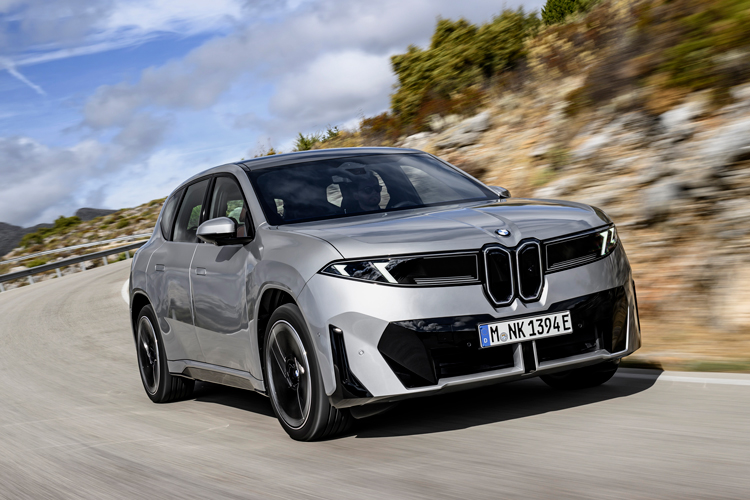
Design-wise, the iX3 introduces a new BMW aesthetic, featuring sharper lines and a slimmer kidney grille outlined with LED lighting. Inside, the most striking element is the four-spoke steering wheel arranged in a “plus” pattern.
 2027 BMW iX3 50 xDrive
Traditional gauges are gone, replaced by the Panoramic iDrive display first previewed in the Vision DEE concept. The projection stretches 110 centimetres across the base of the windshield and is fully customizable.
The centre display measures 17.9 inches, running BMW’s new in-house-developed iDrive OS X.
BMW Canada has yet to announce pricing, but expect the 2027 iX3 to land around $85,000 CAD. What’s clear already is that this SUV represents a significant leap forward for the brand; technologically sophisticated, thoughtfully engineered, and, most importantly, unmistakably BMW in the way it drives.
Quick Facts: 2027 BMW iX3 50 xDrive
Powertrain: Dual-motor all-electric AWD
Output: 463 horsepower
Torque: 476 pound-feet
Battery: 108.7-kWh lithium-ion
Architecture: Neue Klasse, 800-volt
0–100 km/h: 4.7 seconds
Estimated Range: Up to 645 km (EPA est.)*
Max DC Charging: Up to 400 kW
Expected Price (CAD): Approx. $85,000
On Sale (Canada): Summer 2026 (as 2027 MY)
Website: BMW Canada
Compare at a Glance
Mid-Size Luxury Electric SUVs (Canada)
2026 Audi Q6 e-tron quattro
Drivetrain: AWD
Estimated Range: 625 km (est.)*
Charging: 800-volt / CCS
Why It Matters: Premium interior and advanced tech stack
2027 BMW iX3 50 xDrive
Drivetrain: AWD
Estimated Range: 645 km (EPA est.)*
Charging: 800-volt / up to 400 kW
Why It Matters: First Neue Klasse model; BMW-centric driving dynamics
2026 Porsche Macan Electric
Drivetrain: AWD
Estimated Range: 460–505 km (EPA est.)*
Charging: 800-volt architecture
Why It Matters: Sporty, premium handling with strong brand cachet and performance focus