
6 photos
Photo: Instagram | tedoradze.giorgi
Could a new Isetta be found among the multitude of vehicles that BMW currently has in the making, most of which going down the Neue Klasse route in terms of design? You already know the answer to this question, because it is very simple and obvious: no.
You see, the model that was also marketed as the Iso Isetta, the Velam Isetta, and the Romi Isetta, among the BMW Isetta, was put together between 1953 and 1961, and was offered in different body styles. A cabriolet, a van, and a pickup were on the list, and all of them featured a very exotic mid-engine and rear-wheel drive layout. But there was nothing exotic about the powertrain, as it was a mere 236 cc two-stroke unit that made a very modes 7 kilowatts or almost ten horsepower.
A manual gearbox with four forward gears and a reverse gear sent the power to the rear wheels in a very basic way, by using a chain drive. The narrow track is said to have eliminated the need for a differential. There was absolutely nothing sporty about it, because it took more than half a minute to reach 31 mph (50 kph) from zero. The 0-62 mph (0-100 kph) was never measured for a very simple reason: the top speed was 47 mph (75 kph).
The Isetta had a 3.4-gallon (13 liters) fuel tank, and it averaged between 50 and 58 mpg US (5.6-4.0 l/100 km). The microcar with its bubble-shaped body and seating for two adults that had to open the large front (literally front!) door to enter and exit, and to facilitate access, the steering wheel and column swung out with the large door. The Isetta became quite popular in the ‘50s in war-torn Germany, and it helped BMW avoid bankruptcy, featuring a 250 cc unit making 12 horsepower, topping out at 53 mph (85 kph).

Photo: Instagram | tedoradze.giorgi
The engine’s displacement was eventually increased to 298 cc, and it gained one horsepower during this process. That’s less important, as what matters more is that the BMW Isetta became more reliable. The DeLuxe variant was introduced, featuring a redesigned body, with sliding side windows. The model eventually evolved into a four-seater with the introduction of the BMW 600. The Isetta is considered an innovative ride, and it came to life in Germany, Italy, France, Brazil, Argentina, and the United Kingdom.
Now, it is clear that with the crossover boom, there is no chance for the Isetta to make a comeback, especially in BMW’s portfolio, though to be honest, chances of such a thing selling in plenty of numbers to justify the investment are quite high. Especially if it becomes a city car with battery-electric firepower, and more than enough range for the daily commute. Such a thing would also need to keep the pricing in check if it wants to sell.
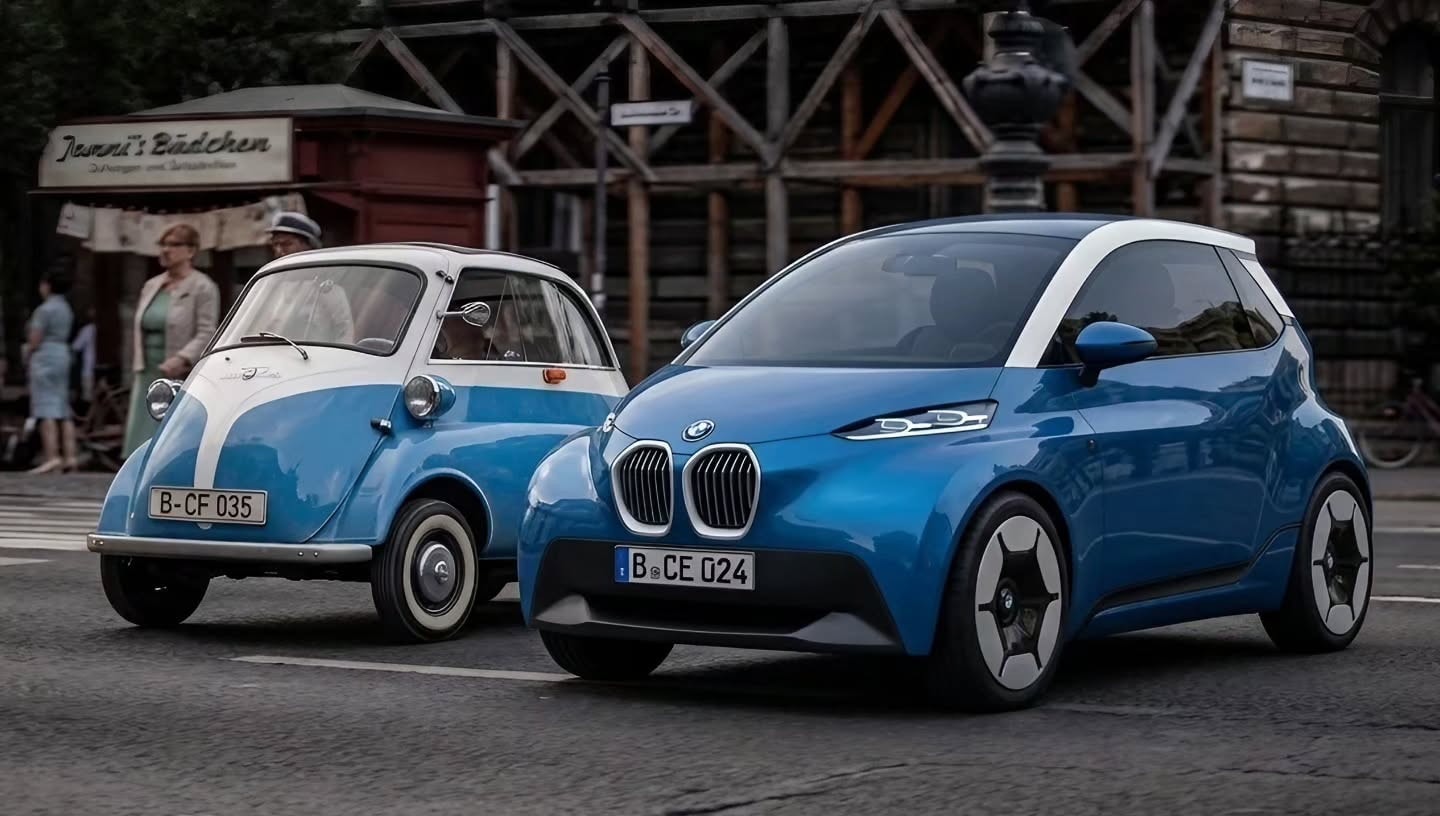
However, while BMW clearly has no intention of making a new Isetta, the rendering crowd has had its way with this model numerous times over the years. Thus, we’ve seen a fair share of new-gen BMW Isettas for the modern day, and one of the latest to have crossed our screens came from @tedoradze.giorgi on Instagram. This model looks suspiciously similar to the Smart ForTwo, and this likely tells us that the defunct city car was likely used as an almost blank canvas in order to design this new BMW Isetta.

Photo: Instagram | tedoradze.giorgi
Posing next to its iconic predecessor reveals that the modern-day BMW Isetta is significantly larger. It also features a cute interpretation of the kidney grille, has a pair of familiar-looking slim headlights, and a wide air intake in the middle of the front bumper. The profile is a bit too Smart ForTwo-ish, as mentioned above, and at the rear, it does not look anything like a BMW, as it sports a pair of small vertical taillights on each side of the branded tailgate, and has a plastic-y bumper.
This imagined new-generation BMW Isetta is presented in a bit-tone look, with blue used on the lower parts of the body, and white on the upper elements. The roof has a black finish in the middle, and the wheels appear to feature some aero-like covers on them that would improve the electric range, because this is an EV, and one that would want to be noticed. And noticed it would be, as it is very cute. The proportions are not bad at all, to be honest, though ditching the Smart ForTwo-inspired look would be a must in order for it to be successful.
Nevertheless, as we already told you, BMW has zero plans of dusting off the Isetta nameplate in order to use it on a new small machine, though maybe it should, as something like this would rival Smart’s new #2. And if you had to choose between these two rides, which one would you get and why?