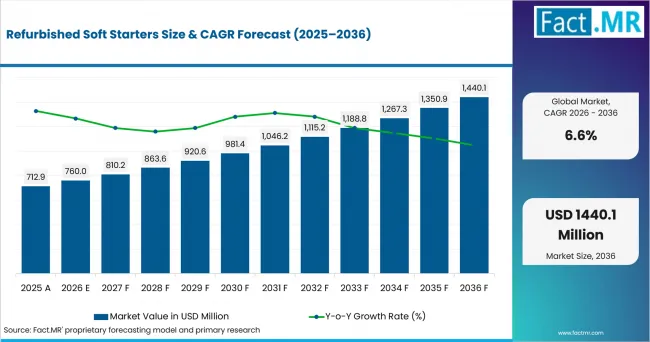
The market covers revenue from complete soft starters that are restored for resale or exchange after inspection, repair, component replacement, testing or remanufacturing. It includes OEM-certified remanufactured units, independently refurbished units, board-level repaired units, tested used or reconditioned units and core-exchange units sold into industrial motor-control applications.
What is included in the scope?
Included products are second-life soft starters used to control the starting and stopping of industrial AC motors across the specified power ranges.
Coverage includes units purchased for manufacturing, water and wastewater, mining, oil and gas, and HVAC or building applications. Revenue is counted when a refurbished or exchange starter is commercially supplied as a usable unit.
What is excluded from the scope?
The scope excludes newly manufactured soft starters, variable frequency drives sold as separate products, complete motors, contactors and motor-control centers sold independently, field labor without a supplied refurbished unit, scrap electronics, and untested used equipment sold without functional reconditioning.
General industrial repair services are excluded unless tied directly to a refurbished soft starter supplied to the customer.
How Was the Analysis Built?
Primary research focuses on industrial maintenance managers, motor-control distributors, repair depots, automation integrators, OEM service teams and procurement managers in manufacturing and process industries. Interviews examine failure triggers, repair-versus-replace thresholds, turnaround requirements, warranty expectations and acceptance of independently refurbished versus OEM-certified units.
Desk research draws on manufacturer lifecycle documentation, repair and exchange programs, public industrial statistics, circular-economy policy, motor-system guidance and sector-level evidence from manufacturing, water utilities and other motor-intensive industries.
Market sizing uses the installed soft-starter base, replacement and failure cycles, repairable share, refurbished-unit pricing, exchange-program penetration, power-range mix and industry mix. Forecasting considers new repair infrastructure, component availability, product obsolescence, circular procurement and buyer acceptance of documented second-life equipment.
Validation checks compare supplier service capability with observed buyer workflows and country-specific industrial conditions. Updates focus on product lifecycle notices, repairability, new OEM refurbishment programs, industrial output and policy changes affecting reuse or remanufacturing.