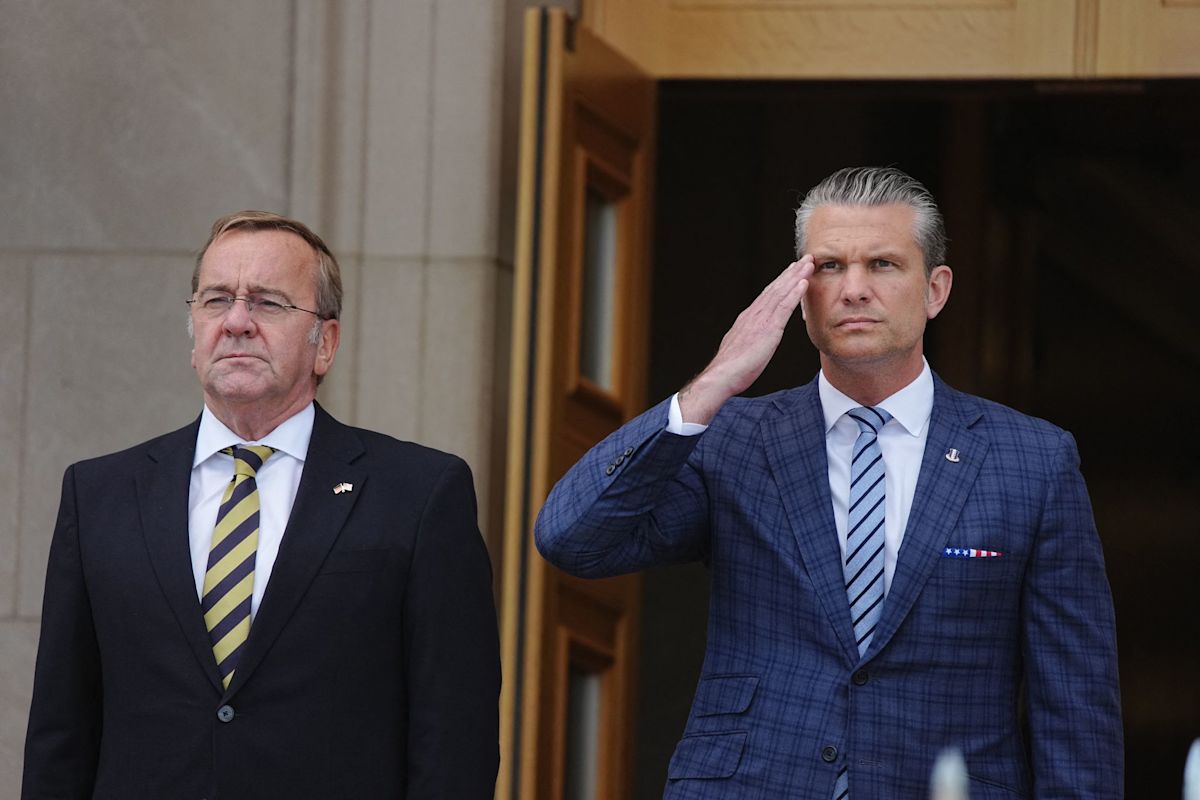
German Defence Minister Boris Pistorius and his US counterpart Pete Hegseth on Tuesday signed a declaration of intent on closer cooperation on armaments projects.
“Germany and the United States agree that the current security policy challenges require a robust and mutually beneficial, closely interlinked defence industrial base on both sides of the Atlantic,” the German Defence Ministry said regarding the meeting in Washington.
Both countries have powerful defence industries that could and should complement each other even more closely in the future in the production of state-of-the-art weapons systems, components, and complex munitions, it was further stated.
High demand for defence equipment requires increased production capacity, short delivery times and a reliable supply on both sides of the Atlantic to ensure the alliance’s supply security and operational readiness.
The declaration of intent sets a political framework for future projects, the ministry said. It covers the development, production, licensed production and maintenance of defence equipment. The aim is also to strengthen supply chains, review rules on technology transfer and step up cooperation in research and development.
Pistorius: Our joint potential goes further
Ahead of his meeting with Hegseth, Pistorius had referred to the collaboration on the F-35 stealth fighter and the planned production of guided missiles for the Patriot air defence system in Germany.
“But our joint potential extends even further. Germany has a strong industrial base, highly skilled workers and cutting-edge technological expertise. With these assets, we can create further production capacity,” Pistorius said.
If the US and Germany were to combine their strengths even more closely, deterrence and defence systems could be deployed quicker and in greater numbers. “In doing so, we strengthen the operational readiness of Germany, the US and the entire Alliance,” he said.
The German government also intends to purchase Tomahawk cruise missiles from the US and has already reached an agreement in principle on this matter on the sidelines of the NATO summit in Ankara in July.
US government changes its tone towards Germany
A key issue is whether and how the US armed forces will alter their troop presence in Europe – which is vital for deterrence and defence. Germany has offered NATO ships, fighter aircraft and unmanned weapon systems as a replacement for capabilities previously guaranteed by the US military in Europe. The German minister has also previously called for a timetable for the handover of these responsibilities.
Pistorius last visited Hegseth in Washington in mid-2025. This May, he was in North America, where he promoted defence cooperation centred on German submarines in Canada. There was no meeting with Hegseth, who was in Singapore attending the Shangri-La Dialogue, Asia’s most important security conference.
However, the later timing of the meeting could now prove to be a positive development, as the US has changed its tone towards Germany. For a long time, US President Donald Trump and his cabinet had sharply criticized the German government, accusing it – like other European states – of not doing enough for its own defence.
Germany, in particular, has, however, made a significant U-turn. In August, US Under-Secretary of State Elbridge Colby even praised Germany at NATO headquarters as a model for other allies. What Germany had set in motion over the past 18 months was “an extraordinary tectonic shift”, a “historic transformation”, he explained.
Germany had moved from extensive demilitarization to rapid rearmament, he said. Furthermore, Germany was proving to be very cooperative, and discussions on joint arms production and other avenues of cooperation were proving very results-oriented.
Deal struck in Texas: Germany to receive F-35s
Pistorius will travel on from Washington to New York. On the agenda are talks with UN representatives, including Secretary-General António Guterres. These will focus on the future of Blue Helmet missions and also on continued international engagement in Lebanon, where the Bundeswehr has so far been involved in the UN mission UNIFIL.
In Fort Worth, Texas, Pistorius will visit the US aircraft manufacturer Lockheed Martin on Friday. There, the company will officially hand over the first of the F-35 stealth jets ordered by Germany. The aircraft are intended to replace the ageing Tornado fleet.
As part of a modernization programme worth billions, the Ministry of Defence has ordered 35 of these aircraft from Lockheed Martin. The first aircraft delivered will initially remain in the US, where they will be used for pilot training.
The F-35 is regarded as the world’s most advanced fighter aircraft and has also been purchased for Germany’s so-called ‘nuclear sharing’ programme, a NATO deterrence concept under which allies have access to US nuclear bombs. Thanks to its special shape and external coating, the aircraft is difficult for enemy radar to detect.