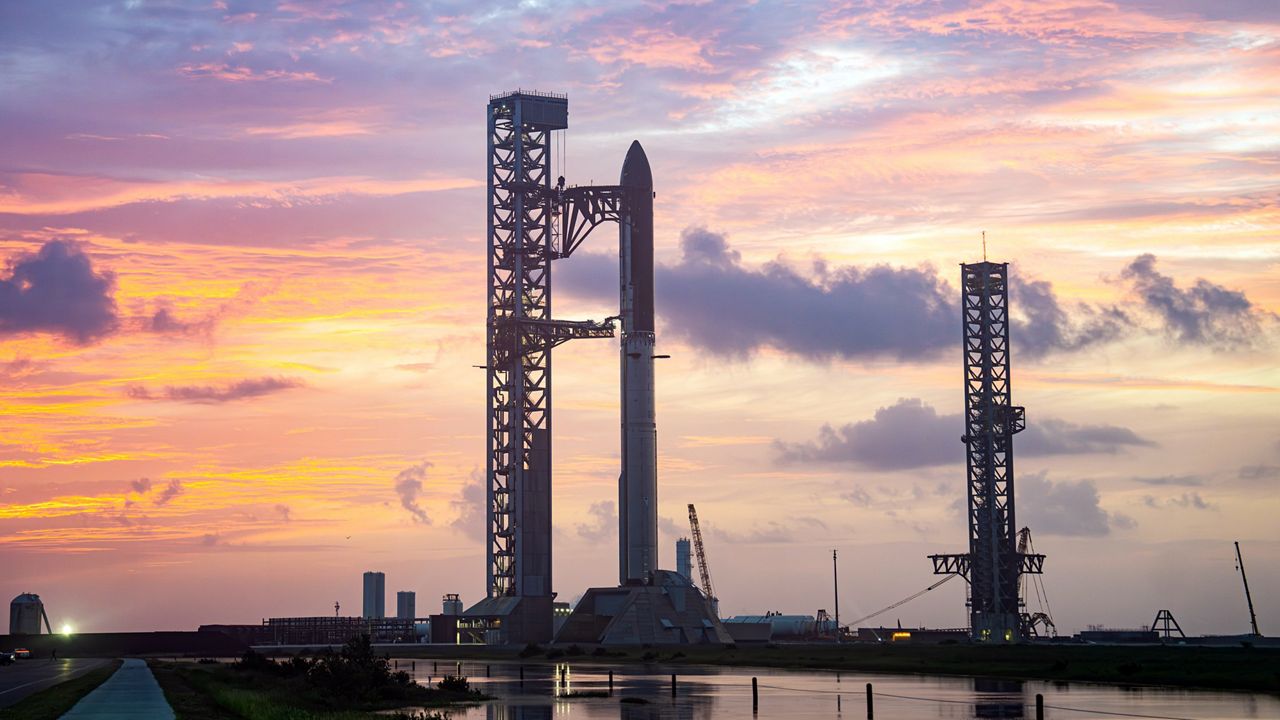
BOCA CHICA BEACH, Texas — For the first time, SpaceX will conduct an orbital test flight of its Starship in its 14th test flight on Monday, Sept. 28.
Originally, the flight was set for Tuesday, Sept. 22. However, the company made a change on its website, stating that they will launch as soon as Sept. 28, pending regulatory approval. No reason was given for the launch date change.
What You Need To Know
The previous Starship test flights have been suborbital
The nearly 10-hour flight test will see a series of firsts, like orbiting Earth about six times
The uncrewed Starship stands 407 feet (124 meters) tall, and it will take off from SpaceX’s Starbase facility in Boca Chica, Texas, the company stated.
The 75-minute launch window is set to open at 8:15 a.m. ET for Starship’s first orbital test flight.
The previous test flights have been suborbital.
(A suborbital flight goes into the boundary of space and can last up to an hour, peaking between 50 and 70 miles (80 to 110 km) before coming back down and not completing a full orbit. An orbital flight goes at an extreme speed — about 17,400mph/ 28,000 kph — to maintain an orbit between 100 and 250 miles (160 to 400 kilometers) about the planet and stay there for hours to months before returning to Earth.)
Starship is the spacecraft, and the Super Heavy is the rocket booster. When they are stacked together, they are jointly called Starship.
Scroll down to see the Starship flight tests timeline.
 
What to expect from the 14th test flight
The Starship, expected to be part of NASA’s Artemis III mission next year, will do some new things during this nearly 10-hour test flight, SpaceX confirmed.
“The upcoming flight is planned to be the first to send Starship into orbit around Earth. Flight tests until this point have intentionally flown passively safe suborbital trajectories to maximize public safety while allowing for maximum learning. By going to orbit, the next phase of developing Starship to be fully and rapidly reusable can begin,” explained SpaceX.
The Super Heavy rocket booster’s job for this mission comes in a series of stages:
Launch
Ascent
Stage separation from the upper stage
A boostback burn
A landing burn in the Gulf
This Starship will fly about 171 miles (275 kilometers) above Earth’s surface, with one of its goals being to complete approximately six orbits around our little round planet.
In addition, the 14th test will see another first: The Starship will deploy 26 Starlink V3 satellites, and once they make contact with ground control and the rest of the Starlink constellation using radio signals and laser links, they will join their mechanical brothers and sisters in low-Earth orbit.
“Three of the satellites have been modified with a suite of cameras to scan Starship’s heatshield and transmit imagery down to operators to continue testing methods of analyzing Starship’s heatshield readiness for return to launch site on future missions,” SpaceX explained. “Each Starlink V3 satellite will add 1 Terabits per second (Tbps) of capacity to the constellation, for a total of 26 Tbps of capacity added on this mission alone.”
Because test flight 13 was a water landing in the Indian Ocean that saw Starship floating for days (it usually sinks soon after), SpaceX was able to study and gather data to make improvements to the heat shield.
“(Those improvements) include additional retention mechanisms added to tiles in areas deemed to be at highest risk of falling off during ascent, addressing recently discovered areas that offer flow paths behind tiles for plasma, and flying multiple areas with a curved tile design that has shown the ability to reduce heating in the gaps between tiles. And finally, two tiles recovered from Ship 40 are planned to be reflown on Ship 41, marking the first tile reuse for Starship,” SpaceX shared.
The Starship upper stage will see other test objectives in addition to orbiting Earth about six times and deploying the Starlink satellites. They include:
The first orbital insertion maneuver (Starship will fire its engines in a controlled manner to put it in the right speed and path to enter orbit)
A deorbit burn using one Raptor engine while in space
Controlled reentry and splashdown in the Pacific Ocean, just west of Chile
Starship’s Test Flights
Look back at all 13 test flights of the Starship.