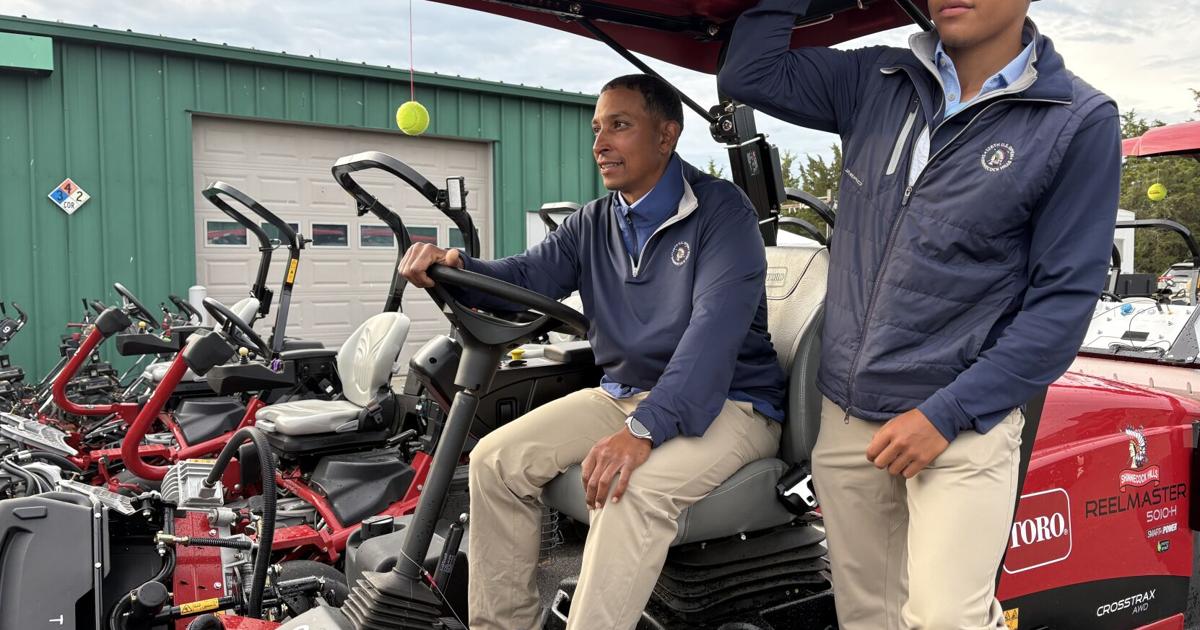
On Monday afternoon, during the first day of U.S. Open practice rounds at Shinnecock Hills Golf Club, assistant course superintendent Matt Smith was crouched down just off the ninth green, watering hose in hand, waiting for the right moment to make his move for a quick syringe of the green in between groups. By his side was his son, Menuhki, soon to be 13, eager to jump in and help.
“He kept saying, ‘Hey dad, do you think now’s a good time?’” Smith said, recounting the moment.
Once the golfers finished putting, the father and son team ran out together, quickly spraying the green, prone to drying out because of the high winds that are a near constant presence at the world-famous course. They worked together efficiently, doing what they needed to do and getting off the green again before the next round of golfers hit their approach shots.
The following day, Smith repeated almost the same scenario on the 14th green, this time with his father, the Reverend Michael Smith, who, decades ago, worked as a greenskeeper at Shinnecock Hills.
Those back-to-back experiences, each over in a matter of seconds, held a lifetime of meaning and significance for Smith, 42, in his sixth year working at Shinnecock Hills.
“You’ve got a little kid, with all these spectators watching him,” Smith said of that moment with his son, the first of a few times that day they worked together syringing greens. He smiled as he told the story, while driving a golf cart around the front nine in the early morning darkness on Friday, overseeing members of the club’s maintenance team and volunteers as they cut fairways, raked bunkers and prepared the course for the day. “The first time, it was really shocking to him, and then the second time around, he was a pro. We were high-fiving, giving pounds. He really took it in and loved every minute of it. That’s something he’ll never forget. Right now, he doesn’t know how important the U.S. Open is, but when he gets older and really knows what it is, he’s going to appreciate that moment even more.”
Anyone who knows the history of the golf course — which is hosting the U.S. Open for the sixth time this week — knows that the Smith name is inextricably linked with the historic club, which became the first incorporated golf club in the country when it opened in 1891.
Smith’s uncle, Peter Smith, was the golf course superintendent at the club from 1980 to 1999, presiding over two U.S. Open Championships, in 1986 and 1995. He took over the job from his own father, Elmer Smith, who was club superintendent from 1955 until his death in 1980.
Many members of the Smith family, all enrolled tribal members of the Shinnecock Nation, have worked at the course throughout the years. The bones of their ancestors are buried on the course, which is part of a large swath of land that was stolen from the Shinnecock people through a series of fraudulent and coercive land deals back in the 1700s and 1800s. Shinnecock people built the course, and a Shinnecock man, Oscar Bunn, competed in the first Open held there in 1896.
In the more than a century since then, many members of the Shinnecock Nation have worked at the course, tending to and caretaking for the land that is so sacred to them.
There was a time, not too long ago, when almost every member of the maintenance staff was from the Shinnecock Nation. A framed photo of the crew from the 1986 Open that hangs above one of the doors to the garage in the maintenance facility shows Peter Smith standing proudly alongside his staff, a testament to that fact.
That’s not the case anymore.
A lot has happened since then, and the relationship between the tribe and the golf course that bears its name and even its likeness on the logo has gone through ups and downs. Matt Smith’s presence, and the important role he plays as a high ranking member of the maintenance staff, is a testament not only to the enduring partnership between the club and the tribe, but also to Smith’s personal determination to preserve it.
Smith tells a lot of the story of how he ended up working at Shinnecock Hills, and what the tribe’s relationship has been like with the club over the years in the Golf Channel’s new 48-minute documentary film, “The Land We Share,” by Seth Fader and Farrell Evans, that can be viewed on both the Golf Channel and YouTube. He spoke about that experience, and more, while out on the course in the predawn hours on Friday.
The Cool Uncle
From a young age, Smith dreamed about working at Shinnecock Hills. His uncle, Peter Smith — his father’s brother — was the reason why.
“My Uncle Peter was a big father-figure in my life as well,” he said. “Me and his sons were like brothers. He was into fishing, hunting, just being outdoors, and that’s kind of where I got my interest in all of that. So I’ve always looked up to him.”
Peter Smith had the kind of aura that was irresistible to Matt Smith, especially when he was young.
“He was always a cool guy,” Smith said. “He had the gold chains on, the rings, the nice watch. He had that swagger, and I picked up on that at an early age.”
Peter Smith opened up a whole new world to his sons and nephew too, Smith said, allowing them to make Shinnecock Hills their playground. They’d take the golf carts out for a ride, doing spins on the cartpaths — but never on the grass, Smith was quick to point out. They’d play hide and seek on the course, turning the lights out, trying to see who could stay hidden the longest. They’d also catch tadpoles and frogs in the small pond by the sixth hole, the only water feature on the course. In the winter, they went sledding down the hill on the 10th hole.
All that access only added to the allure for Smith.
“I didn’t realize how big of a deal this course was,” Smith said. “It’s a top-five course, and he’s allowing us to do all this. You don’t realize how high the stakes are until you get a little older. Back then, it was like, this is what I want to do because [Peter Smith] had his brother around, he had his sons around, he had his whole family around him. I didn’t see it as a golf course business. I saw it as home and family and friends.”
Then, in 1999, it all changed. Smith was let go, unexpectedly, by the club, replaced by former Pebble Beach superintendent Mark Michaud. Smith was devastated, and eventually took a job at a golf course at Foxwoods in Connecticut. Three years later, he died of a heart attack.
His dismissal opened up a schism between the golf club and the tribe. Matt Smith was still in high school and remembers the moment well and the impact it had on him at that time.
“When he got let go, the course was kind of just ripped away from us,” he said, calling it a turning point. “I always wanted to be part of this place, but when he got fired, I kind of gave up on that dream.”
A Leap-of-Faith Pivot
A little over six years ago, Matt Smith was in a pretty good career groove. He was 12 years deep into a job as a foreman for a high-end landscaping company, leading crews on jobs at wealthy estates with caretakers for valuable clients, making good money with good benefits, and caring for his two children as a single dad.
Then, his father came to him with a proposal.
In the years since his brother’s unexpected dismissal, Mike Smith had been in communication with the club management, trying to find a way to ensure the relationship between the tribe and the club wouldn’t sever completely, and trying to find a way to repair the damage that had been done when his brother was let go.
That’s how The Elmer F. and Peter E. Smith Apprentice Award in Professional Turf Management was created. Named in honor of father and son who oversaw the caretaking of the club for nearly half a century, the scholarship covers the cost of turf management school for a Shinnecock tribal member, providing an opportunity to get into the industry.
“My dad came up to me and said, ‘What would you think about trying something like this?’” Smith recalled.
He wasn’t sold at first.
In the years since his uncle’s death, Smith’s relationship with the club had become almost nonexistent. But Michael Smith has been steadily putting in the work to keep it alive.
“He put his pride and ego aside and was always nourishing that relationship,” Matt Smith said. “And he’s a good guy, so they respected him.”
Between the need to leave his comfortable landscaping job, and the prospect of going back to school in his 30s, while caring on his own for two young children, Smith was unsure whether or not to make the pivot. Ultimately, he decided to do it, not just for his own future, but for the sake of keeping his family and his tribe’s connection to the course, and keeping that legacy of Smith family stewardship alive.
The Payoff
Smith said he figured if he didn’t seize the opportunity (at that time, no one else from the tribe had shown interest in the scholarship), the club would eventually rescind it. He didn’t want that to happen.
So he went back to school, taking his parents up on their offer to help care for his kids.
It was hard, Smith said. And there were plenty of days — the hard labor, the early morning grind — when he questioned his decision. But the smile on his face as he drove around the course Friday morning, the sunrise lighting up brilliantly around him, leaves no doubt that he’s right where he belongs.
“I just wanted to keep that name alive for our family,” he said. “To keep the legacy alive.
“It was definitely uncomfortable,” he added. “But I’m glad I did it, because now we’re here.”
As the sun rose in an explosion of vibrant color on Friday morning, the wind was still whipping, putting a slight chill in the air. After Peter Smith was fired, and after his death at a young age, some people suggested that a curse had been born. In 2004, at the first Open the course held since Peter Smith presided over two in 1986 and 1995 that were widely regarded as a runaway success, the USGA and Michaud took a lot of heat for the condition of the course, which many golfers said was “unplayable” because of the speed of the greens. By the next Open, Michaud was gone and current superintendent Jonathan Jennings — who will retire at the end of this year — had taken over. But the shadow of 2004 hung over the 2018 Open as well, even though the end result was not nearly as disastrous.
As Matt Smith piloted his golf cart around the front nine on Friday morning, he remarked that the wind was stronger than it had been forecast to be that morning. He joked that maybe the high winds were part of the curse of Elmer and Peter Smith. Then he took a closer look at the sunrise, a brilliant shade of orange and pink.
“With that sunrise, it looks like they’re smiling on us,” he said. “They’re trying to help us.”
He may have been right. Friday wasn’t an easy morning for the maintenance crew. Play had been suspended due to darkness on Thursday night, with several players having to mark their balls on the greens and fairways in the middle of playing their final holes. A fog delay on Thursday morning had pushed back the schedule. Instead of leaving down regular ball markers, the players placed golf tees in the area to mark their spots, to make them more visible and ensure they wouldn’t easily be displaced. Making sure they did not disturb or misplace those tees was of paramount importance for the maintenance crew, and the need to finish up those rounds meant the team went to work even earlier than usual, with the morning meeting led by Jennings, which usually starts at 4 a.m., starting at 3 a.m. instead. It was a grind, especially because most of the crew had been out on the course for the evening shift until past 10 p.m. the night before.
Despite all that they finished their work a few minutes early, without any major hiccups or errors.
Once that high-intensity morning prep is done, members of the staff often try to catch a quick nap on one of the gray sofas in the maintenance building’s laundry room. Some of the volunteers are able to go home for a bit to rest, before coming back for the evening shift.
Smith didn’t expect he’d be sleeping for long, if at all. With no school because of the Juneteenth holiday, he was going to spend time with his son on the course again, and his father, who is on the volunteer team, and wouldn’t have missed the Open for the world.
Smith marveled at the fact that he’s been watering greens with both his son and his father at this year’s Open, recognizing how special and rare it is to have that kind of three-generations full circle moment.
“I used to follow my dad around here and now he’s following me around and my son is following me around,” he said. “It’s a cool experience and the journey has been phenomenal. I couldn’t ask for anything more. It’s like I’m living the dream. And it is hard work but when you see the big picture and get to do events like this, it’s worth it.”
Smith is one of three Shinnecock tribal members working at the course currently. Ron “Snoop” Eleazer, a senior greenskeeper who runs the fairway mowing team, has been at the club for all four of the modern Opens.
And now, thanks to the influence of Smith and his decision to take advantage of the opportunity his father suggested, there’s another Shinnecock scholarship recipient on the team. Smith’s cousin, Wequai Smith, 20, is part of the team at Shinnecock now, working as an intern. He’s been with a group taking care of bunkers at the Open.
Smith feels a lot of pride at seeing Wequai at Shinnecock. He’s close with Wequai’s father, and said the relationship he has with Wequai is more like an uncle and nephew. Setting an example by taking advantage of the scholarship opportunity himself laid the groundwork for Wequai, and hopefully others, to follow.
Early Friday afternoon, Smith set out with his father and son to take in some of the action along with the rest of the spectators. His son, Menuhki, was eagerly checking the USGA app, trying to find out where his favorite golfers would be, enthusiastically updating his father and grandfather about who was under par, over par, who had just made or missed a big shot.
They paused for a photo together near the 13th green, three generations of the Smith family at a U.S. Open Championship at Shinnecock Hills.
Reverend Michael Smith noted that the 13th hole had special significance. It was where his brother, Peter, was told by the club, in 1980, after his father, Elmer had died, that he’d be taking over for him as course superintendent.
The time that Smith puts in at the course every day — at work hours before the sun rises and, during the championship week, not home until after it sets — can feel interminable.
On Friday morning, it was clear he wasn’t thinking about that. His thoughts were on his dad instead, and what it has meant to him to be back out on the course, alongside members of the staff, on a swath of land that means so much to the Shinnecock people.
“He loves this place,” Smith said. “It has a special place in his heart. Letting him relive those moments, and have the opportunity to reign over the course again like that, it puts a smile on my face.”