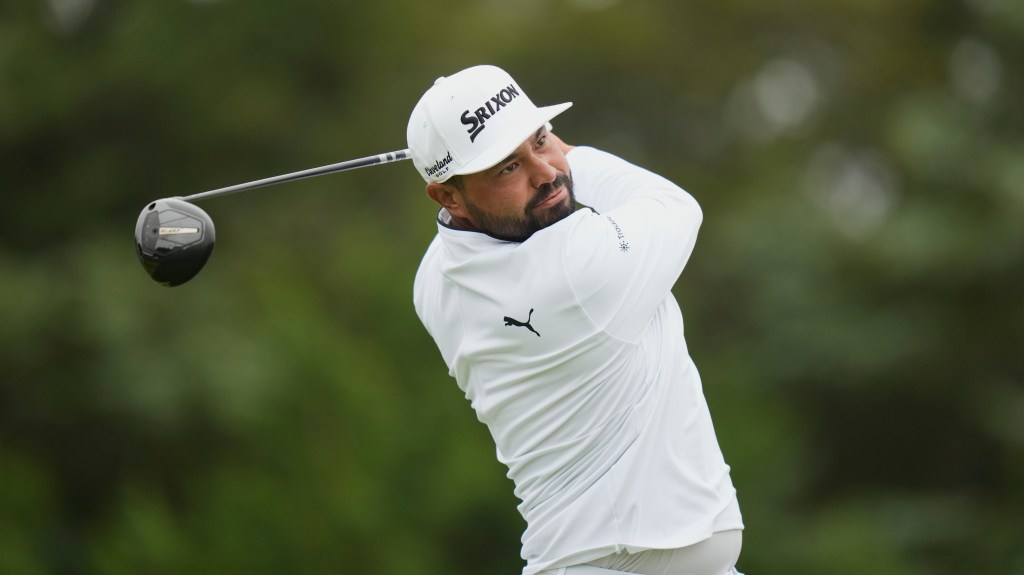
As he approached the final holes of the grueling 2025 U.S. Open at Oakmont Country Club, soon-to-be-champion J.J. Spaun had a secret weapon.
It wasn’t his quality drives or exceptional short game and iron play he’s known for. Rather, in his pocket he had the silver lining byproduct of the thing that almost stole his dream of golf glory: Type 1 diabetes.
How could a diagnosis of a condition with no remission that demands a lifetime of constant oversight become a fierce weapon for victory? At the player’s clubhouse area of the Travelers Championship on Wednesday in Cromwell, Conn., fresh off playing a pre-tourney pro am, he explained.
“Diabetes made me strong; it made me resilient,” he told the Herald. “It’s easier to look in the face of a tough hole, or a tough last stretch scenario now. I think to myself: I’ve done tougher things than this. If I can deal with type 1 diabetes, I can do this.”
That kind of view came at a temporary cost though, one that plunged Spaun from top contender in events to a struggling player who lost his PGA card for a bit.
It all started in the 2019 season when Spaun suddenly began losing weight and he often felt weak on the course. A visit to his doctor shocked him. Despite his young age and fitness level, he was diagnosed with type 2 diabetes. Type 2 is a metabolic disorder in which the body still produces some insulin but has time using it for what it is meant for, to convert food to fuel.
Spaun called the diagnosis “disorienting,” but decided to apply his competitor mindset to working it out.
“I felt like it was something I could manage,” he said.
But he could not. As time went on, he tried harder and harder, removing nearly all carbs from his diet, upping his exercise, ingesting less than 1,200 calories a day and trying to focus on his game even though he felt weak and depleted.
As he sunk down in rankings (he’d earned $3.1 million and risen up to 62nd in the FedEx Cup by 2018; by 2021 he’d dropped to 584 and temporarily lost his card), Spaun began to experience a devastating side effect of the diagnosis.
Self doubt.
“The first few months I was trending in the right direction, but all of a sudden I was losing stamina. I was weak and playing poorly. It was tough. Right as I was establishing myself, I got this thrown at me,” he said.
 J.J. Spaun speaks during a news conference after winning the U.S. Open at Oakmont Country Club on Sunday, June 15, 2025, in Oakmont, Pa. (AP Photo/Gene J. Puskar)
But then he discovered a life ring.
“I’d lost another 25 pounds (bringing his once stout frame down to about 150), and a friend who is a doctor saw me and said, ‘This is wrong. You need to see an endocrinologist,’ ” he said.
He did, and at that appointment, after labs and a physical, the doctor sat down to deliver what he saw as bad news: “JJ,” he said, “You don’t have type 2. You have type 1.”
Spaun’s reaction was immediate.
“I looked at him and said, ‘This is great news,’ ” he remembered.
Type 1 diabetes, unlike type 2, is a condition when the body produces almost no insulin at all. The solution is administering insulin and monitoring blood sugars. And, Spaun learned, well managed type 1 diabetes need not get in the way of sporting success, be it the diet needed, intensity of the sport or anything else.
He went at it anew – looking to learn all he could to compete well and with a newly-focused goal of championship level play.
It didn’t happen in a day. From the change in his body demanding adjustments in most of his game to the trial and error plodding most people with type 1 take on to master a sport or activity, he had to learn, practice and trust.
Then, at the Travelers Championship came another lifeline in the form of Andy Bessette, the executive vice president and chief administrative officer for Travelers who happens to be father to a son with T1d. Bessette got word that Spaun had won the tourney’s famed “hole 15 1/2 challenge” and donated his $10,000 win to Breakthrough T1d (https://www.breakthrought1d.org/).
Bessette matched the donation and then gave Spaun something as valuable – the lifetime support of a diabetes dad.
“He told me he would help me any way he could,” Spaun said, “He’s this giant bear hug of a guy and I just feel like I have him out there for me. “
His tips, such as connecting him with the notion of inhalable insulin which Spaun uses along with a continuous glucose monitor (CGM), helped him come back. Now a U.S. Open champion and two-time Valero champ who’s ranked 12th in the world, he’s back to his focus on being the best.
That action, he said, makes this week’s Travelers Championship even more special to him.
“It feels like a hometown event for me,” he said.
Other Tour players have been open and helpful about his condition.
“Collin (Morikowoa ) just saw me do a shot in the locker room and asked me if I have to do that every day,” he said. “So that was another chance to educate.”
He also feels the lift of the thousands of fans who follow him because of their shared connection to diabetes.
“I’ve gotten so many messages from parents and kids and adults with type 1,” he said. “They label me as a hero. It’s incredible. You know, there’s always more to golf. I think this – showing the world how to do well with type 1 diabetes – is my calling.”
Spaun tees off Thursday with the goal of a win. With his peanut butter on wheat bread and Gatorade in his bag, he’s ready, despite diabetes, to win.