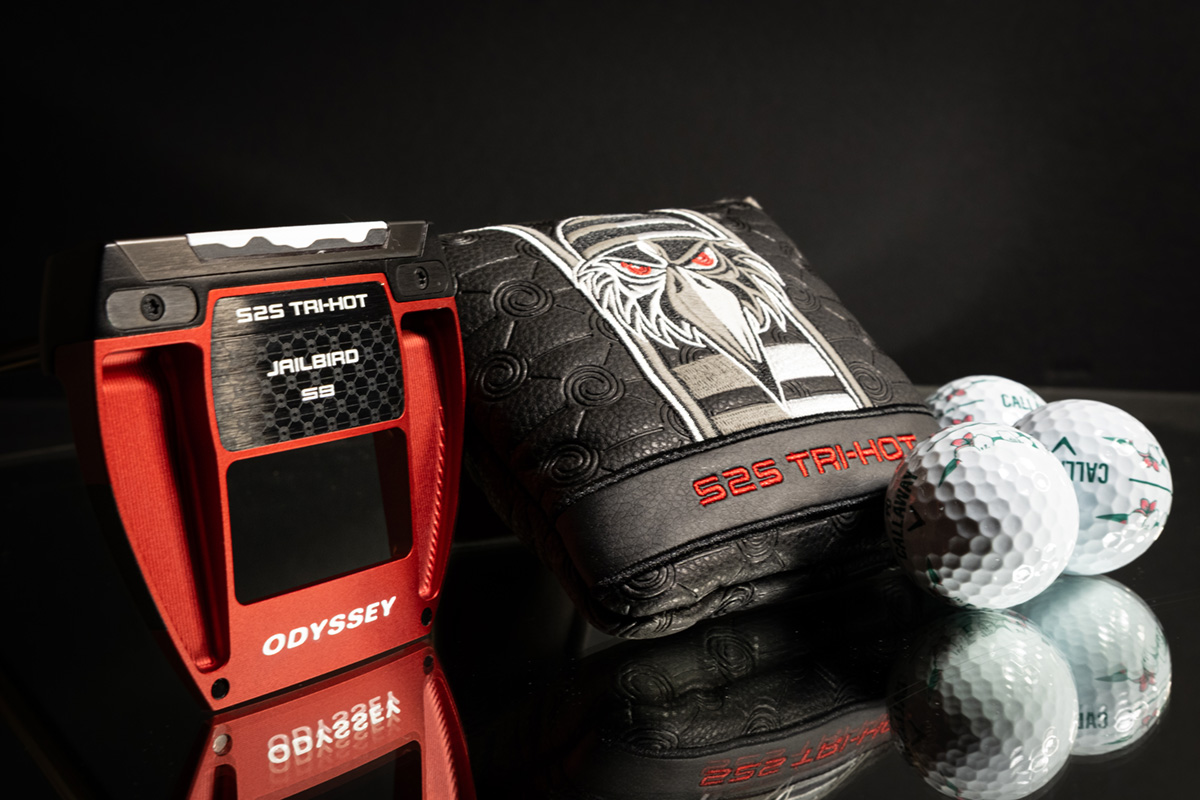
Zero torque isn’t new anymore, but it still hasn’t fully crossed over.
For all the attention the category has received, there have been some consistent sticking points. The look, the setup, and in many cases, the requirement to use a center shaft have all limited how many golfers are willing to give it a real chance. It’s a little-known secret that the same putters that seem to start popping up everywhere online, also happen to be the most returned.
Odyssey saw that early with the original S2S Tri-Hot line. They pushed the category forward by moving the center of gravity closer to the face and eliminating the need for excessive shaft lean. Now, with the S2S Tri-Hot SB, they’re taking the next step by changing something that, on paper, seems simple but could completely change the category.
Today Odyssey is introducing a single bend, heel-oriented zero torque putter.
Solving the Barriers
“We identified three things holding golfers back: shaft lean, center shaft only, and alignment,” explained Jacob Davidson of Odyssey Golf.
That line sums up the direction Odyssey is heading with the SB line.

The original S2S Tri-Hot addressed the first issue by moving the CG forward, allowing the shaft to enter the head along the topline. That created a more natural setup without forcing players into a forward press or unfamiliar hand position.
Still, there was hesitation from players who simply don’t like the look or feel of a center shafted putter.

This is where the SB comes in. By maintaining that forward CG and shifting the shaft toward the heel using a single bend, Odyssey has created a putter that looks much closer to what golfers are used to while still retaining the main benefits of zero torque.
Odyssey’s Director of R&D Eric Steuben told us, “It’s a simple change, but it only works because we moved the CG forward first.”
Single Bend, Different Outcome
The SB designation stands for Single Bend, but it represents more than just a hosel option.
In traditional designs, moving the shaft toward the heel would compromise the torque profile. That’s why most zero torque putters have leaned heavily into center shaft constructions.
Here, the forward CG does the heavy lifting. With more than 80% of the mass positioned under the topline and closer to the face, Odyssey can maintain that “face stays square” behavior while shifting the shaft location.

The result is a setup that looks familiar at address.
“A heel-shafted look with a traditional setup just wasn’t possible before without it looking awkward,” explained Steuben
That familiarity shows up immediately when you put the S2S Tri-Hot SB down behind the ball. The alignment lines are cleaner, the sight picture is less obstructed, and there’s no visual cue that forces you to rethink how you set up to a putt.
Odyssey S2S Tri-Hot SB Alignment and Setup
One of the underrated benefits of this design is what it allows Odyssey to do with alignment.
“For the first time in zero torque, you get clean, long alignment lines,” said Steuben

That’s been a real limitation in the category. Center shafted designs often break up the topline or force compromises in alignment aids. By shifting to a single bend configuration, Odyssey opened up the ability to use longer, uninterrupted lines across shapes like the #7.
It may seem subtle, but the cleaner visual makes a noticeable difference when standing over the ball.
Multi-Material Construction and CG Placement
Everything still revolves around the Tri-Hot construction.
These putters use a combination of aluminum, steel, and a significant amount of tungsten, upwards of 120 to 140 grams positioned toward the front of the head. That mass placement is what allows the CG to move forward, which in turn allows the hosel to sit on the topline and closer to the face.
From a design standpoint, it’s all connected. Without the weight forward, none of the other changes work. From a performance standpoint, it’s what gives the putter that stable, square-to-square motion through the stroke.
Ai-Dual Insert and Roll Characteristics
Odyssey continues to let their insert technology shine here. The S2S Tri-Hot SB uses the same Ai-Dual insert found in the original line. This is a dual-layer urethane design with a firmer inner core and a softer outer layer. The goal is to maintain ball speed consistency across the face while improving forward roll.


The insert works in conjunction with the FRD groove pattern, which features a more aggressive 19-degree slope designed to get the ball rolling sooner, regardless of strike location.
“You’re getting top spin across the entire face, not just in the center,” noted Steuben.
We’ve discussed the Ai-Dual insert quite a bit since the original S2S Tri-Hot line dropped. It’s notably softer than Ai-One, it’s forgiving, and the roll technology truly is remarkable.
Odyssey S2S Tri-Hot SB Grip and Shaft Pairing
Odyssey also made a few other changes in the S2S Tri-Hot line that shouldn’t be overlooked.
The Black SL 120 shaft is heavier and stiffer than previous offerings, helping create a more stable overall feel. The Pistol Plus grip is mid-sized with more defined edges, giving players a clearer sense of face orientation throughout the stroke.

These aren’t headline features, but they play an important role in how the putter balances and feels in hand. If we could give a simple, one-word description, it feels “normal”.
Odyssey S2S Tri-Hot SB Shapes and Options
The S2S Tri-Hot SB lineup includes three primary shapes: Jailbird, #7 and Rossie.


There is also a Cruiser version of the #7, featuring a longer 38” build, heavier head, and extended grip for players who prefer a counterbalanced setup.
All models share the same core design principles, with differences coming down to head shape and overall weighting.
Early Thoughts – Jailbird SB
We’ve spent a couple weeks working with the Jailbird SB, both indoors and on-course and one thing stands out immediately, it looks familiar.
If you didn’t know what you were holding, you wouldn’t immediately identify it as a zero-torque design.
We have mixed feelings about that. On one hand, the Tri-Hot SB really makes the entire zero torque category more accessible. On the other hand, it’s impossible to deny that unusual looking designs stand out more on TV and on the rack. In other words, Odyssey will have to devote substantial marketing effort to let consumers know this line is unique. Of course, they’ve recognized this and even include special stickers advertising the zero-torque technology on the grip.

The transition from a traditional mallet into this line should be much more seamless for golfers dabbling in zero torque than what we’ve seen from most of the category. The visuals are intuitive, alignment is clean and there’s no immediate adjustment period just to get comfortable over the ball.
There’s another point we need to make though. If you have found great comfort in a standard zero torque putter, especially a center-shaft design, the S2S Tri-Hot SB will actually feel a bit unusual. Ironic, right? The net effect of the heel-shafted orientation is that you’ll want to stand a bit farther from the ball. Of course, you’re also probably not the target consumer here.
From a stroke perspective, you can feel the stability. The head wants to stay square, but it doesn’t feel forced or mechanical. We found the same benefits we’ve come to love from the S2S Tri-Hot line: easy alignment, an incredibly stable face, the ability to consistently start the ball on the target line, and impressive forward roll.
Tour Validation
There’s already some validation of the S2S Tri-Hot SB on Tour as well. Max Greyserman has the SB Jailbird in the bag, and it’s present on other world tours as well.
“As soon as he saw the single bend, it was an immediate. ‘Yeah, I want to try that,’” said Steuben
Players who were previously hesitant about center shafted designs have been more willing to test this version, and in some cases, keep it in the bag. Odyssey expects to see more Tour adoption now that they’ve moved beyond prototype seeding.
Our Take
While we shouldn’t be surprised, it still is cool to see the Odyssey R&D machine at work.
Zero torque has proven it can deliver performance. The challenge has been getting golfers comfortable enough to try it.
“This is the zero torque putter people have been waiting for,” said Davidson

That sounds bold, but there’s some truth to it. By removing the visual and setup barriers, Odyssey has made this concept easier to approach. You don’t have to change how you aim. You don’t have to change how you set your hands. You just pick it up and putt. For a lot of golfers, that’s what has been missing.
Odyssey S2S Tri-Hot SB Details and Availability
Odyssey S2S Tri-Hot SB putters will be available beginning April 24, 2026, with retail pricing set at $599.99 for the three standard models and $649.99 for the #7 Cruiser.
All models feature the Ai-Dual insert, forward CG multi-material construction, and Single Bend configuration.
For more information, visit odyssey.callawaygolf.com.