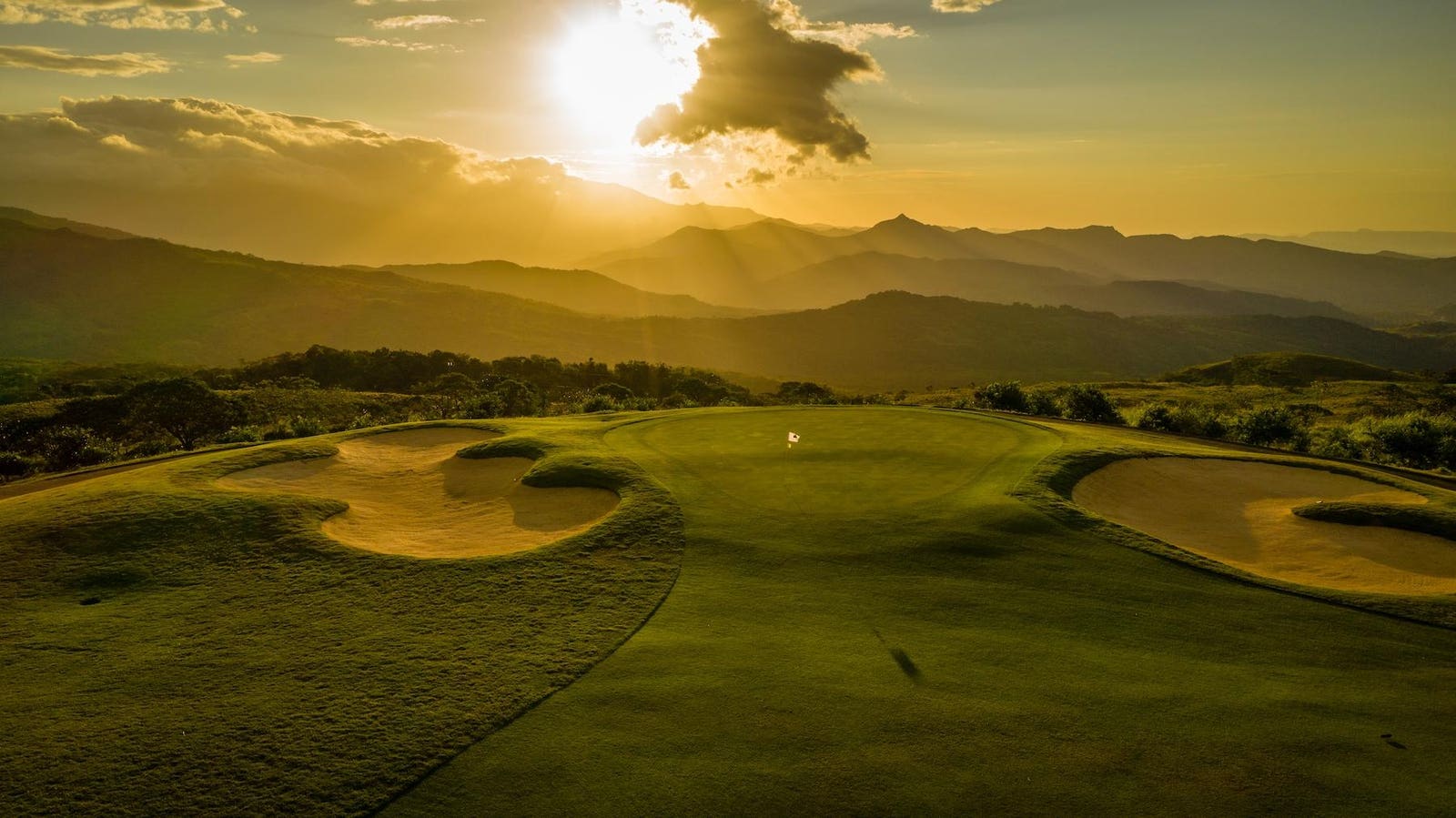
Forty-five minutes north of David (pronounced dah-VEED), Panama’s third-largest city, a few miles east of the mountain town of Boquete, is a bright green sign for a narrow two-lane road called Calle Raideep Lal that leads to the highest golf course in Central America (3,601’ above sea level to be exact).
The ‘Infinity’ green on the 14th hole at the Lucero Golf & Country Club is one of the most jaw dropping par fours in all of Latin America.
Courtesy of Joann Dost for Lucero Golf & Country Club
The Indian provenance is unique for a road name here. By this point on my drive up from the Pacific coast, the heavy heat of the tidal plains has already given way to jagged mountain ridges, cloud forest, plunging rivers, and a cool, Northern California-like climate that feels like a freak of meteorology this close to the equator. We’re also approaching the solid green area in the middle of the Central American map where almost all the roads disappear: less than 30 miles from Costa Rica and La Amistad International Park to the west, equidistant between the Pacific Ocean and the Caribbean Sea north and south, and hemmed in by semi-autonomous indigenous protected areas to the east.
The drive up from David up to Lucero. In the background is the extinct Volcán Barú, at 11,401′ Panama’s tallest mountain
getty
After banking softly right, Calle Raideep Lal coils up through tightly planted coffee farms that fan out like wine vineyards into dense swatches of lush, spongy rainforest. Depending on which way you look, the views open up on either side of the road to the mist-bound flanks of 11,401’ Volcán Barú, Panama’s highest peak, or the deep, green valleys draining this part of the North American continent down to the Pacific.
Over the past five years I’ve traveled to Panama on more than half a dozen occasions, each time growing increasingly more outspoken about sharing with the world what everyone else is missing out on. But up until now, I’ve stuck mostly to Casco Viejo, Panama City’s gawkingly well-preserved colonial historic district, the Bocas del Toro archipelago on the Caribbean side of the country, and the Pearl Islands further south of here off the Pacific Coast. This part of the country, called the Chiriqui Highlands, feels more like wild Hawaii. Or Indonesia.
A panoramic view of Lucero with Volcán Barú’s foothills in the background, including the Treehouse suites to the front right , the new modern Canopy suites to the front left and the homes of phase one development behind the golf course. The clubhouse is to the right in the middle of the frame.
Courtesy of Lucero Golf & Country Club
I’ve come here at the invitation of Sandeep Lal, an entrepreneur-turned-“reluctant developer” who’s currently bringing to life one of Panama’s most potentially transformative real estate projects — the plainly, if aptly, named Lucero Golf & Country Club — a statement I don’t make lightly. If you write about supertall skyscrapers or Miami’s hyper-frothy housing market, as I frequently do, every new development these days comes wrapped in the ‘transformational’ label. Yet, few actually change anything consequential. Even fewer have the potential to do something profound and ignite a new narrative about a place that shifts how an entire neighborhood, city, or even a country is preceived from the outside in.
Lucero immediately felt like it had that potential. For as long as I’ve been coming to Panama, it’s seemed like everyone is waiting for the ‘Guggenheim Moment’ to happen: for that one alchemizing project to break ground that finally elevates Panama to its rightful place on the coveted global real estate map, the way the aforementioned museum did for Bilbao, Spain, Amanpuri did for Phuket, Thailand, and the first ‘eco-lodges’ did for Costa Rica back in the 1980s — transforming it from a small-scale banana and coffee exporter into the international poster child for sustainable, community-based tourism.
Lucero Golf & Country Club encompasses more than 700 contiguous acres of rainforest, farmland, and exquisitely maintained fairways in the foothills of 11,401′ Volcán Barú.
Courtesy of Joann Dost
Lucero’s country club currently features three clay tennis courts, an infinity pool, and a gourmet, farm-to-table restaurant called Seasons in addition to a championship level 18 hole golf course.
Courtesy of Lucero Golf & Country Club
Lucero’s new clubhouse and racquet sports center will include all new hard courts and pickleball along with a state-of-the-art spa and fitness center, wellness, and longevity programming.
Courtesy of Lucero Golf & Country Club
The entrance to Lucero’s new clubhouse and racquet sports center features world-class architecture and design.
Courtesy of Lucero Golf & Country Club
Lucero is not a Frank Gehry. But it possesses the scale, sophistication, and serendipity to be the kind of tipping point project that everyone in Panama has been hoping for. With over 700 contiguous acres to work with, zoning for 450 homes (40 are already built), an 18-hole, championship golf course designed by J. Michael Poellot (a protégé of Robert Trent Jones) already playing, a world-class country club and racquet sports center currently under construction, no debt or bank financing, and the choicest property of all along the 14th hole reserved for a branded luxury hotel and residences by the likes of a Montage, Ritz Carlton, or Four Seasons, Lucero has the capacity to launch Boquete into primetime — which would be a powerful, natural accelerant for a town already considered one of the best places to retire and famous for growing the world’s most expensive coffee (one kilogram sold for more than $30,000 at auction here last year).
That, in turn, might just light the fuse that makes everyone finally realize that Panama is one of the last, best kept real estate and hospitality secrets in the Western Hemisphere still hiding in plain sight.
Sandeep Lal in his company’s new LEED-certified building back in 2006 when he was President of Metro Label Company Ltd.
Toronto Star via Getty Images
“Printing labels isn’t as sexy as building rockets,” Lal tells me. “But you can do pretty well financially if you’re good at it.”
Lal and I have just finished breakfast, and he’s busy fiddling with the shifter on one of his whizzy, new electric golf carts from China so he can take me on the grand tour of Lucero. I’ve barely known him an hour, but it’s already clear he likes to speak in analogies, an autonomic talent presumably honed through decades leading a sales-driven manufacturing business. “Then, there’s real estate development — which is an entirely different game altogether.”
In his former life, Lal was President of a Toronto-based company called Metro Label, a family business started by his father in 1974 which Sandeep helped grow into one of the largest label manufacturing companies in North America. If you bought deli meat at a Stop ‘N Shop, poured Bacardi into a Coke glass, or wore contact lenses manufactured by Novatis in Canada within the past forty years, there’s a good chance the label on the packaging was printed on Metro Label’s presses.
Today, in the bright, atomized light of a clearing rain, Lal still seems surprised to be here, which makes sense because his journey to Panama isn’t a linear one. Back in the early 2000s, Lal’s younger brother, Raideep, after whom the road up to Lucero is named, had grown tired of Toronto’s winters and began looking around the Caribbean for a hotel to buy. He ended up in Boquete and decided to build his own instead — starting with the golf course.
“I didn’t come to Lucero for the first time until after the first nine holes were finished,” recalls Lal of the project’s early origins during the Great Recession. We’re standing at the tee box of the par three 3rd hole which commands sweeping views of the course and the coastal mountains stretching to the Pacific Ocean more than 30 miles away. “But Raideep saw something here when he first arrived in the landscape, the mix of grazing land, farmland, and forest, and the climate that he and Michael (Poellot) knew they could turn into something special.”
Golfers tee off into the mist-shrouded flanks of 11,401′ Volcán Barú on Lucero Golf & Country Club’s par four first hole. Some of the first residences built at Lucero along the course are in the middle of the frame.
Courtesy of Peter Lane Taylor
Raideep Lal and J. Michael Poellot envisioned a championship level course in the shadow of Volcán Barú that would take advantage of the natural topography, climate, and ecosystem.
Courtesy of Joann Dost for Lucero Golf & Country Club
Raideep Lal and J. Michael Poellot transformed Lucero’s grazing land into fairways, while keeping the specimen trees, rainforest, farmland, and orchards intact as much as possible.
Courtesy of Joann Dost for Lucero Golf & Country Club
After acquiring the land that now forms Lucero between 2004 and 2005, Raideep and Poellot began laying out the course as the centerpiece of the property, elegantly conforming it to the natural topography, preserving the specimen trees, and finishing the first nine holes in 2009. They were about to begin construction on the back nine the following year when Raideep unexpectedly passed away in June 2010. That ground the project to halt just as the infrastructure for the clubhouse and the first phase of residential development was finishing up. (The back nine holes were completed in 2011).
At that point, Sandeep faced a potentially life changing decision at the same time he was selling the family business after more than two decades at the helm: divest from one of the finest golf courses in Latin America and 700 acres that symbolized his brother’s vision. Or take everything he’d learned about business in almost forty years at Metro Label and breathe new life into his brother’s legacy.
“I didn’t have to think about it for long,” remembers Lal, whose commitment to family runs neck and neck with his gift for entrepreneurship. “It also didn’t take me long to see the opportunity in Panama.”
Jackfruit — one of the endless fruits and berries growing on the thousands of trees planted on the property.
Courtesy of Lucero Golf & Country Club
Lal explains the seed biology of a red guava fruit.
Courtesy of Peter Lane Taylor
Lal is now 72, yet still moves with the calm, centered urgency of someone who’s been the steadying force in chaos more than once. One moment, he’s intently describing the succulence and seed biology of a red guava fruit, holding it out for me in his cupped hands to marvel at; a few minutes later, as we move onto the next hole, he’s obsessing over the geography of charging ports in his hotel rooms, how language barriers offset labor efficiencies, and what a shame it is that we can’t buy state-of-the-art Chinese EVs and smart toilets in America the way he can in Panama and Canada.
“I grew up in a culture of arranged marriages,” Lal explains to me when I ask about his background and what, if any, through line runs from there to here. “Our parents influenced career choices and relationships. You learned to love your spouse from the arranged marriage and your work. I’ve always thought that being in a family business — as I was for most of my life — was a bit like an arranged marriage. I found the things I loved about it, and then did the work that needed to be done.”
The same rich volcanic soil and cool, moist climate that gives the Boquete region its agricultural abundance also lends itself to perfectly to long, lush fairways.
Courtesy of Joann Dost via Lucero Golf & Country Club
Lal’s last remark about love and work lingers a little longer in the air because it explains a lot about what makes Lucero different from most other master planned real estate developments. Every developer I’ve written about is passionate and obsessive. But Lal’s relationship with Lucero and the land here is personal.
“Stepping in to manage Lucero isn’t much different from my life at Metro Label,” he says. “I dropped out of university to help my father with his new business, and 34 years later I chose to step in again. This time to help my younger brother, whose business here needed someone to see his vision through. What makes Lucero different is the stage of life I’m doing it at. And the legacy it can leave here in Boquete and in Panama.”
Boquete and the Caldera River that runs through it. Boquete is considered one of the best places in the world to retire and is home to the world’s most expensive coffee.
De Agostini via Getty Images
This hanging suspension bridge in the cloud forest outside of Boquete could be ripped right out of an adventure travel brochure for Costa Rica.
Getty Images
Before I left the U.S. to fly to David, I read up a little on Boquete and the phrase I came across most often to describe it was “quietly extraordinary”. In an age when stealth wealth and quiet luxury dominate real estate and hospitality headlines, that’s a coveted label (pun intended).
The first surprise about Boquete is that it isn’t the Panama most people imagine, partly because most people I talk to don’t have any real sense of what happens in Panama in the first place. Almost everyone knows there’s a canal. A lot of people over 50 remember the U.S. invasion, but few can recall what happened and when (we snatched Panamanian President Daniel Noriega in 1989 and flew him to the U.S. to face federal drug trafficking charges in case that sounds like history repeating itself today).
Today, Panama is undergoing a Renaissance. Yet, Boquete is still a world away from all that. There are no gleaming glass skyscrapers or mega-port projects here. The humidity doesn’t feel like the inside of a hot, black van by breakfast. And despite Panama’s reputation as a modern, global finance hub, Boquete shares the same vast, sub-tropical mountain range as the eastern half of Costa Rica so it looks like it’s been ripped right out of a Top 10 adventure travel brochure.
That divergence explains why affluent North Americans, Europeans, Latin Americans, retirees, CEOs, doctors, artists, entrepreneurs, digital nomads, foodies, and creators of all types have been quietly finding their way into these mountains for generations. Boquete was originally settled in the late 19th century by an eclectic mix of German, Yugoslavian, Swiss, and other European farmers drawn to the steep slopes and thin air that reminded them of home, many of whose descendants still work the land today. Another wave of newcomers arrived in the 1990s drawn by the climate, safety, affordability, and infrastructure, which pushed Boquete up to number one in AARP’s 2002 rankings of the Western Hemisphere’s best foreign retirement destinations and number one on Fortune Magazine’s 2005 list of the world’s Top 5 best lifestyle values.
The summit of 11,401′ Volcán Barú, the tallest mountain in Panama, is the only place in the world where you can see two oceans at the same time, which results in weather patterns that occur nowhere else on earth.
getty
Boquete produces the most expensive in the world called Geisha.
AFP via Getty Images
Pineapples grow from the rich, volcanic soil along the tee box at multiple holes at Lucero Golf & Country Club and end up on residents’ and guests’ breakfast plates each morning.
Courtesy of Peter Lane Taylor
The other surprise about Boquete is its climate and the natural greenhouse conditions the local geology creates. Volcán Barú’s rich soil, high altitude, and collision of weather patterns from two oceans produce an almost theatrical mix of sun, soil, moisture, and terroir. In this sense, Boquete shares more in common with Burgundy, France or Napa, California than any other place in Central America or the Caribbean.
All of these converging forces are what brought Raideep here in the first place and convinced him that Boquete could support a world-class golf course along with a country club and community built around it. They also spoke to Sandeep, and inspired him to see his brother’s dream through.
“My vision for Lucero comes from a simple belief,” Lal tells me somewhere around the 8th hole. “People are drawn to places where nature and lifestyle are in harmony. That’s what I’m trying to build here. Watching trees that I planted grow and bear fruit is genuinely blissful. It reminds me that life can be simple, peaceful, and healthy, and that others can share in something beautiful in this corner of Panama.”
Farm-to-table Lucero style at Seasons restaurant.
Courtesy of Lucero Golf & Tennis Club
The more Lal describes Lucero this way, the more everything non-linear about its development makes sense — and Lal himself starts to look less like an accidental developer and more like someone who always belonged here in the first place.
Lal grew up in an extended-family home with a fruit garden and flowers planted around the lawn. His grandfather, Jagat Mohan Lal, was a pioneering Indian tennis player in the 1920s who made a historic run to the fourth round at the 1925 Wimbledon Championships. Jagat not only inspired Sandeep to take up tennis — which, in turn, introduced him to country club culture — but also had a profound impact on Lal personally.
“My grandfather was a proud man who believed in dressing well and kept impeccable order in his life and his work,” recalls Lal. “The garden was always immaculately kept, and the fruit trees meant we had fresh fruit and vegetables year-round. Everyone talks now about the value of organic food and freshness. We grew up with farm-to-table our whole lives. The pandemic then made me more certain than ever that wellness and organic food will only matter more to people over time.”
Fresh fruit and vegetables are harvested daily at Lucero and Lal has plans to grow thousands more trees as well as coffee.
Courtesy of Lucero Golf & Country Club
Championship level fairways and lush tropical rainforest thrive side by side at the highest golf course in Central America.
Courtesy of Joann Dost via Lucero Golf & Country Club
By the 14th hole, the full breadth and scale of Raideep’s vision for Lucero are finally starting to settle in. Yet, it’s the little things from Lal’s past that he’s layering into Lucero’s present — berries, tennis, nature, quiet — that I keep coming back to as we talk.
Respecting tradition is a big part of Lucero’s forward motion now. But the willingness to innovate at the same time is another core principle that also stems from Lal’s former life. Metro Label under his leadership was a constant test lab for new ideas, especially when computer-driven automation began transforming manufacturing in the 1990s and 2000s. That led to a culture of innovation that still flows from Lal into Lucero today.
“At Metro Label, we could read the trends that were coming,” he recalls. “We learned to anticipate what a client would need before they asked. Most importantly, I learned that to be at the leading edge, you sometimes have to be at the bleeding edge: you have to make bold decisions and take them early.”
More than two decades since Raideep first broke ground here, that’s meant experimenting with new design technologies like smart toilets, intelligent lighting, and remote controlled, retractable glass walls in ten sleek, new Canopy Suites that recently opened as well as an eleven residence condominium building called Forest Brook Reserve that’s just about to begin construction. More generally, being bold has also meant respecting Lucero’s international pedigree and allowing a wide range of architectural typologies to take root, from Spanish Colonial-style estates to Miami Beach-modern spec homes. The result visually is a classy, organic mix of homes that feels like it’s evolved here compared with the repetitive, Vegas-style placelessness of most other master planned communities throughout Central America.
Lucero’s new condominium building called Forest Brook Reserve will feature one and two-bedroom units with smart technology built in along with an owner’s rental program for fully-managed, ‘lock-and-leave’ living.
Courtesy of Lucero Golf & Country Club
The Pollux model spec home, the largest at Lucero, lists for $1.525 million.
Courtesy of Lucero Golf & Country Club
Lucero’s new racquet sports center will cater to players from all backgrounds and levels.
Courtesy of Lucero Golf & Country Club
At a higher level, being on the bleeding edge in real estate also means knowing your customer and building your brand accordingly. And thanks to Poellet’s golf course, hitting the green here isn’t Lucero’s problem. Golf remains the world’s premier lifestyle sport, and after almost two decades in the wilderness, country club culture is back with a vengeance. So, too, are racquet sports in general, thanks to pickleball’s boom and the tennis Grand Slams recent vault to the top of the A-list celebrity event calendar.
Lal’s long-game bet is that this convergence will find an inevitable audience at Lucero. Modern, upscale buyers and travelers have a long list of needs and wants these days beyond just a gate, square footage, and the view. They want character, authenticity, an active lifestyle, food they can trust, and a place where human connection and thriving are prioritized as much as the spa and furniture packages.
“People are realizing that what they’re really looking for isn’t a list of amenities, it’s belonging,” says Lal. “And ‘Club’ culture is growing again because people want a place to live where they’re known, where the same faces turn up, and where community is built into the design rather than left to chance. The golf course matters enormously here. It’s the anchor of the property, it shapes the rhythm of the place, and a serious course signals that the whole community is built to a serious standard. But life at Lucero is much bigger than golf.”
Lucero has the potential to launch Boquete into primetime, which might just finally put Panama in its rightful place on the coveted global real estate map.
getty
Historic Casco Viejo frames distant skyscrapers of the new Panama City.
getty
Panama consistently ranks as one of the top places in the world to retire and live as an expat due to its climate, safety, affordability, healthcare, and modern infrastructure.
getty
The wider hope for Panama, of course, is that Lucero also serves as a bigger, louder voice for the country in general.
“When I talk to people about Panama, their reaction is almost always surprise,” says Lal. “The first surprise is the currency. People don’t realize the legal tender here is the U.S. dollar. The second surprise is safety. Many people assume Panama is like the headlines they read about Mexico or Ecuador, with violent crime, and that simply isn’t the reality here. They’re also shocked by how widely English is spoken, and by how good the medical care is. Panama tends to overturn people’s assumptions the moment they arrive.”
This is where Lucero begins to feel less like a real estate play and more like an emerging lifestyle thesis. If Costa Rica holds title to Central America’s first mainstream eco-adventure destination, Boquete may signal the next, quieter, more refined version for people who want nature without isolation, authenticity without instability, golf without Palm Beach, and some of the best restaurants outside Panama City without the fuss or the crowds.
Lal is careful not to oversell this. In fact, he’s more likely to tell you what about Lucero, Boquete, and Panama still needs improving, which may be his most persuasive quality. Developers like to speak in rendered perfection. Lal speaks in opportunities instead: orchards that are overdue for planting, roads that need resurfacing, a culture of hospitality that requires deeper foundations, and a community that needs to be built carefully, not as a real estate project, but as a living organism.
“The differentiation at Lucero isn’t complicated,” Lal replies when I ask him to sum up its value proposition right now. “It’s a lot of simple ideas, genuinely thought through: fresh bread for residents and guests every day, granola and ice cream made on site, and fruit trees planted to reflect the diversity of the people we hope to welcome. That’s our real value proposition: not a list of amenities and extras any developer can buy. But the feeling that someone actually cares.”
The view from outside Lucero’s Canopy Suites and Treehouse Suites looks back up the second hole to the silhouette of Volcano Baru.
Courtesy of Peter Lane Taylor
Fore.
Courtesy of Joann Dost for Lucero Golf & Country Club
At dinner the night before I leave, my conversation with Lal returns again to family and, more specifically, to the importance of legacy. Lal named the road to Lucero in his brother’s honor. He anonymously sponsored Canadian junior tennis tournaments that nurtured top ten players like Milos Raonic and Eugenie Bouchard for more than a decade. Other charitable gifts made quietly after Metro Label was sold in 2015 were given in the family’s name, not his own. For all his success as an entrepreneur, Lal is far less interested in being known for his accomplishments than in leading a life that is genuinely meaningful in the most literal sense of the word.
“I hope my legacy is simply that I was mostly a good man — consistent, respectful, caring, and generous,” he tells me. “And at Lucero I want to carry that legacy forward for my family. If I do that in the end, then I’ve done what I set out to do.”
Early the next morning, Volcán Barú is cloudless, the air is cool, and somewhere below the clubhouse, the sun is just starting to rise through a notch in the mountains, lighting up dewy patches of freshly mowed fairway in the distance. Beyond it, Boquete is waking up slowly, as mountain towns typically do, and I swear I can smell $30,000 coffee in the air.
Before I get in my car to the airport, I recall something Lal said in our first conversation that ties Lucero’s whole story together: “I want to build something beautiful here that survives me.”
Some people spend their lives building companies. Others spend their lives planting trees. Others spread joy through food, design, or golf.
The Lal brothers somehow ended up fortunate enough to do all three.