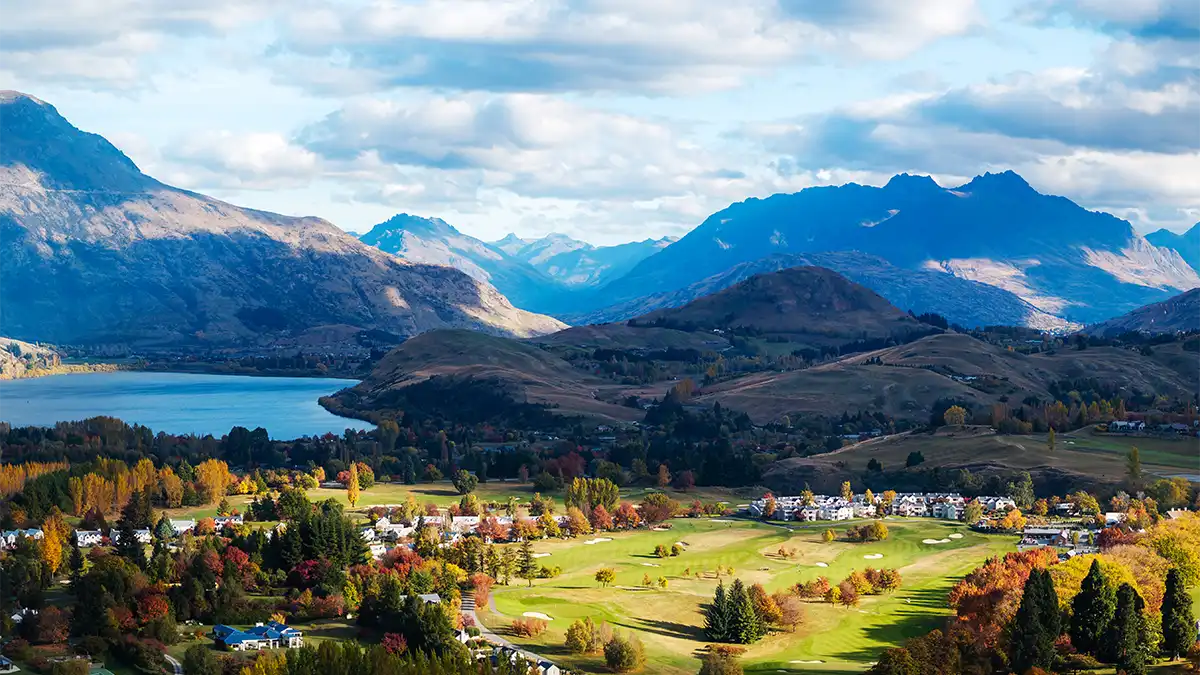
Golf reigns in Queenstown, but there’s a whole lot more to what many regard as one of the best destinations on the planet.
The enthusiasm in Greg Turner’s voice is infectious. The 63-year-old tour player-turned-course architect is walking the site of the under-construction Hogan Gully course outside Queenstown on a Wednesday morning in late February. Turner has called Queenstown home since 1993 and he’s been involved with several previous design projects on the South Island, but something about this one has him a little giddier.
And rightly so. Penned in conjunction with design genius Gil Hanse, Hogan Gully will add another layer to the golf scene in Queenstown and Arrowtown when it opens in 2028. Add OCM’s current redesign of the golf course at The Hills, Turner’s now well-established augmentation of Millbrook Resort to bring it to 36 holes, plus his new nine-holer at Gibbston Valley, and you have high activity in a destination known for setting a fast pace. Throw in the ever-popular Jack’s Point, Arrowtown and Queenstown courses, and the region has expanded from a tidy long-weekend golf destination into a place where a week is fast becoming the bare minimum.
Does the region need more golf courses? Incoming golfer traffic suggests the demand is here, especially the yearn for variety. “I think golfers behave a bit differently to other sports, don’t they?” Turner muses. “Skiers will probably come and ski one mountain for a week, but golfers want to play a different golf course every day. So you need the critical mass to really become a destination. I think we’ve got that here now.”
 Hogan Gully is set to open in the summer of 2027-2028.
Hence the eagerness for Hogan Gully. For those familiar with the region, it sits a stone’s throw from The Hills and Arrowtown courses, east of Queenstown. A golf course and adjoining resort had been in various stages of development for several years, with the initial resource consent application rejected by local council in 2019. Developer Sir John Davies appealed to the New Zealand Environment Court, and in 2021 received planning approval for the development. It began as a solo Turner design, but Hanse’s firm was announced as a co-designer in 2024.
Hanse described Hogan Gully as “one of the most unique and interesting inland sites for golf that we have ever seen”, adding, “We are looking forward to contributing to the team, and working with Greg on capitalising on all the natural potential in the site. I can’t wait to spend more time in New Zealand.”
The new course’s name is fitting, as the whole site sits within a gully while many fairways ride the natural ridgelines within the land with smaller gullies flanking their edges. The first few holes are grassed with final shaping taking place elsewhere, meaning the 2028 timeline for opening should hold firm. Despite the proximity to the neighbouring courses, the views from Hogan Gully are subtly different. Yes, the region’s iconic mountains frame many holes, but the new location affords several different looks.
“It’s probably got the most dramatic landform of all the courses in the region,” Turner says. “Obviously Jack’s Point has got a lot of grandeur around the course, but with Hogan, there’s some really dramatic landforms within the course itself.
“I think one of the interesting things about the whole Queenstown area is that you can go just a kilometre down the road and, all of a sudden, the landform changes quite markedly. Millbrook is quite different even to The Hills, which is basically next door. And Jack’s Point is very different again. Then you get Kelvin Heights (Queenstown Golf Club) and Arrowtown, which are complete opposites. I think people will be quite surprised when they get to Hogan Gully that, given that at its closest point it’s probably only a few hundred metres away from The Hills, but it’s quite different again.”
The physical attributes of the Hogan Gully site provide Turner and Hanse a lot of opportunity.
“The landforms are so significant, but the site is quite large,” Turner says. “The valleys tend to run in one direction. If you were formulaic about your attitude – if you wanted to have all your par 5s running in different directions and you didn’t want to run back-to-back par 5s, or something like that – then it would be a bit more difficult. I think we’re both in agreement that you take what the land gives you, and it’s strong landscape to work in. I don’t think I’ll ever get a site quite like it again.”
 The new Gibbston Valley Golf Course.
Turner’s other recent design of note in the area is the boutique Gibbston Valley Golf Course, a nine-holer carved from within the valley of the same name and beside the Kawarau Gorge. Turner worked with the site’s natural features again by incorporating the site’s striking rocky outcrops and gold-mining tailings into the layout in lieu of bunkers, giving golfers potentially more penal hazards to think about. One some holes, the outcrops form a picturesque backdrop, framed within the broader valley, while on other holes the rocks act as the border of the fairway. At the seventh hole, the 228-metre dogleg left is a death-or-glory par 4 where even a cautious layup is impacted by the proximity of the rocks.
Gibbston Valley is a smart addition for visitors who don’t want golf to be the focal point of their day. With five par 4s, four par 3s and no hole longer than 305 metres, it’s a great place for a quick nine – especially at times of day when the larger courses can’t host nine-hole players.
“Our goal is to create a golf course that accommodates the new needs of the modern golfer,” says Gibbston Valley Golf Course director Jesus Santos. “People can play nine, have lunch with a glass of wine and then be back with their families for the rest of the day.”
Indeed, you could easily let a few hours slide away across the road at the Gibbston Valley Winery, such is the calibre of the drops on offer. You can also eat and stay at the winery, where the quality of the food and accommodation is matched by the surrounding scenery. One must-do activity is a visit to the winery’s own cave, where you can enjoy a tasting deep inside the hillside, experiencing the cooler temperature alongside your chosen vino. The stylish accommodation is a little further away from the vibrancy of Queenstown, however its location is tranquil and handy to the other golf courses.

GRADUAL GROWTH
Hosting the New Zealand Open since 2014 has given Millbrook Resort a newfound following, but in truth it’s long had one – now it’s simply larger. Ever since the completion of the Turner and Scott Macpherson-designed Coronet course gave Millbrook a full 36 holes in 2021, it has generated attention that hosting the national championship has further ignited.
The NZ Open layout borrows holes from across the property in a composite layout to suit the tournament. The Coronet course is home to the better holes with more pronounced movement in the land and sharper features, but whichever combination of holes you tour, you’re sure to get a taste of the true Millbrook.
“The first course (the Sir Bob Charles-designed Remarkables layout) was the first of its type over here,” Turner says. “It was pretty ambitious at the time, but it is still relatively rudimentary by today’s standards. Now we’ve obviously added a bit to it and made some tweaks to try and modernise it a little. But I think having two courses that are a bit different in style and a bit different in look and feel is probably what you should be trying to do if you’re on a 36-hole complex.”
Around the corner, Arrowtown Golf Club is proud of its points of difference, which are so pronounced that it has become a must-play on any South Island itinerary. The clubhouse is quaint yet basic and you won’t be swayed by peripheral trappings, but that purity is why people love it. There are also no bunkers on the golf course, as instead the schist outcrops do the guard work. Arrowtown features holes on either side of Centennial Ave, while the nines were swapped a few years ago, meaning that the excursion now ends beside the clubhouse rather than across the road.
It is a step-back-in-time course, the kind that doesn’t require grandeur to capture the imagination. Instead, the layout lets golfers use their imaginations to navigate a path. It’s nicknamed “Narrowtown” for a reason, too, as accuracy is your best asset on the 5,400-metre layout. The quirk factor is high, yet the playing surfaces are exceptional for a course with only a handful of greens staff. The only change to the layout in recent times was Turner designing a new green complex for the first hole, which opened in January 2025 and adds 46 metres to its length.
The first time you encounter the golf course at Jack’s Point is, quite appropriately, like your first time aboard one of Queenstown’s iconic jetboats. Things start off sedately before quickly accelerating to a pace that you think can’t be maintained. Wrong. That heart-in-throat pace is precisely the speed at which the sleek watercraft is designed to travel. At “Jack’s”, as it’s known to all, the rapid thrust takes place at the fifth hole, where the stunning views of Lake Wakatipu create a backdrop to the green of the pulsating par 5 then accompany you for the next few holes. At the downhill seventh, the lake looks like it’s right behind the green of the short par 3 and is impossible to ignore.
John Darby’s design at Jack’s Point is a majestic weaving of a modern layout on an ancient tapestry. With the lake on one side and the Remarkables framing the eastern side of the course, you are forgiven for being distracted before hitting any shot. Lifting your head is understandable at Jack’s because to play with any other posture would be to miss the best bits. However, it’s the ground features that often rule. You tee off across a rock wall on the 15th hole, hoping to avoid the barrier and the many sheep it protects before ascending to the pulpit-like green. At the next tee, one of the jagged ridges in the mountain range will serve as your aiming point as you watch your drive hang against that scene for what feels like an eternity before the ball strikes terra firma again. Earlier, it’s rocky bluffs, a wetland or a crop of native tussocks you’re trying to avoid, as the layout maintains its frenetic pace in varying ways.
To call Queenstown Golf Club hidden in plain sight would not be inaccurate. The golf course occupies one of the most visible sites in town yet to drive there is a looping, 15-kilometre excursion. The layout sits at the tip of the Kelvin Heights peninsula that protrudes so prominently into Lake Wakatipu with holes that flow down to the shoreline and back up across what is deceptively undulating land. While the area’s other courses are closer to Arrowtown or well east of the CBD, the club has a curious juxtaposition of being central yet distant.
Whether you drive out and back or manage the quick boat trip across, the layout is worth the journey. And if it’s been a while since you played Queenstown, you might be pleasantly surprised upon your return. In recent years the club has removed selected trees, which improved the condition of the turf thanks to the additional sunlight – always important at lower latitudes – and amplified the lake and mountain views.
“A strong focus on the greens has paid off with air injection and scarification programs reducing thatch to below 10 percent, eliminating moss and controlling poa,” says general manager Andrew Bell. “The greens are now firm, yet receptive, with true roll and speeds between 10.5 and 11 feet. They have drawn the greatest compliments.”
Drawing compliments is what the whole region does best. With an ever-burgeoning golf scene, the praise is
only going to become more lavish.

GOOD TO THE FINAL DROP
Kinross winery and cellar door is in the heart of Gibbston, just a few minutes’ drive from Gibbston Valley Golf Course. With a bistro serving a delicious seasonal menu between 11am and 4:30pm daily and 14 cottage studios (complete with kitchenettes and laundry facilities), Kinross makes for an easy multi-night stay when guests are basing themselves in Central Otago. The cellar door offers a wide range of wine-tasting experiences, with wines from five highly awarded Central Otago wineries Valli, Wild Irishman, High Garden, Hawkshead and Kinross.
Located 25 minutes from Queenstown Airport, 15 minutes from Arrowtown (Millbrook and Arrowtown Golf Club) and 25 minutes from Cromwell, Kinross is in a sweet spot for a mix of downtime in the cottages outside the hustle and bustle of Queenstown, wine tastings and dining.
Visit kinross.nz for more.
SIMPLY REMARKABLE
Remarkable Golf Tours specialises in tailor-made group golf experiences across New Zealand. Based in Queenstown, the company combines world-class courses with seamless itineraries, managing every detail – from accommodation and transport through to tee-times. To further enhance flexibility, Remarkable Golf Tours also offers high-quality, self-drive vehicle hire, giving guests the option to explore the region at their own pace in comfort and style. The focus is on delivering exceptional, stress-free golf holidays for Australian travellers seeking quality and convenience. With deep local knowledge, a commitment to personalised service and an exceptional reputation forged across almost 20 years of service, Remarkable Golf Tours creates memorable holidays that showcase the best of New Zealand – on and off the course.
Visit remarkablegolftours.co.nz for more.
TRY SOMETHING UNIQUE?
Hire an exotic rental from Luxury Car Rentals NZ for a tour of the famous roadways of the South Island. Feel the alpine air in your hair from the wheel of a DB11 Volante or McLaren 570s Spider, or waft about the wineries in a Range Rover or BMW X7 with friends.
The choice is yours at LCRNZ.co.nz.

THRILL RIDES
It almost ought to be law – you can’t visit Queenstown without experiencing at least one of its many white-knuckle attractions. During my visit, I used a sun-drenched Saturday to sample everything from local wines to clay-target shooting during a 12-hour window into just how diverse your itinerary can be.
While jetboating, bungee-jumping and heli-skiing are perhaps the most visible adventure pastimes in town, I chose activities that were just a notch below those when it comes to adrenaline inducement. Still, a 9am start at Oxbow Adventure Co. at Gibbston had my pulse racing pretty quickly thanks to the tempting trilogy of off-road driving in an all-terrain 4WD, jetboat sprints and clay-target shooting. Oxbow’s might be the Vardon, Braid and Taylor of adventure triumvirates.

My next stop was far more sedate – a private wine-tasting session at award-winning Amisfield winery. Sipping (and scoring) wines at 11am felt every bit as opulent as it sounds and whether your palette tends towards pinot, sauv blanc or something else, you’ll find a drop to match.
I’ve always enjoyed taking the gorge road that winds through the back of Queenstown and crosses the Shotover River. It’s also a sneaky-good time-saver when driving between town and where most of the golf courses are located. Heading in that direction also takes you past Canyon Brewing, a riverside restaurant and brewery that became my lunch stop – and could easily have consumed my entire afternoon.
From there I wandered around town, including walking a full lap of Queenstown Gardens (replete with a disc golf course!) and rode the Skyline gondola to soak in the best view in the region. Drinks and dinner at the magnificent Soda restaurant completed the best non-golf day you could possibly wish for.
Queenstown might not be for the faint of heart, but it is also as fast or slow-paced as you choose to make it. And that breadth of choice is its appeal. Take it from Greg Turner, who has seen the full evolution of the town since moving there in 1993.

“We didn’t really have a supermarket back in day and I think we’ve got about four of them now,” Turner recalls. “You literally flew into Queenstown and your baggage came off on an open cart and you just lined up out the front and they brought it out with a little tractor. Now we’re over 50 flights a day, and I think 12 or 14 to Australia. So it’s a very different place.
“The things that once kept people away don’t anymore. It used to be, one, the climate’s changed a little bit, but also connectivity is a whole lot better and the houses are a lot warmer. People used to have to live at a port, didn’t they? That’s where all the cities evolve, but you’re seeing more and more inland locations now. And this has become a real all-year destination. It used to be a ski town, really. And then obviously a lake in the summer for around the summer holidays, but it’s now a 12-months-a-year destination. And along with the facilities that support that have come the facilities that support people to live and work from here.
“Some years ago I said, ‘Every city starts as a village.’ And I think we’re more like a small city now than a
town, really.” – Steve Keipert