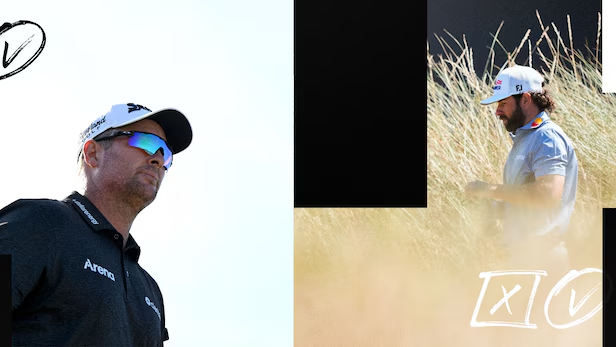
The data will point to several tangible factors that made Ryan Fox and Cam Young the top two finishers at Royal Birkdale. One is harder to quantify, however: how well the contenders breathed.
This might seem like a joke, since technically, any player who didn’t breathe successfully over 72 holes would no longer be alive. Yet increasingly, players point to breathwork as an important tool in regulating their nervous systems under pressure. Plus, they say it gives them something to focus on beyond the stakes of a potential life-changing victory.
“I was just trying as much as I could just to deal with the thoughts that come along,” said Young, who finished a stroke behind Fox. “Just keep walking, keep breathing. Not that I was super nervous, but I just needed something to latch onto.”
Although Fox acknowledged one of the reasons he tends to play fast is to limit the intrusion of negative thoughts, he said there are occasions when he senses he’s playing too fast. This is when he returns to focusing on his breath, which he did during a tense back nine Sunday.
“The other thing we worked on was, especially over the putter, just take some deep breaths,” Fox said. “I do tend to get a little quick at times, and just taking a second longer, especially over a putt, just get myself ready, get myself relaxed. I did that a lot down the stretch. I’m pretty sure you could probably see it on camera as well. There was a lot of deep breaths walking down some fairways just trying to compose myself. It obviously worked pretty well.”
More than just an anchoring tactic or distraction, experts have discussed the benefits of intentional breathing as a way of managing competitive anxiety. And it isn’t just about “taking a deep breath,” as is commonly advised, because exhaling might be even more important. Popular techniques include box breathing, a pattern of inhaling, holding, exhaling, and holding for specific counts, or what is known as cyclic sighing, in which you double-inhale through the nose and then allow an extended exhale. According to research from David Spiegel, the Director of Stanford University’s Center on Stress and Health, cyclic sighing is effective in activating the parasympathetic nervous system, which lowers the threat response we feel under pressure.
“I just think it’s everything,” said Sean Foley, who also wrote about the benefits of effective breathing in a story for Golf Digest. “It’s coherence. Once you can get the lungs and the heart moving in the same direction. It just gives us the ability to tap into what we’re able to do when we feel like that. It’s nothing we need to do. The processes are already inside us.”