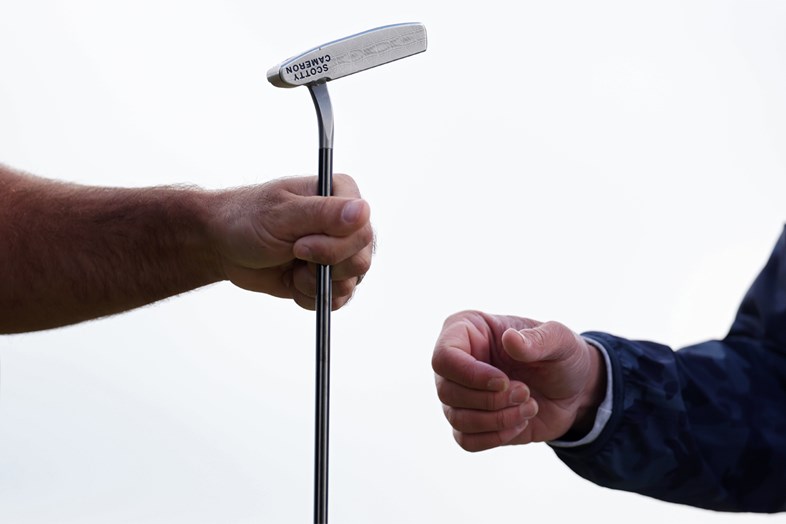
For years, golfers accepted the trade-off. If you wanted stability and forgiveness, you chose a mallet. If you wanted feel and feedback, you played a blade. But after testing 110 putters for 2026, we’re not convinced that compromise still exists.
Blade putters have spent the last decade losing ground.
Once the dominant shape in professional and amateur golf, they have steadily been overtaken by larger, more forgiving mallets. More recently, the rise of zero-torque putters has given golfers yet another alternative promising greater stability and consistency on the greens.
Yet despite all those advances, blade putters always retained one trump card.
Feel.
Ask golfers why they still use a blade and you’ll hear the same answers time and time again. They feel better. They sound purer. They provide more feedback. They tell you exactly where you’ve struck the ball on the face.
In short, they offer a connection to the golf ball that larger putters simply can’t match.
Or at least that was always the theory.
Because when we analysed the results from our biggest-ever putters test, the numbers told a very different story.
 How we tested
Seven golfers tested 110 putters over three days at Stoke Park using Titleist Pro V1 golf balls.
Each putter received scores out of 10 for:
Looks
Alignment
Stability
Roll
Feel & sound
To investigate the long-standing belief that blades provide superior feedback, we compared the average feel scores for every putter type in the test.
 Which type of putter feels best?
The results were surprising.
Not only did blades fail to top the rankings, they actually finished last out of the three putter types.
Zero-torque putters produced the highest average feedback score in the test, while mallets also outperformed traditional blade designs.
Putter TypeFeedback ScoreZero-torque6.68Mallet6.50Blade6.37
The margins aren’t enormous, but they are significant because they run completely counter to one of golf’s most widely accepted equipment beliefs.
For years, golfers have accepted a compromise.
If you wanted forgiveness, stability and alignment help, you played a mallet.
If you wanted feel, you played a blade.
Our data suggests that blade putters’ only remaining trump card may no longer exist.
The best-feeling putters in the test
The individual rankings tell an even more interesting story.
RankPutterTypeFeedback Score1TaylorMade Spider TourMallet9.02Scotty Cameron Studio Style Fastback OCZero-torque8.4T-3L.A.B. Golf OZ.1Zero-torque8.3T-3TaylorMade Spider Tour XMallet8.3T-5L.A.B. Golf OZ.1 HSZero-torque8.1T-5L.A.B. Golf Mezz.1 MaxZero-torque8.1T-5Bettinardi BB6.0Mallet8.1T-5Mizuno OsakaBlade8.19L.A.B. Golf OZ.1iZero-torque8.010Scotty Cameron Phantom 7.5Mallet8.0
The highest-rated putter for feel wasn’t a traditional blade. It wasn’t even a compact mallet.
It was the TaylorMade Spider Tour, which received an exceptional feedback score of 9.0.
Meanwhile, five of the top 10 positions were occupied by zero-torque models, a category often criticised by traditionalists for being overly engineered and leaving the golfer disconnected from any tangible feedback.
Perhaps most surprising of all, only one blade putter appeared among the top 10 ranking for sound and feel.
 Why are blade putters losing their feel advantage?
Part of the answer lies in how putters are made.
Modern mallets and zero-torque putters are no longer the hollow, clicky designs many golfers remember from a decade ago.
Manufacturers now spend enormous amounts of time tuning sound, vibration, and face technology to create a more refined impact experience.
The best modern mallet putters don’t simply roll the ball well – they feel good doing it.
At the same time, golfers have gradually become more accustomed to larger head shapes. What once felt unusual now feels normal.
As a result, the gap between traditional blade feel and modern mallet feel appears to be shrinking rapidly.
 Time to bury your blade?
None of this means blade putters feel bad – far from it.
The Mizuno Osaka was one of the best-feeling putters in the entire test, while models such as the Ping PLD Anser and Scotty Cameron Studio Style Newport also scored strongly.
Nor does it mean every golfer should immediately switch to a mallet or zero-torque design.
Putting remains deeply personal, and confidence will always play a huge role in performance. If you feel better with a blade, stick with it.
But the results do raise an uncomfortable question for blade loyalists.
If modern mallets are more forgiving, more stable, and easier to align – as our test has shown them to be – and they can now match or even surpass blades for feel, what exactly is keeping you in a blade?
 Are blades on borrowed time?
For years, blade putters survived because they offered something many golfers believed no other design could replicate.
Feel.
But after testing 110 putters, that argument looks weaker than ever.
The highest average feedback scores came from zero-torque putters.
The best-feeling putter in the entire test was a mallet.
And only one blade managed to crack the top 10 for feel.
Golfers will always love traditional blade putters. Their clean shapes, compact profiles, and rich heritage ensure that.
But if feel was the last major reason for choosing one, the evidence suggests it may no longer be quite the advantage it once was.