
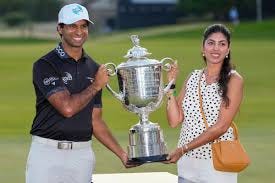
 Aaron Rai, the PGA trophy, and wife Gaurika
The next Ryder Cup doesn’t happen for 16 more months. It isn’t too early for Team USA to ask for a continuance.
The mighty Europeans are picking up worthy new candidates on a weekly basis, like Pied Pipers handing out Costco hot dogs. Last week in Charlotte, it was Kris Reitan of Norway, outlasting the field. The week before it was Great Britain’s Alex Fitzpatrick, joining his brother Matthew to win the team event in New Orleans.
Sunday at the PGA, Aaron Rai, as in wry, of Wolverhampton, England broke free of the huddled masses on the leaderboard and displayed his finishing kick. He shot five-under-par 65 and won his first major championship by three strokes.
Along the way Rai looked like an absolute nightmare in Ryder Cup foursomes matches, because he plays straight and narrow golf, and his unblinking demeanor will serve him well in singles, too. The toughest part about that competition might be the act of making the team. Remember when it was just the U.S. vs. Britain, and then we let them have the rest of Europe to even it up? Maybe they’ll give us Australia and Japan in 2027, if we haven’t invaded them yet.
Rai wasn’t considering the Ryder Cup, or the wide-open window to the rest of his golfing life, his world ranking or even his method of celebration, although he said it was likely he’d be hitting a nearby Chipotle. He wasn’t looking past the one foot he was putting in front of the other. He birdied the 11th to take the lead from Matti Schmid of Germany, then drilled a five-iron to the edge of the 550-yard par-4 15th and made par there. Rai then birdied the par-5 16th and, already up by two, he sent a 68-foot putt scurrying through hill and vale and into the cup on 17. Before he knew it, he was beside the 18th green, kissing his wife, Gaurika Bishnoi, a member of the Ladies European Tour. He has caddied for her and vice versa, and he admits he doesn’t beat her very often.
Rai began the fourth round in a four-man queue, two strokes behind Alex Smalley. The leader opened the door with an early bogey, but the best and the brightest were reluctant to enter, as if a water bucket was perched above. Scottie Scheffler led the field in driving accuracy and was No 5 in greens in regulation, but had another miserable putting day. Rory McIlroy kept hitting his drives to all fields. Ludvig Aberg was Rai’s playing partner and couldn’t figure out the greens, either, a common shortcoming. Only Jon Rahm, among the headliners, took up the challenge, finishing tied for second with Smalley.
Rai, 31, improved his score every day. Of the 82 who made the cut, he was 74th in driving distance. He was also first in approach shots, fourth in percentage of fairways hit, fifth in putting and ninth in greens in regulation. Those who wanted to wade into the numbers could find Rai sitting there, a very live underdog. For the PGA Tour season he is fourth in driving accuracy and eighth in greens in regulation, and, critically, second in approach-shot accuracy from 120 to 150 yards.
All of that made him a snug fit for Aronimink Country Club, and yet no one saw it that way before the bell rang, because the pros had already misjudged their position. McIlroy and others were lamenting the removal of trees. He said that it took away from the strategy off the tee because not everyone could just bomb it anywhere and be fine. What he learned later was that the rough was where golf balls could hide from the authorities, and where birdies went to die. The tournament was decided on the short grass, which is Rai’s home away from home. The most significant stat was Rai’s 6-under-par performance on the eight par-5s for the week. McIlroy, the top rocket launcher in golf’s wide world, was even par.
Rai also didn’t mind the craggy greens, courtesy of legendary architect Donald Ross, who once said he didn’t intend for Aronimink to be his masterpiece but became convinced it actually was. Rai’s only other PGA Tour victory was in Greensboro, at Ross-designed Sedgefield.
But Rai was not an outrageous long shot. He is ranked 44th in the world and has four Euro Tour wins. Twice he has beaten Tommy Fleetwood in playoffs, in the Scottish Open and in Abu Dhabi, and he snipped M. Fitzpatrick to win in Hong Kong. One of his prized wins was the Kenyan Open, on the European challenge tour in 2017. His mother Dalvir was a Kenyan immigrant, and she was on hand that day, which was Mother’s Day.
Amrik, Rai’s father, came from India and was a community worker, but spent most days helping Aaron play golf. The story goes that Aaron got hit with a hockey stick when he was very young, so the parents brought plastic golf balls because they would do less damage. When Aaron practiced in the rain and mud, Amrik meticulously cleaned his irons, applied baby oil and put them in iron covers, and Aaron uses similar covers to this day.
“It’s the message and the meaning,” Rai has said. “I have access to all kinds of equipment now, but I don’t want to lose sight of what’s important.”
You’re wondering why he wears two gloves? Pretty much the same thing. He started doing that as a kid, misplaced one of the gloves one day, was miserable without it, and has never gone back. Ridicule from social media might have convinced Rai to leave all that behind. That’s why he’s not on Facebook, X, or anything else.
The parents wanted Aaron to get the feel of scoring, so they had him tee off in the fairway. He had to wait a few years before he even got to the ladies’ tees. “They thought the distance would come naturally, with growth,” he said. His teachers, Andrew Proudman and Piers Ward, approved. They are still his teachers. Rai was late to what the Europeans call “club golf” because of that approach, so he didn’t interact with a lot of golfing kids his age. Even today he’s the lone wolf on the practice range, the last man there before they turn off the lights.
Every so often there’s a workingman who gets to a major championship and shrugs off the bother. He knows what real pressure is like, the kind that arrives on late Friday afternoon, when a cut has to be made that will allow him a chance at weekend money, which in turn will determine whether he keeps his card. J.J. Spaun beat the odds, and everybody else, at the U.S. Open last year, and Aaron Rai now holds a bulbous silver trophy that will distinguish him for the rest of his life. And the Americans, like Xander Schaffele, who praised Rai’s work habits and his essential niceness will likely see him again, on an international scoreboard that’s becoming a blue wall.