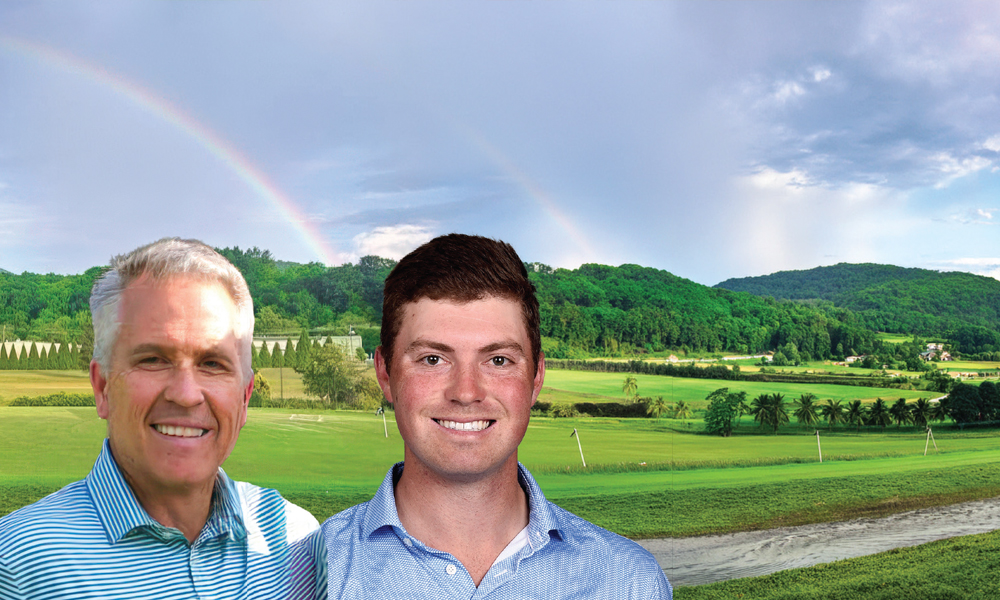
It a made-for-TV par-3 shootout in Austin last fall, PGA Tour star Ben Griffin got hot at exactly the right time.
The former UNC Chapel Hill golfer, who ranked 16th in the world in April, rolled to victory at the Tito’s Shorties Classic. He nearly beat the course record, stacking birdies and pulling away from fellow PGA Tour players Keith Mitchell and Jake Knapp and Charley Hull of the LPGA.
Then came a moment that mattered far beyond Texas: Griffin announced that his $250,000 first-place charity prize would be used to help rebuild the front nine at Asheville Municipal Golf Course, a historic public course that was devastated by Hurricane Helene in September 2024.
Moments later, Griffin texted Wyndham Championship Executive Director Mark Brazil, an Asheville native who has worked to rebuild the course. “Well, looks like I just got y’all a quarter of a million dollars,” Griffin wrote. “I guess I’m a Wyndham guy for life.”
The message changed the scale of one of western North Carolina’s more unusual recovery efforts — a public golf course rebuild that has become part FEMA project, part preservation effort and part fundraising campaign.
Brazil got involved after a conversation at the Masters last year with retired Raleigh banker and golf industry kingpin Jim Hyler. Brazil knew Helene had torn through his hometown, where his 91-year-old father still lives. Seeing the course sharpened the urgency. The Swannanoa River had surged over its banks and ripped through the front nine, which sits in the floodplain. Greens, fairways, bunkers, tees, irrigation, cart paths and a restroom building were heavily damaged or washed away.
Sadly, the storm’s timing came less than a month after the completion of a $2.9 million restoration overseen by Greensboro golf course architect Kris Spence.
“It had just been redone. It was perfect,” Brazil says.
The back nine, on higher ground, reopened about a month after the storm and remains in play. The front nine has been used for a disc golf course while restoration planning continues.
FEMA RULES
City officials say the goal is to restore the front nine largely to its pre-storm condition, while making it more resilient. Asheville City Council approved a design contract last summer with Biohabitats of North Carolina, working with Ron Forse of Forse Golf Design and Boone-based Cutlip Golf Design.
The matter underscored a major misunderstanding of how FEMA works, says Chris Corl, the city’s director of community and regional entertainment facilities.
“People always are saying, ‘How much is FEMA going to pay?’” he says. “It’s not actually about how much they’re going to pay. It’s about what scope they agreed to replace.”
That distinction matters. FEMA generally covers one-for-one replacement, not enhancements or modernization. If a municipality wants to build back in a more resilient way, outside dollars may be needed.
“Scope matters more than the funding,” Corl adds.
That is where Brazil and his network stepped in. Asheville Muni needed support to survive a possible two- to three-year stretch before the work could be finished. Brazil estimated the gap at roughly $300,000 to $350,000 and decided to use the Wyndham Championship as a fundraising vehicle. FEMA has committed $7.7 million for the project, with Asheville officials seeking additional funding later this year.
At a sponsor event during tournament week in Greensboro, Brazil told the Asheville Muni story. Wyndham Hotels & Resorts CEO Geoff Ballotti immediately pledged $10,000. Others followed, including Griffin and fellow PGA Tour player Andrew Novak. By late summer, about $130,000 had been raised through tournament-related giving and other outreach.
Then Griffin’s win in Austin quickly surpassed those early efforts. The money flows through the Brazil-led Piedmont Triad Charitable Foundation and supports Friends of Asheville Muni, a nonprofit tied to the course’s recovery.
“Without Mark, I don’t know where we would be,” Corl says. “We’d be struggling a lot more than we are.”
PROUD HISTORY
The course has great historical importance. Opened in 1927, Asheville Muni was the first public golf course in North Carolina and later, the first integrated public golf course in the South. It hosts the historic Skyview Tournament, one of the region’s longest-running Black golf events. Both the course and clubhouse are listed on the National Register of Historic Places.
“It’s still golf for the common man,” Corl says.
For Brazil, Asheville Muni’s importance ranks with Gillespie in Greensboro and Winston Lake in Winston-Salem as public courses that introduced generations to golf. It’s one of many N.C. courses designed by famous architect Donald Ross.
“You can certainly make an argument, with all the great golf courses in western North Carolina, that that has been the most important one as far as introducing people to the game,” he says.
The city is about 30% through design work, Corl says, with hopes of finishing design this year, then bidding construction in January or February. A reopening is projected for a year after construction starts, pending approvals and cooperative weather.
His definition of success is straightforward.
“It’s an open 18-hole course that has a front nine that looks very, very similar to Donald Ross’s original design intent and is resilient to future flooding events,” Corl says.
In the meantime, Griffin’s shot-making in Austin and Brazil’s organizing have helped ensure Asheville Muni has something nearly as important as design plans and federal paperwork: time.
For a public golf course that has meant so much to so many, time may be what keeps it alive. ■

-Brad King is a Winston-Salem-based writer