Did you notice anything weird about the presentation ceremony at the World Cup final last month? Not the tragicomic sight of Gianni Infantino hustling Donald Trump offstage as Rodri and his Spanish team-mates lifted the trophy, as if Ol’ Burger Bite Face was a kind of incontinent grandpa who had wandered into a debs photo. That was weird, yes. But just the regular Trump kind of weird.
Wind the tape back a bit though, back as far as the presentation for Young Player of the Tournament to Pau Cubarsi, the 19-year-old Barcelona centre-back. The award has been on the go since the 2006 World Cup but there was something different about this go around. The camera panned to the right of the presentation party and there, in all his salt-and-pepper glory, stood Yasir Al-Rumayyan, ready to hand Cubarsi his bauble.
Al-Rumayyan is, of course, the top man at Aramco, sponsors of the Fifa Young Player award. More to the point, he is the dude in charge of the Saudis’ Public Investment Fund (PIF) and a key board member for the 2034 World Cup in Saudi Arabia. Getting himself on to the podium for the most-watched presentation ceremony on earth was more than just a publicity stunt for an oil company. It was an expression of Saudi power and dominance. He was there because he could be there.
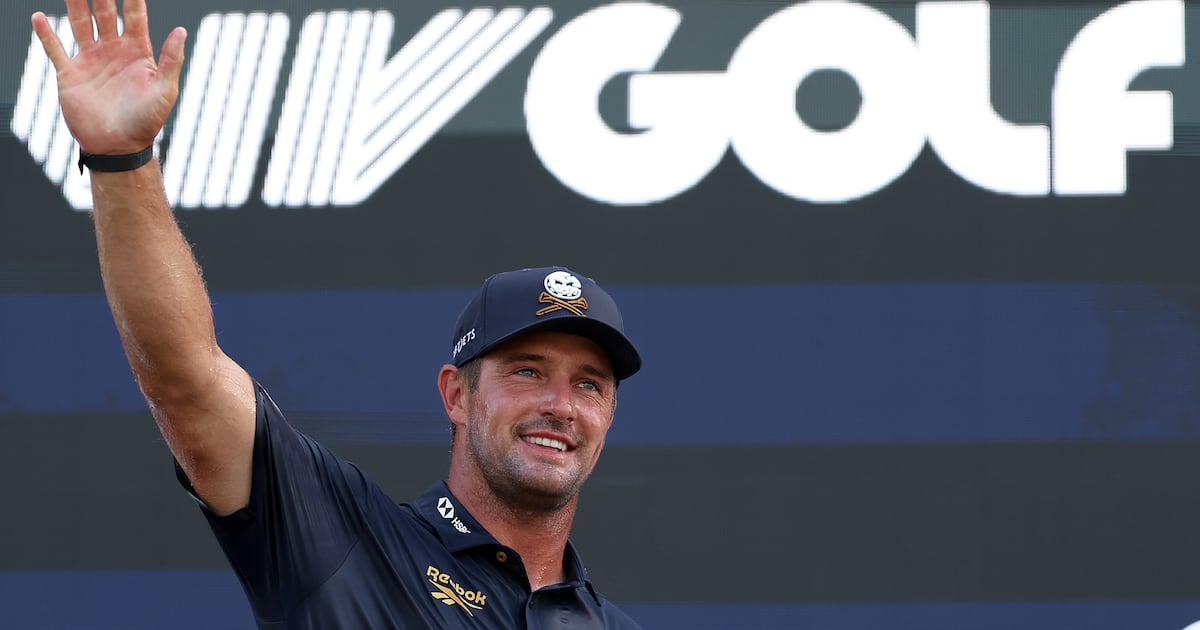
He could have been somewhere else, of course. Specifically, he could have been at Birkdale watching the Open Championship, which had reached its climax a few hours earlier. In his guise as chairman of LIV golf, al-Rumayyan had frequently made it his business to be on-site at the Open but not this time. Though the Saudis are still (just about) writing the cheques, al-Rumayyan stepped away from his involvement in April.
When the full grim story of LIV Golf is finally written, maybe nothing will symbolise the speed at which it went down the drain than him sacking off the Open to be at the World Cup. Two LIV golfers went into the final round in contention, Bryson DeChambeau and Lucas Herbert both in with a shout. And yet the man who had done more than anyone to enrich them as LIV golfers was in New Jersey for a photo-op.
By all accounts, this weekend is where the curtain falls. LIV Golf is currently playing out its final individual event of the 2026 season in Indiana and has been forced to hastily turn it into the final team event too. Every other LIV season has finished with a team event spectacular, $50m on the line, everybody getting that gravy. But with the Saudis cutting off the money gusher, LIV have had to scrap this year’s team version which was due to be played next week in Michigan.
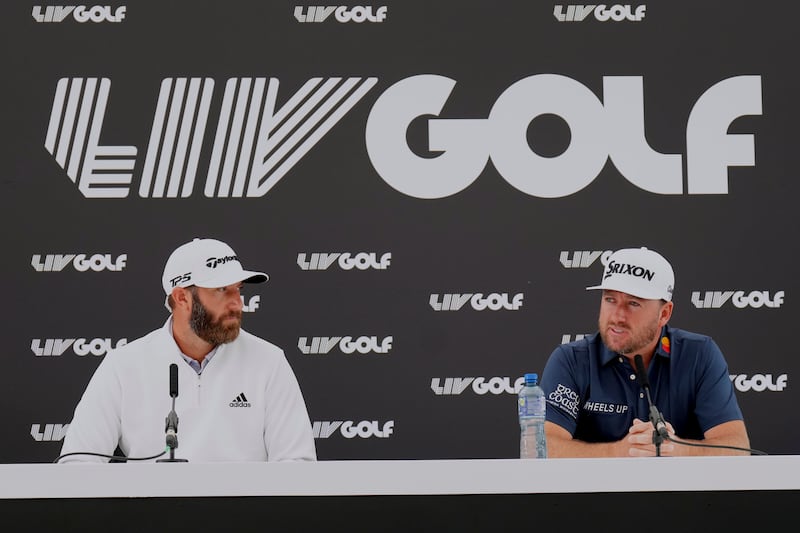 Dustin Johnson and Graeme McDowell attend the press conference prior to the first LIV Golf event in London. Photograph: Aitor Alcalde/LIV Golf/Getty
Time flies. It is just four years and two months since the first LIV event on the outskirts of London. In that time, by general estimations, the PIF has burned through $6bn. When people throw around numbers like that, it can be hard to get your brain around what they mean. So maybe it’s best to think of it this way – if you were able to stack six billion $1 bills on top of each other, the pile would reach 400 miles into the sky.
That’s what the Saudis have spent on LIV. By any measure, they’ve had a miserable return on their investment. For comparison, they bought 5 per cent of Uber in 2016 for $3.5bn, an investment that is worth around $5.3bn now. If they thought LIV was going to be an industry disrupter in Uber’s vein, they wildly overestimated the potential for a minority sport like golf to deliver for them.
Instead, all they’ve done is make a few dozen middling golfers rich and a handful of exceptional golfers very rich. They’ve tapped into an international audience, particularly in Australia and South Africa, but have found no great enthusiasm, whether on the ground or via TV ratings elsewhere. Mostly, their main legacy has been to strengthen the PGA Tour, which is where they were heading with their money in the first place.
And now it’s over. LIV may well limp on into next year with another backer but after this weekend, the Saudis are essentially gone. They’re getting out of a lot of sport, by the way. They were going to bid for the Rugby World Cup in 2035 and the Asian Games in 2029, they were looking at making the Saudi Snooker Masters a thing. Now they’re not. They’ve sold off 70 per cent of Al-Hilal, the soccer team with which they accommodated Neymar and Benzema and various other old lags sniffing a last-saloon pay-day.
Between one thing and another, the PIF has spent somewhere in the region of $60bn over the past decade on sport. But those days are gone. Their sports investments over the rest of the decade and beyond will focus mostly on the 2034 World Cup, with some boxing, Formula One and eSports thrown in.
As for LIV, it will go down as a risible chapter in pro golf history. It was wild to see a sport get put through the spin cycle, reduced to being a petrostate’s plaything for a few years until it got bored and moved on. The only possible good to come out of it will be if LIV somehow serves as a cautionary tale for other sports somewhere down the line.
We’ll not be holding our breath on that one.