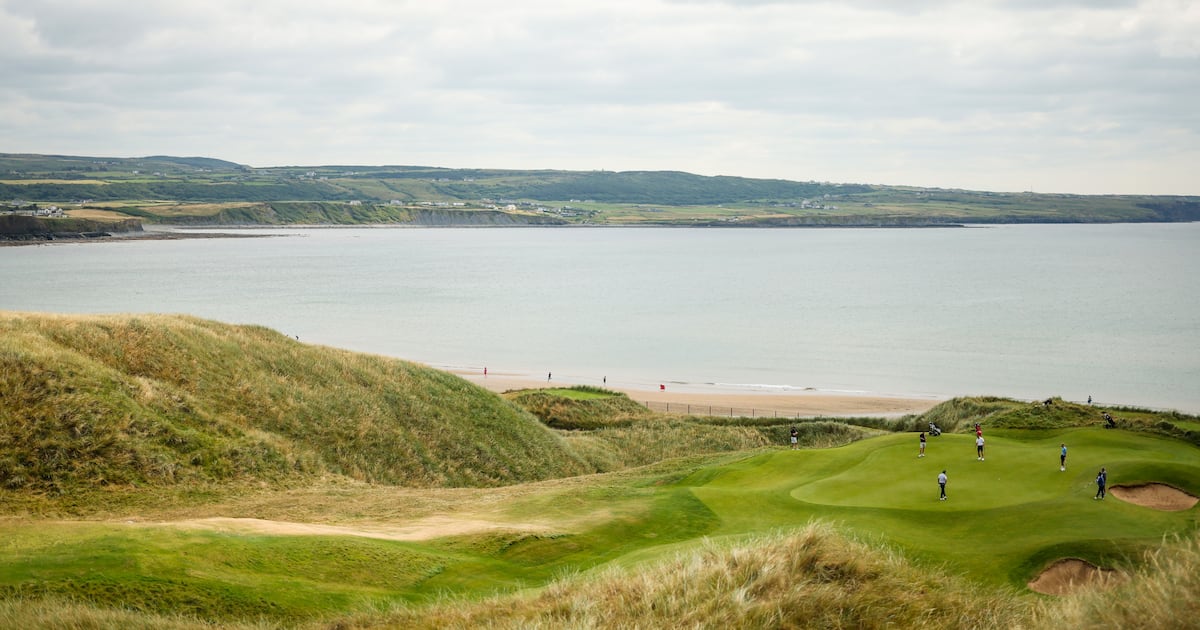
Walker Cup venues don’t miss. After the almost fictional beauty of Cypress Point on the Monterey Peninsula in California last time and the home of golf St Andrews the time before that, the best amateur golfers from the US, Britain and Ireland will soon compete at Lahinch Golf Club, a course described as Ireland’s St Andrews.
“I liken it to everyone’s favourite auntie. Nobody has a bad word to say about Lahinch,” says Paul McGinley, who hosted the Irish Open at the Old Course in 2019.
Indeed, it is hard to find anyone in west Clare with a bad word to say about Lahinch Golf Club, one of the top links courses in Ireland, where the course is intertwined with the community. That special relationship is akin to St Andrews. Physically it looms over the village and many people’s livelihoods relate to its success.
“There are very few clubs like this who are so adjacent to the people who live in the village, when you think about it. Clubs like Waterville, Tralee, Ballybunion, they are all a drive out of the village, so it is a unique model,” Lahinch’s lady captain Miriam O’Keeffe says.
To play at the famous Old Course at Lahinch, however, you will have to pay a pretty penny for the privilege. In 2023, it was €275 to play at Lahinch, with a gradual rise to €450 for this year. Next year, it will rise once more to €500, without a Golf Ireland-discounted rate. Playing the Old Course requires at least one caddie in the group, where a senior caddie costs €100 for a bag, or €160 for a double bag.
Accounts from 2025 showed Lahinch recorded an operating €2.5 million surplus on green fees, which increased by 26 per cent on the previous year to €4.2 million. Income from green fees makes up 65 per cent of the club’s revenue, while €1.6 million was made from the club’s shop. Tee times at that €500 price are already all booked up from September 10th to September 25th next year, with the Ryder Cup not too far away in Adare Manor.
“That’s pretty standard for all of the top clubs tend to be in or around the same,” says club captain John Gleeson, with Lahinch’s €500 green fee for next year the same as Ballybunion, Waterville and Tralee and still less than Portmarnock (€530), Royal Portrush (€554) and Royal County Down (€577).
 Dylan Keating tees off on the fourth hole during the South of Ireland Men’s Amateur Open at Lahinch Golf Club in July. Photograph: Nick Elliott/Inpho
“Without the green fee income, this model wouldn’t work. Green fees would be a considerable revenue source. It’s always been the case, even going back to the 1950s, Lahinch has always relied on green fees. It’s very significant now.”
Gleeson says “very, very few” Irish people pay the standard green fee, instead taking advantage of the €50 guest fee to play with a member, and the full price is aimed at the US market. Annual membership at the course costs a very reasonable €950, where you also play on the Castle Course.
But with 2,500 members, new members are limited mostly to family members of existing members, making it “nigh on impossible” for outsiders to join.
Hosting the Walker Cup is estimated to cost Lahinch between €500,000 and €600,000 in green fee revenue, but Gleeson says it is “money very well spent” on an event that will be broadcast across the world on Sky Sports and NBC in the US with wall-to-wall coverage.
The money earned in recent years has at least been put to good use with the completion of a lavish new €6.1 million clubhouse worthy of its status at the top of the game. “It is something that will serve members and visitors for a significant period of time,” says Gleeson.
Lahinch was established in the 19th century, with Old Tom Morris, a four-time Open Championship winner, invited over to advise on the layout. Morris called it the “finest natural links I have ever laid eyes on” and two of the most famous holes at Lahinch, the par-five Klondyke (fourth hole) and the par-three Dell (fifth hole) remain from his day, with blind shots a prominent feature.
How to play the famous 5th and 6th holes at Lahinch. Video: David Gorman
After some work from Charles ‘Mo’ Gibson, Alister MacKenzie made his mark at Lahinch before constructing masterpieces like Augusta National and Cypress Point. The Englishman had a special love for the Co Clare links, though, saying it would “become the finest and most popular golf course that I, or anyone else, has constructed”. Many of the sloping greens are credited to MacKenzie, with Martin Hawtree aiming to restore the essence the renowned architect created with his restoration in 1999.
The club’s logo features a goat, in tribute to the presence of the animals that freely roam across the course, which only adds to its natural feel. The Atlantic Ocean is most beautifully seen from the sixth hole, a par-four aptly named Paradise.
“I play a lot of courses, and a couple in Ireland that have five to six unbelievable holes. But I’d say Lahinch has 18 really good golf holes. That’s what makes it special,” says Patrick Adler, the 2024 South of Ireland champion who played on the PGA Tour’s John Deere Classic this year.
 The Lahinch Golf Club logo pays tribute to the goats that still roam on the course. Photograph: Nick Elliott/Inpho
Unlike the burnt out fairways and rough that were typical this summer across Ireland, Lahinch was kept in immaculate condition for the South of Ireland Championship, Ireland’s oldest and one of its most important provincial amateur championships, in big part down to the work of head greenkeeper Brian McDonagh.
Despite hosting the Irish Open in 2019, which Gleeson described as a party atmosphere with “everyone out enjoying themselves until two in the morning, with streets mobbed by people”, Lahinch considers the Walker Cup to be the biggest event the course has ever hosted, despite smaller numbers attending.
The Irish Open had more than 20,000 people a day, sold out, whereas the Walker Cup is limited to 7,000 per day, as the R&A focuses more on the quality of the course rather than infrastructural concerns.
“The R&A want people to walk the fairways,” says Gleeson. “There will be ropes and teams of people with every match to give players some space. But it’s unique to the Walker Cup that you can get very close to players hitting the shots.”
Gleeson says the DP World Tour would “love to come back” and have been in touch with Lahinch about hosting the Irish Open again, but it has been a busy time with the Palmer Cup in 2024 and now the Walker Cup.
While the prestige does not match the Ryder Cup, the closest professional equivalent, €45 per day tickets are fantastic value compared to €499 for Adare Manor next year, especially when it will be much easier to see the action for the average punter.
 Stuart Grehan plays a shot on the third hole at Lahinch during the South of Ireland Men’s Amateur Open. Photograph: Nick Elliott/Inpho
Those who attend will likely see future Major champions, as the likes of Tiger Woods, Scottie Scheffler and Phil Mickelson played in the event before turning professional.
On the Irish side, Rory McIlroy, Pádraig Harrington and Graeme McDowell are among those to have represented the Britain and Ireland team. This year spectators can see future stars like world number one Preston Stout and 17-year-old phenom Miles Russell, while home fans can cheer on Irishman Stuart Grehan, who won the Amateur Championship earlier this year, the only Irish player in a 10-strong team, although David Howard and Thomas Higgins are reserves.
With Robert Rock shooting a course record 60 in 2019 in benign conditions and champion Jon Rahm firing a final-round 62, Lahinch will require wind to blow to test the world’s best amateurs, but with a focus on match play, the 18-hole scores are less important.
“It’s an unbelievable match play golf course,” Britain and Ireland Walker Cup captain Dean Robertson says. “You got to plot your way around. We will be doing our homework and preparation.”