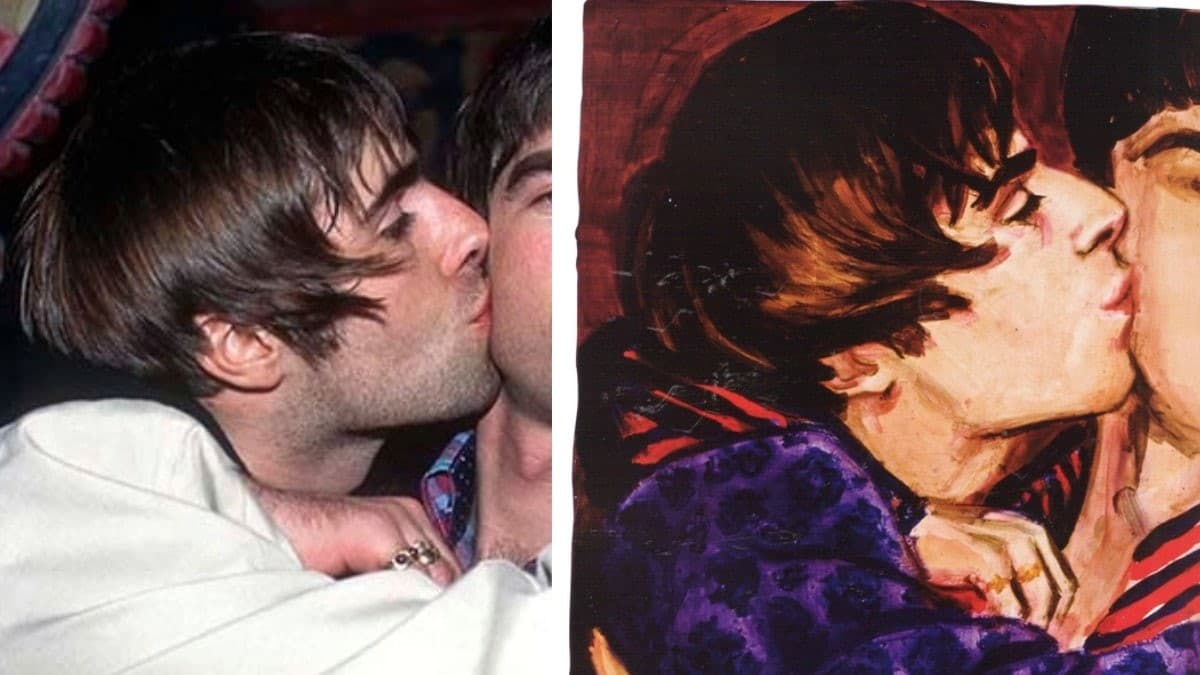
A music photographer says artist Elizabeth Peyton turned his photo of Oasis brothers Liam and Noel Gallagher kissing into a painting, which sold at Sotheby’s for $1.92 million.
Liam and Noel Gallagher of Oasis have spent three decades fighting with each other. Now a photograph of them kissing has started one too.
Music photographer Justin Thomas took the photo at an Earls Court afterparty in 1995, at the height of Oasis’s Britpop reign and just after (What’s the Story) Morning Glory? turned the band into a global phenomenon. Earlier that year, Noel had reportedly hit Liam over the head with a cricket bat during the album’s recording sessions, so the kiss wasn’t exactly a representative sample of Gallagher family life.
That contrast—two famously combative rock stars caught in a moment of seemingly genuine tenderness—is a big part of what makes the image so memorable. Thomas later ran a black-and-white version on the cover of his photo book, How Does It Feel? – Oasis 1995/2002.
What Thomas says he didn’t know was that, back in 1996, the American painter Elizabeth Peyton had made an oil painting of the very same kiss.

The photograph on the cover of Justin Thomas’s book How Does It Feel? (L) and Elizabeth Peyton’s Earl’s Court (Liam + Noel), 1996 (R)
Peyton is a prominent contemporary artist who has long worked from photographs and other found images. Her Earl’s Court (Liam + Noel) depicts the brothers from the same angle and in the same pose as Thomas’s photo, right down to the ring on Liam’s hand near Noel’s collar. Her source has never exactly been a state secret. An Irish Examiner preview of the painting’s May 2026 auction described Peyton as “appropriating a photograph,” while art advisor Todd Levin—who says he placed the painting with a collector back in 1998, for $12,000—recently posted the two images side by side on Instagram and wrote that the painting “reproduces a photograph” of the Gallaghers.
Here are the original color photograph and Peyton’s painting side by side:

Justin Thomas’s 1995 original color photograph of Liam and Noel Gallagher (L) and Elizabeth Peyton’s Earl’s Court (Liam + Noel), 1996 (R)
Thomas, who now lives in Spain, says he’d never heard of Peyton or her painting until earlier this year, when Sotheby’s came calling.
In April, the auction house was preparing to sell Earl’s Court (Liam + Noel) in its May contemporary evening sale in New York, where the painting carried an estimate of $1.5 million to $2 million. About a month before the sale, a Sotheby’s rep asked to license Thomas’s photograph as a “comparative illustration” for an essay in its online catalog. Thomas agreed to $2,000 for a year of digital use plus two weeks on a print lot card. Then, after about a week, the photo suddenly disappeared. Sotheby’s told him it had pulled the image “at the request of the artist’s representative,” and, since it hadn’t gotten the full use it expected, asked whether he’d take less money. Thomas agreed to $1,500.
Then he saw the painting. He concluded that Peyton’s representative wanted his photo out of the catalog to “hide the origins” of what he calls “just a slavish copy” of his original photo. (Sotheby’s isn’t always so cagey about sources: at a June 2025 sale it openly credited photographer Stefan De Batselier for a different Peyton painting of the Gallaghers; apparently no one sued over that one.)
The sale went forward without Thomas’s photograph. The painting brought in $1.92 million with fees.
Last week, Thomas filed a copyright infringement lawsuit in the Southern District of New York against Peyton, Sotheby’s, and David Zwirner Gallery, which represents Peyton and displays the painting on its website. He says Peyton copied virtually every significant element of his photograph: the composition, the brothers’ poses and expressions, the tilt of each head, the hair, the hands, the lighting, even the placement of Liam’s ring near Noel’s collar—and changed only the cropping, the colors, and the medium.
The complaint calls the painting an unauthorized derivative work, and adds claims against Zwirner and Sotheby’s for reproducing, displaying and distributing it.
Thomas isn’t the first rock photographer to take issue with Peyton’s source material. In 2014, Sex Pistols photographer Dennis Morris sued her over drawings based on his photos of Sid Vicious and John Lydon. These were loose, gestural charcoals that borrowed the pose and not much else. Peyton denied infringement and asserted a fair use defense, and the case soon settled out of court.

Dennis Morris’s photograph of Sid Vicious (L) and Elizabeth Peyton’s rendering of the same image (R), from Morris’s 2014 copyright infringement complaint.
Two years later, Morris threatened to sue Peyton again, this time over John Lydon, Destroyed, which was subsequently pulled from a planned Sotheby’s sale at the consignor’s request.

Dennis Morris’s 1977 photograph of John Lydon, from his book Destroy (L), and Elizabeth Peyton’s John Lydon, Destroyed (R). The painting was pulled from a 2016 Sotheby’s sale after Morris threatened to sue.
Copying Isn’t Infringement
At this point, it’s probably worth reminding everyone that copying and copyright infringement aren’t the same thing. Otherwise, this would be a really short article.
Copying still matters, of course. When a defendant denies using a plaintiff’s work, courts infer copying from access plus similarities too close to write off as coincidence. Here, that doesn’t seem particularly controversial. All the talk about Peyton “appropriating” or “reproducing” Thomas’s photograph goes a long way toward establishing that she actually copied it, and the side-by-side makes independent creation a tough sell.
But the Copyright Act doesn’t prohibit all copying, only the unlawful appropriation of protected expression. Thomas has no exclusive right to Liam and Noel Gallagher’s faces, their kiss, or the moment itself. What he owns is his particular expression of that moment: the framing, the angle, the lighting, the timing and other creative choices that went into capturing it. The question is how much of that Peyton actually took, and the answer is messier than the side-by-side suggests.
The gap between copying and unlawful copying can produce some counterintuitive results. Just ask photographer Jeffrey Sedlik.
In Sedlik v. Von Drachenberg, nobody disputed that Kat Von D copied Sedlik’s photo of Miles Davis to make a tattoo. She traced the image, transferred a stencil to her friend’s arm and inked it with the photo right beside her—a process her shop cheerfully described as producing a result “100% exactly the same.” A Los Angeles jury still took about two hours to decide the tattoo wasn’t substantially similar to the photograph.

Kat Von D at work on the Miles Davis tattoo, via Instagram
There’s a caveat. Sedlik was tried under the Ninth Circuit’s much-maligned “total concept and feel” test, which asks jurors to make a subjective comparison without dissecting the works into protected and unprotected elements. The Ninth Circuit is now reconsidering that test en banc, with oral argument scheduled for September 29.
Thomas sued in New York, where the Second Circuit takes a somewhat different approach. Its “more discerning ordinary observer” test focuses the comparison on protectable expression while still considering the work as a whole.
It’s a different test, but the underlying problem is the same. Peyton will say the obvious similarities flow from things copyright doesn’t protect, and Thomas will insist that she took far more than that. Some might say his side-by-side looks damning. Sedlik’s looked worse, and he still lost.

Jeff Sedlik’s photo of Miles Davis (L) and Kat Von D’s tattoo of it (R)
The Warhol Problem
Even if Thomas establishes unlawful appropriation, Peyton still has a fair use defense. And if “famous artist turns a photographer’s portrait of a famous musician into a far more valuable work of art” sounds familiar, it should.
In Andy Warhol Foundation v. Goldsmith, Lynn Goldsmith photographed Prince; Andy Warhol used her photograph to create his Prince Series. But the Supreme Court didn’t decide whether Warhol infringed by creating those works. It looked at one later use: the Warhol Foundation’s licensing of Orange Prince to Condé Nast for a magazine tribute. Because Goldsmith licensed Prince photos to magazines too, the Court found the two uses served the same commercial purpose, and rejected the idea that Warhol’s added expression, by itself, was enough to make the Foundation’s use transformative.

Lynn Goldsmith’s 1981 photograph of Prince (L) and Condé Nast’s 2016 tribute magazine featuring Warhol’s Orange Prince
But the Court also stressed that other uses might come out differently. Displaying Warhol’s work in a museum or reproducing it in a book on twentieth-century art “might well point to fair use.” Each challenged use, the Court emphasized, “must be assessed on its own terms.”
That gives both sides something to work with here. Turning a photograph into an oil painting doesn’t automatically give the painting a new purpose. But creating or displaying a painting as a work of fine art presents a different fair use question from licensing an image as a commercial substitute for a photograph.
Which is where that $1.92 million auction price helps Thomas less than it might seem. Peyton painted Earl’s Court thirty years ago, and the Sotheby’s transaction was a resale of the physical painting on behalf of its current owner, not a license of Peyton’s image. Owning the painting is separate from owning the copyright embodied in it, a distinction the art world has occasionally blurred. Sotheby’s separate reproductions of the painting in connection with the auction, and Zwirner’s display of it on its website, present different uses. After Warhol, each of those uses has to be judged on its own terms.
The thirty-year gap raises obvious statute-of-limitations questions too, although Thomas says he only discovered Peyton’s painting this year. I’ll save that rabbit hole for another day.
One last coincidence is too good to skip. Thomas v. Peyton was assigned to Judge John Koeltl, the same judge who ruled in 2019 that Warhol’s Prince Series was transformative and handed the Warhol Foundation summary judgment on fair use. The Second Circuit reversed, and the case went on to produce the Supreme Court decision that will now frame Peyton’s defense. Thirty years after Peyton painted the Gallaghers, Judge Koeltl gets another famous artist, another photographer, and another portrait of a famous musician. It’s not quite a reunion tour, but this is copyright law. We’ll take what we can get.
As always, let me know what you think in the comments below or @copyrightlately on social media. In the meantime, you can read Thomas’s complaint here.