Skin cancer doesn’t discriminate when it comes to golfers.
Five years ago, I had a small brown spot appear on my face that I didn’t notice, but my daughter Lauren did. It looked like nothing, but I was due for my annual dermatology exam anyway, so I went to my local doctor, Jason McBean of Fairfield, Connecticut, who did a routine inspection of my whole body. He paused on my left cheek. “Need to do a biopsy of this,” he said in his normal monotone. A few days later, I got a call with the bad news: it was melanoma, the most serious and aggressive form of skin cancer.
Golfers in their 60s who have spent years in the sun like I did should not be surprised by a diagnosis of basal or squamous cell carcinoma. It usually can be dealt with by an outpatient procedure removing the tumour in thin layers and immediately examining the results under a microscope. It’s typically found on the exposed areas of the body like your head, ears, shoulders and legs. You endure a little pain but walk out of the office cured.
About 230,000 Americans are diagnosed annually with melanoma, split almost evenly between non-invasive and invasive (penetrating the deeper layers of the skin). In Australia, that number is more than 17,000. If it’s superficial, you have 99 percent chance of survival; if it spreads to the lymph nodes, it’s about 76 percent; if it spreads to distant organs, the number drops to about 35 percent, according to the American Melanoma Foundation. In a lifetime of being lucky, mine was caught early and turned out to be Stage 0 or in situ, meaning remaining in the top layer.
In the way only golf connects us with the medical profession, I occasionally play with Dr Phil Ozuah, who is known among friends as “Nitro” for his explosive power off the tee. He is also the president and CEO of Montefiore Medicine, one of the great health institutions in the New York area. He arranged three quick surgeries in a little over a month – the first removing a portion of my cheek that was about the size of a 50-cent piece. Further testing resulted in a second procedure that removed about a dollar. For a short period of gauze wrapping, I resembled Humphrey Bogart in “Dark Passage”. This was followed by plastic surgery to reconstruct my face, which sounds worse than it was, only my skin had to be dragged up from my neck, and I’m now left with a handsome little scar. Six-month check-ups have followed, and so far there has been no recurrence.
My advice is to follow the ABCDE of skin cancer detection: The warning signs of melanoma are moles that are Asymmetric with uneven Borders, multiple Colours, larger than a pencil eraser in Diameter, and Evolving in size or shape.
Golfers are susceptible to skin cancer. Fred Couples, Greg Norman, Davis Love III, Tom Kite, Gary Player, Stewart Cink and Adam Scott have all reported scares. In the early 1990s, when Retief Goosen was still in his 20s, he found a lump near his collarbone that was diagnosed as melanoma spread to his lymph nodes. His physicians told him it could have been fatal without the successful surgery he had before winning two US Opens.
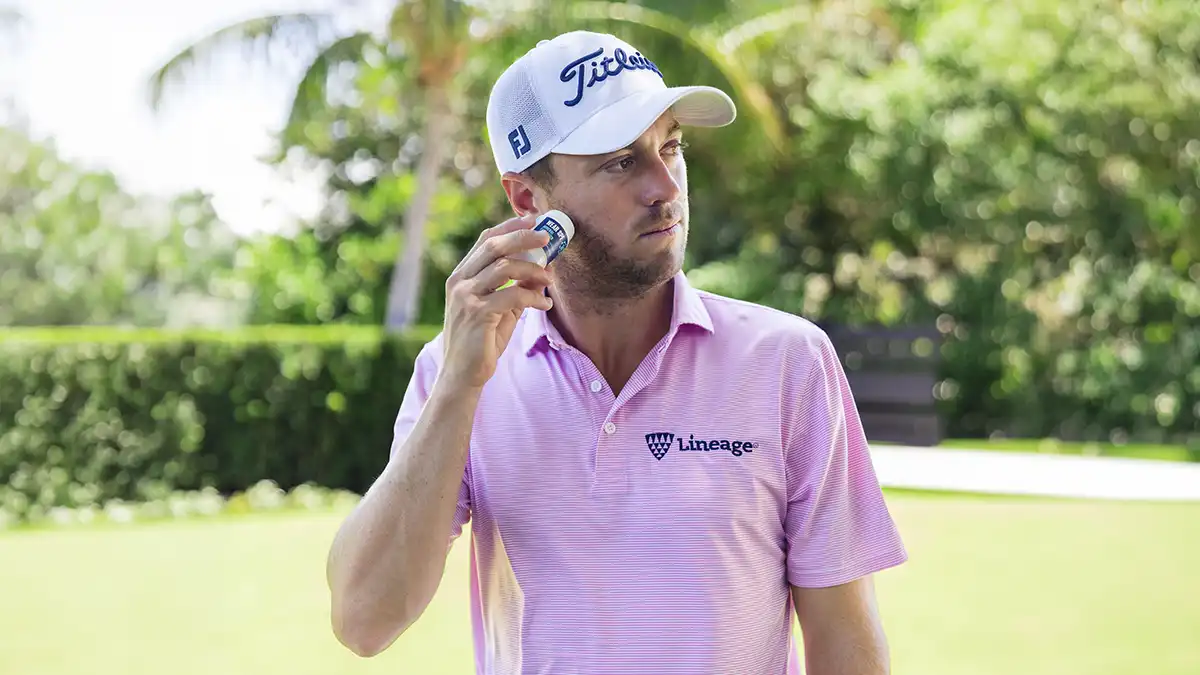
Justin Thomas, on his yearly check-up in 2019, discovered that the mole on the back of his left calf required a biopsy. He still remembers getting a call from his doctor at 9pm telling him it was melanoma, “an eye-opening thing to hear for a 26-year-old, a scary moment in my life,” says Thomas, now 33 and healthy. “I didn’t think it happened to people my age. My doctor shaved off the mole, leaving a three or four-inch scar the shape of a football on my leg, and no further treatment was required. The more I read, the more I realised how extremely lucky I was.” Thomas signed an endorsement deal with WearSPF and became a spokesman for awareness. He advocates using 50 SPF sunscreen lotion, paying close attention to any changing moles, and getting annual check-ups with a dermatologist.
Skin cancer doesn’t care about your age or handicap. You need to take this lesson seriously.