
There are many relatively new terms in the Rules of Golf that regular players are still getting used to saying. Matches, for example, are no longer “all square” when neither side is up. It’s now called “tied.” Another one that might trip you up, especially if you’ve been playing for a long time, is that there is now no such thing as an “outside agency.” It’s now “outside influence”, and it covers things that might move your golf ball like animals or someone who tries to pocket it.
What outside influence doesn’t cover is another term new to the book in 2019: “natural forces.” The formal definition is, “the effects of nature such as wind, water or when something happens for no apparent reason because of the effects of gravity.” This is the term that comes into play in the scenario in this headline.
Let’s break it down: First, understand that if it’s not known or virtually certain (95 percent sure) what caused your ball to move, and you know it moved, then natural forces are considered the only possibility. For example, you’re playing a par 3 and your shot stops on a slope behind the green. As you arrive at the ball, you find it has rolled down the slope and is now on the putting surface. Congrats! Natural forces moved the ball, and you should play it from its new position.
Unfortunately, luck runs both ways. If you hit a shot on a bank and then it rolls down into a penalty area, you now have to proceed under penalty-area rules (Rule 17). It doesn’t matter if the movement occured one second or one minute after the ball had stopped. Unless you saw a squirrel knock it into the water, you have to proceed from its new position. Tough break there.
More Rules Reviews from Golf Digest  Rules Review Rules of Golf Review: He rotated his golf ball without marking it. He says it’s OK because he didn’t lift it. True?
 Rules Review 5 rules most golfers get wrong
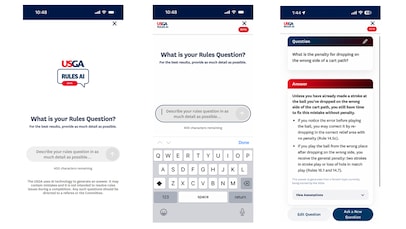 Technology Got a rules question? The USGA is harnessing AI technology to get you fast, accurate answers
However, there is an important exception to Rule 9.3. In 2023, the Rules of Golf clarified it to say that if your ball comes to rest, and then it’s dropped, placed or replaced for whatever reason within the rules, you wouldn’t have to play from its new position.
It might work out like this: You just took relief from standing on a sprinkler head on the bank to hit your chip shot onto the green. You dropped your ball legally on the bank but then a gust of wind rolled it back into a pond or another penalty area. Instead of playing from the new position (and having to take another drop for relief, but this time adding a stroke), you must replace your ball on the original spot.
Another exception to Rule 9.3 is what happens when you mark, lift and replace your ball on the putting green—and then it moves. In this instance, you should replace the ball on the spot where you originally marked it. By putting down the mark, your ball now “owns” that spot. If it happened before you mark, you play from its new position. And that is true regardless of what caused the ball to move, not just natural forces.
MORE GOLF DIGEST RULES REVIEWS
What do I do if my ball just hit another ball on the green?
What happens if my three-minute search for a lost ball gets interrupted?
I hit myself with my own ball. Is that a penalty anymore?
My ball ‘might’ be in a pond, but I can’t find it. Can I drop, add a penalty stroke and move on?
What exactly is an embedded ball?
Can you get relief from aeration holes?
Does a ball have to be unplayable to declare it unplayable?
I accidentally hit my ball with a practice stroke … does it count?
I’m on the green. My opponent is not. Who’s away?
My opponent dug his feet in a bunker, got another club and did it again. Is that legal?
I bent my putter and it actually works better. Can I still use it?
This article was originally published on golfdigest.com