Jenni McManus
Significant changes over the past 25 years in the way employment litigation is conducted have created long delays in the Employment Relations Authority and Employment Court and a massive blowout in costs to both employers and employees.
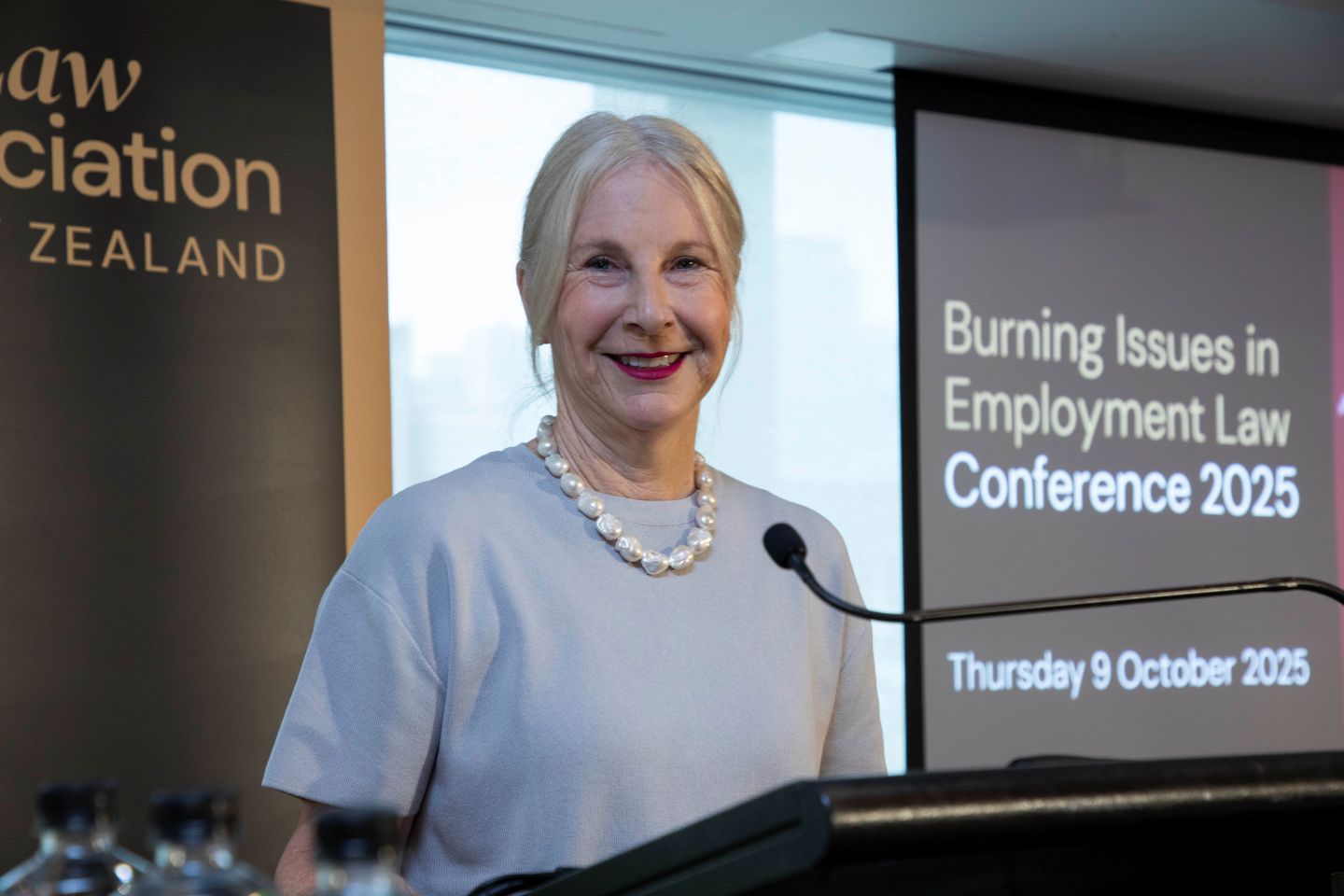
That was the key message from Christina Inglis, Chief Judge of the Employment Court, to attendee at The Law Association’s Burning Issues conference in Auckland today. But “we can learn a lot from that”, Chief Judge Inglis said, in a wide-ranging speech that compared the way employment law was practised at the turn of the century with the way the profession, the Employment Relations Authority and the Employment Court conduct business today. All three could use this information to help address the problems the jurisdiction is facing.
“Academics in the western world have routinely described employment law as being in a state of crisis,” Inglis said, “that the pressures being brought to bear are pummelling it with increased regularity and intensity and that it is being asked to respond to old issues presented in new ways.
“Fragmentation within the world of work ….has been identified as a key contributor….More particularly, globalisation, the fall of collectivism and the rise of individualism, increased worker precarity, flexibility of work, flows of information and misinformation, an evolving understanding of the way in which human rights intersect with and inform employment relationships – all underlie a very difficult time in our legal history.”
The birth of the Employment Relations Authority as an investigative body in 2000 and the expansion of the Employment Court’s jurisdiction to enable parties to run their entire claims afresh was meant to offer a quicker, less technical and more practical way of dealing with disputes, Inglis said.
This is not what has happened. But, she said, “difficult times in history, including legal history, provide an opportunity to recalibrate”.
Costs and delays
In New Zealand, nowhere is the “crisis” more evident than in the area of costs. Inglis said she had first noted the “demonstrable upswing” in costs (after allowing for inflation) when speaking at a Burning Issues conference in 2016.
Her most recent research reveals that over the past 25 years, average costs awards have increased by 100% and average remedial awards are up by 200%, although Inglis notes they are still markedly lower than some of the compensatory awards coming out of the Human Rights Review Tribunal in comparable cases.
And although scale costs were introduced 10 years ago to reduce the need for the court to get involved, the number of costs judgments has increased four-fold since 2000. At the same time, procedural issues have become more complex, costing time and money.
When it came to delay, the biggest contributor has been the “substantial” increase in interlocutory activity over the past 25 years. The question to be asked, Inglis said, was whether this generated any value and whether it was worth it.
It meant the wait time for a substantive judgment has increased by 80 days, although Inglis noted the wait for end-of-hearing judgments has remained well within the published target of 90% (currently 97%) within three months. Since 2000 there has been an 80% increase in procedural issues requiring (or at least prompting) a judgment and a similar decline in the number of substantive decisions (those addressing the issues at the heart of the case).
Other issues
A major contributor to delays in the Employment Court – along with increased cost – is the unrestricted right of parties to appeal.
“The files reflect that by far and away the most popular challenge is one conducted afresh,” Inglis said. “That has obvious implications for timing, it has obvious implications for strategic manoeuvring, and it has obvious implications for costs – for both employers and employees.”
Inglis also cited the “legalisation” of employment problems which she said was now embedded and occurred at a very early stage in a dispute, even though the statutory vision had been for disputes to be resolved between the parties at the lowest level possible, with escalating levels of legal assistance.
“[Legalisation] has actually been the reality pretty much since the year 2000 when the Authority started,” she said. “So something has got to change because it’s not working well for the people that the system is designed to serve. Most employers and employees don’t have hundreds and hundreds of thousands of dollars to spend on resolving an employment dispute.”
This legalisation also shows up in the number of lawyers – 25% of the profession – who now identify as employment lawyers. “There is money, evidently, to be made out of employment problems”, Inglis said. A high percentage of mediations and Authority investigations now involve lawyers and there has been an increased attention to legal point in determinations coming from the Authority – an investigatory body set up to focus on the merits of case rather than “legal niceties”.
There has also been what the chief judge describes as an “explosion” of independent employment investigations, with lawyers routinely helping employers with disciplinary and other processes. And the past 25 years had seen a rise in the unregulated employment advocate industry. The proportion of cases where an advocate appears remains relatively steady, she said, although the type of advocate “differs markedly” from those appearing in 2000, when the sector was dominated by union representatives.
Writing styles have also changed. Practitioners back in 2000 appeared to write more succinctly than their present-day counterparts. “The same can be said for the resulting judgments issued by the court,” Inglis said. While practitioners in 2000 were prepare to “hang their hats” on, say, three main causes of action, “you look at a statement claim now or a statement of problem and it’s page after page after page. Stick to the main point, because if you just throw everything in, it’s massively expensive and time-consuming to work your way through it.”
But the issues at the heart of employment litigation have not dramatically changed, or become significantly more complex, over the past 25 years.
“The files reflect that what might be called the hot topics have remained fairly constant: good faith bargaining; compensatory awards; redundancy processes; procedural fairness; (mis)use of information/disclosure,” Inglis said. “There has, however, been a discernible drop-off in actions pursued on behalf of employees by unions.
“Also of interest is the changing demographic of those who are now appearing before the court, in comparison to those who were appearing in 2000. The news does not bode well for the audience assembled here today. The number of litigants choosing to be represented by a lawyer is shrinking, replaced by a decided upswing in preference for self-representation.”
New approach to costs
Given the broad discretionary powers conferred on the Authority and the Employment Court when it comes to costs and the requirement for this power to be exercised consistently with equity and good conscience, Inglis asked whether it might be time for a more nuanced approach to costs. Should New Zealand follow Australia, the United Kingdom and Ireland, all of which have adopted a costs-lie-where-they-fall-absent-aggravating-conduct approach, particularly at first instance?
The chief judge also asked:
- Is a costs-follow-the-event regime appropriate in a court where a party has a de novo (first instance) right of challenge and the successful party in the Authority is required to wear the cost of a re-run?
- To what extent is a one-size-fits-all approach to costs appropriate, having regard to the resources of some of those who might want to access the employment institutions but do not have the financial capacity to do so?
- Have we allowed the approach to costs in conventional litigation, involving (generally) relatively well-resourced parties, to become the default position for the way in which we approach litigation involving, for example, a small or medium sized business?
- Do we need to pay attention to whether each of the steps we are requiring parties to take is actually a value-add for reaching the end goal? Could we draw on some of the ideas relating to proportionality reflected in upcoming changes to the High Court Rules?
- Why, in 2025, are 24% of the matters filed in the court applications for stay, applications for compliance orders, applications for freezing orders and applications for penalties for breach of settlement agreements?
- To what extent is the de novo right of challenge (as opposed to limited rights of appeal) meeting its intended purpose, having particular regard to the extent of legal front-loading that is the reality in 2025?
‘Perverse outcomes’
Inglis said she did not have all the answers to these questions. “Nor is it my place to answer the last, directed at whether it might be time to consider whether a return to restricted rights of appeal to the court might be worthy of consideration, particularly given the reality of what is occurring in our lower level dispute resolution processes.”
But Inglis said she was routinely told that employment litigation is simply unaffordable, both to pursue and to defend – for employees and employers alike.
“It may be said to have the tendency to encourage the pursuit of cynical claims, early settlements based on economic grounds (better just to pay and get out) rather than the merits and for genuine claims to never see the light of day. And I have a great deal of sympathy for the small-to-medium-sized employer groups and Community Law Centre representatives who tell me that the system is creating perverse outcomes, particularly in respect of settlements.”
The future
Among the fundamental legal principles employment law needs to grapple with is the concept of open justice and what this means in the light of technology advances where personal information can be spread to a very wide audience very quickly and with sometimes devastating – and unintended – consequences, the chief judge said.
The profession would also have to address the accessibility issue – “or the issue will be addressed for us”, she said.
“Access to the institutions will become so difficult, so costly, so off-putting that only a few will venture through the doors. The disputes of others will play out in different, potentially volatile, ways. Workplace problems will not, after all, miraculously go away. They will always go somewhere.”
Read Chief Judge Inglis’ speech here