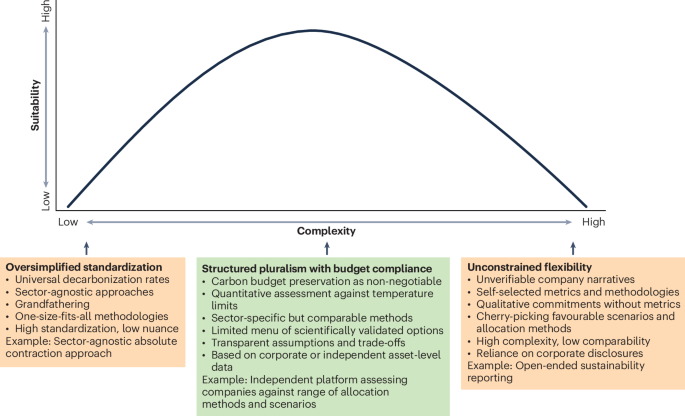
The diversity of corporate actors and decarbonization pathways necessitates methodological approaches that can accommodate differences while preventing companies from minimizing obligation. High complexity and methodological sophistication often trade off against standardization, comparability and transparency8,9. This tension demands a middle path that balances methodological rigour with practical applicability.
Current approaches represent two extremes on this spectrum. At one end, the sector-agnostic Absolute Contraction Approach applies a universal decarbonization rate to all companies regardless of sector or circumstances: extremely simple, highly standardized and comparable, but lacking nuance. At the other extreme lies the approach implied by reporting frameworks such as IFRS S2, where companies freely justify their Paris Agreement alignment through individualized narratives; this approach is highly flexible but resistant to meaningful comparison and vulnerable to cherry-picking.
In navigating these trade-offs, we propose three principles for effective Paris-aligned benchmarking.
Sector-specific differentiation with cross-sector comparability
Frameworks should acknowledge fundamental differences between industries while maintaining enough methodological consistency to enable meaningful comparison between sectors. The sectoral approach developed by Krabbe et al.10, introducing sector-specific emission intensity indicators, provides a starting point but requires further refinement to balance sectoral uniqueness with cross-sector accountability. Recent advances in sectoral pathways demonstrate the feasibility of differentiated but comparable approaches (for example, ref. 11).
Methodological flexibility constrained by carbon budget preservation
Companies should select from a limited scientifically validated set of methodological options, clearly disclose which they have chosen and justify why those choices are appropriate for their circumstances12. This requires scientists to make their benchmarking approaches available through accessible and educational platforms. Initiatives such as the Science-Based Targets initiative are inadequate as they do not currently offer climate performance assessment, nor are their targets transparent or is it clear how they ensure preserving carbon budgets. Carbon budgets should always be preserved in any methodology13, and frameworks should ensure regular reviews as the remaining carbon budget shrinks.
Trade-offs and assumptions clearly communicated by scientists
As there are a variety of climate pathways compatible with a specific temperature outcome, and different methods to allocate these pathways to companies, it is important that key trade-offs and assumptions of these decarbonization pathways and methods are communicated14,15. These include assumptions for underlying pathways, such as carbon dioxide removals required at different time intervals, and trade-offs between sectors across different scenarios.