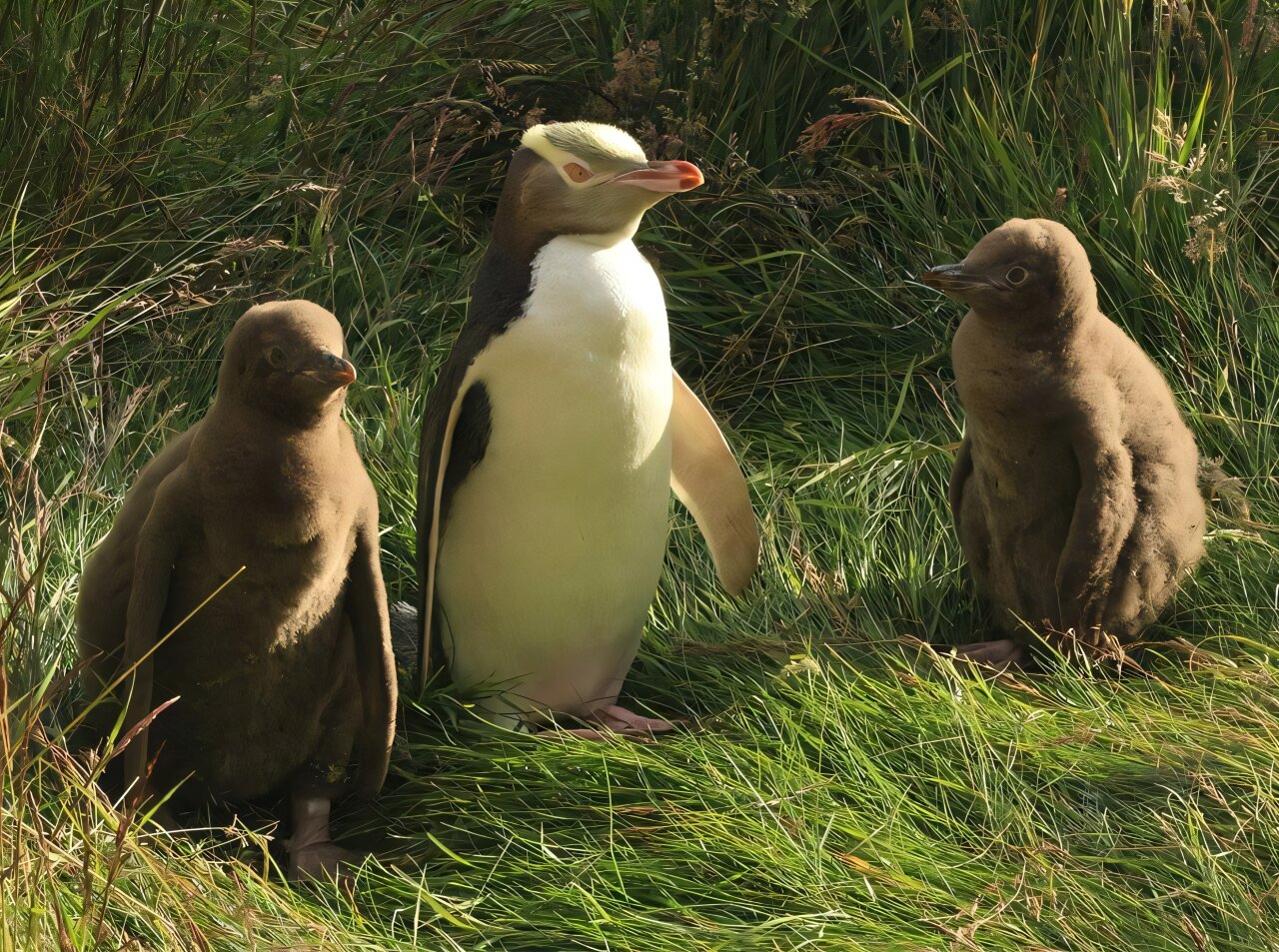
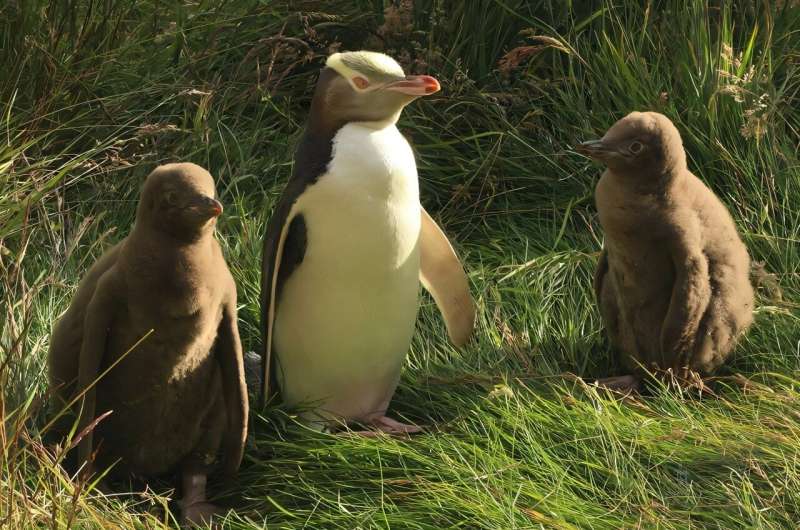
Researchers have revealed the endangered hoiho is actually made up of three distinct subspecies which diverged up to 16,000 years ago. Credit: Janelle Wierenga
Genomic research has found the endangered hoiho is made up of three distinct subspecies, a discovery that may help guard against a fatal disease.
The study is titled “Population genomics of yellow-eyed penguins uncovers subspecies divergence and candidate genes linked to respiratory distress syndrome.” It was led by scientists from the University of Otago—Ōtākou Whakaihu Waka, the Department of Conservation, and Ngāi Tahu, in preprint ahead of peer review on bioRxiv.
Senior author Professor Jemma Geoghegan, of Otago’s Department of Microbiology & Immunology, says the study redefines the species’ evolutionary history and has urgent implications for its conservation.
Using whole-genome sequencing of about 250 penguins from across the New Zealand mainland and the subantarctic Enderby and Campbell Islands, researchers discovered deep genetic divisions in each location, consistent with three subspecies.
Comparing these genomes with ancient DNA from two extinct species shows the three lineages diverged between 5,000 and 16,000 years ago.
“This is a turning point for hoiho conservation. Each group has a unique evolutionary legacy specifically adapted to its environment and without swift, targeted action, we could lose one forever,” Professor Geoghegan says.
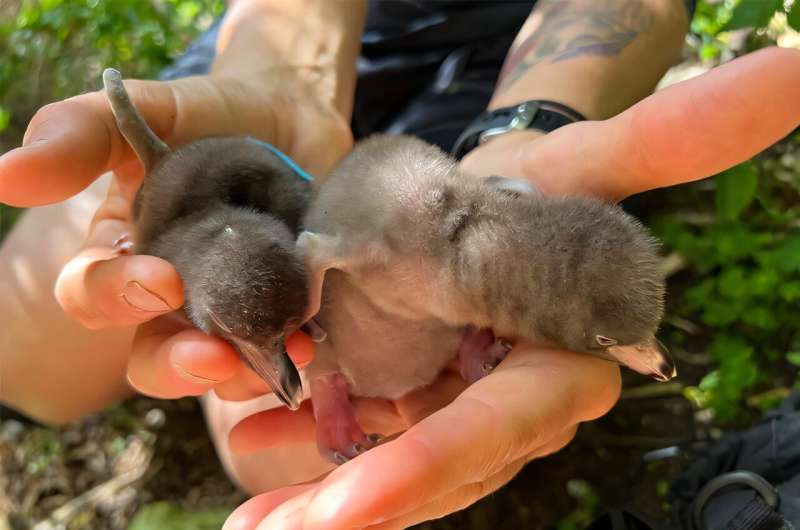
Mainland hoiho are facing a health crisis with many chicks succumbing to respiratory distress syndrome. The researchers hope their findings will provide insight into why the disease affects mainland chicks and not their subantarctic relatives, and hopefully halt further population decline. Credit: Janelle Wierenga
Putting it into action
The discovery comes as mainland hoiho face a crisis. There are fewer than 150 breeding pairs remaining and many chicks succumb to respiratory distress syndrome, a lethal condition linked to a gyrovirus, identified by Professor Geoghegan’s group in 2023.
By combining population genomics and genome-wide association studies, this latest research identified candidate genes involved in immune and respiratory function, offering insight into why the disease affects mainland chicks but not their subantarctic relatives.
Dr. Janelle Wierenga, Head of Wildlife at the Otago Peninsula Eco Restoration Alliance and Postdoctoral Fellow at Otago, says the results suggest genetic differences in immune or respiratory pathways may make the northern subspecies more susceptible to infection. “Understanding these differences is essential to halting further decline.”
Dr. Mel Young from the Department of Conservation says, in partnership with Ngāi Tahu, who hold kaitiakitanga (guardianship) over hoiho, the study’s findings will guide conservation policy and the development of subspecies-specific management strategies. “Recognizing three subspecies acknowledges the cultural and biological diversity within hoiho and ensures conservation efforts that are tailored for each population,” she says.
Dunedin Wildlife Hospital veterinarian Lisa Argilla says urgent protection of the mainland subspecies alongside increased monitoring of both subantarctic subspecies is needed to protect them. “For the northern population, extinction is not a distant possibility, it is an imminent threat. Without urgent, bold and collaborative action, we risk losing these precious birds forever,” she says.
Lead author Dr. Joseph Guhlin, a Postdoctoral Research Fellow at Otago, says the researchers are showing how species-wide genomics can directly improve conservation decisions. “We’ve built shared tools and knowledge that help us understand where these species came from, and how best to protect them. The same systems that helped one endangered bird are now safeguarding another.”
More information:
Joseph G Guhlin et al, Population genomics of yellow-eyed penguins uncovers subspecies divergence and candidate genes linked to respiratory distress syndrome, bioRxiv (2025). DOI: 10.1101/2025.10.20.683354
Provided by
University of Otago
Citation:
Genetic secrets of one of world’s rarest penguins revealed (2025, October 28)
retrieved 30 October 2025
from https://phys.org/news/2025-10-genetic-secrets-world-rarest-penguins.html
This document is subject to copyright. Apart from any fair dealing for the purpose of private study or research, no
part may be reproduced without the written permission. The content is provided for information purposes only.