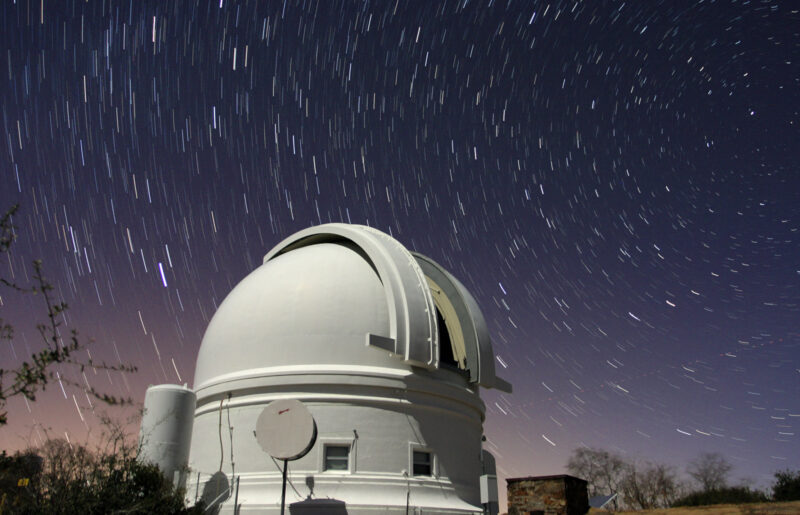
 The 48-inch (1.2 m) Samuel Oschin Telescope at Palomar Observatory. This telescope was used in the 1st Palomar Sky Survey (POSS-1), which recorded the mysterious transient flashes in the 1950s. Image via Palomar Observatory/ California Institute of Technology.
Science matters. Wonder matters. You matter.
Join our 2025 Donation Campaign today.
- Transient flashes of light – unusual short-lived light bursts – were 1st noticed in 2016 in photographic plates from the early 1950s Palomar Sky Survey. The mysterious lights sometimes appeared in straight lines or narrow bands. What were they?
- Data analysis suggests the lights originated near Earth, possibly in high orbits or even geosynchronous orbits. But the 1st satellite, Sputnik 1, wasn’t launched until 1957.
- An updated analysis in 2 new peer-reviewed papers has found many additional transients. The new study hints at a possible correlation between early nuclear tests and possible UAP sightings in the early 1950s.
Odd transient flashes of light in 1950s astronomical plates
Some 1950s photographic plates – collected during the famous Palomar Sky Survey in California – show short-lived flashes of light. Astronomers call them transient flashes. Beatriz Villarroel, a researcher at Nordita at Stockholm University in Sweden, has been leading the investigation into these odd anomalies. She and her colleagues in the VASCO Network just published two new peer-reviewed papers about them. VASCO stands for Vanishing & Appearing Sources during a Century of Observations. The scientists said on October 20, 2025, that their data suggest the flashes might be glints of sunlight off of objects in orbit around Earth. One problem: the flashes appeared before the first earthly satellite, Sputnik 1, launched in 1957.
EarthSky first reported on these flashes in 2021.
Now, in the two updated papers, the researchers report new apparent patterns in the data. They said 68% of the transients flashed on the day after nuclear tests on the ground. There’s also a possible correlation with UAP reports – that is, reports of what the U.S. military and government calls Unidentified Aerial Phenomena, and what the rest of us call UFOs – in the same time frame. There were many such reports in the late 1940s and early 1950s, including some over nuclear test sites and weapons facilities.
The researchers published their peer-reviewed results in Scientific Reports on October 20, 2025, and in Publications of the Astronomical Society of the Pacific. Both papers appeared on October 17, 2025. The new papers build on the previous results, which were published on December 12, 2019, in The Astronomical Journal.
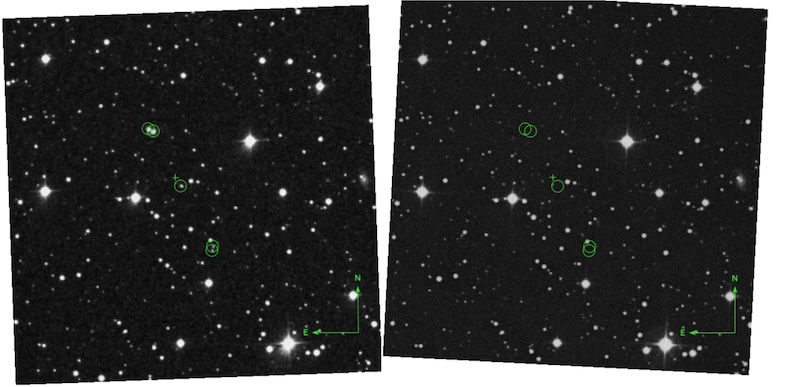 View larger. | Transient flashes – momentary light bursts, circled in green – seen in a digitized astronomical plate from the Palomar Sky Survey on July 27, 1952. Note that the transients disappear in the 2nd image. Image via Villarroel et al./ Publications of the Astronomical Society of the Pacific.
The 1st transients
Villarroel and her team from the VASCO Network found the first candidate transients in 2016. The researchers analyzed digitized astronomical plates from the Palomar Sky Survey of star fields from 1949 to 1957. Astronomical plates were an early form of photography that used glass plates to capture images of the night sky. The purpose was to look for any anomalies in the images, such as transient phenomena that flash or suddenly appear or disappear.
In particular, the researchers wanted to see if there were any such anomalies close to Earth. This has been proposed as an alternative to traditional SETI (Search for Extraterrestrial Intelligence). SETI’s focus has long been primarily on searching for alien radio signals from distant stars. In more recent years, however, SETI searches have begun to shift to looking for other technosignatures as well.
Now, there are currently 107,875 transients identified that occurred between November 19, 1949, and April 28, 1957. These are noted in the Scientific Reports paper.
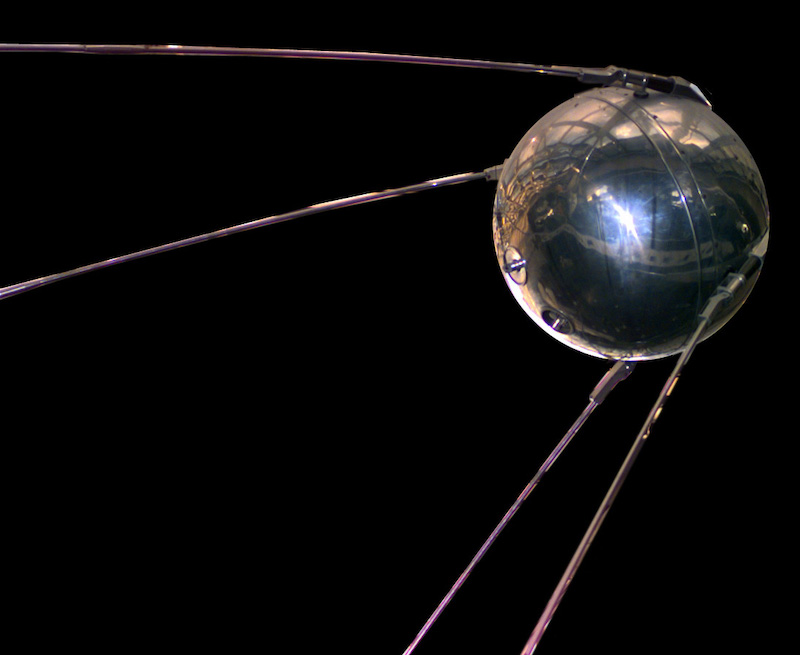 The closest analogy known so far for the transients on the photographic plates are satellites in geosynchronous orbit. But there’s a catch: the transients were seen in 1949 and the early 1950s, and the 1st satellite, Sputnik 1 (pictured here), wasn’t launched until October 4, 1957. Image via NSSDC/ NASA/ Wikipedia.
Objects near Earth before the 1st satellites?
If you conducted a Palomar Sky Survey today, you would find many short-duration flashes in Earth’s night sky. Most are sunlight reflecting off one of the more than 11,000 active satellites in Earth-orbit. But the images in Villarroel’s studies were obtained before the first satellite, Sputnik 1, was launched on October 4, 1957. The last plate images examined were from April 28, 1957, still several months before Sputnik 1. Villarroel said:
Today we know that short flashes of light are often solar reflections from flat, highly reflective objects in orbit around the Earth, such as satellites and space debris. But the photographic plates analyzed in VASCO were taken before humans had satellites in space.
The transients were identified in publicly-available scanned images from the POSS-I survey available on the DSS Plate Finder website.
If some of the flashes were glints from actual objects, then modeling of the glints suggests that the objects needed to have flat, reflective surfaces. That would mean the objects were likely artificial, which, needless to say, would open a huge can of worms.
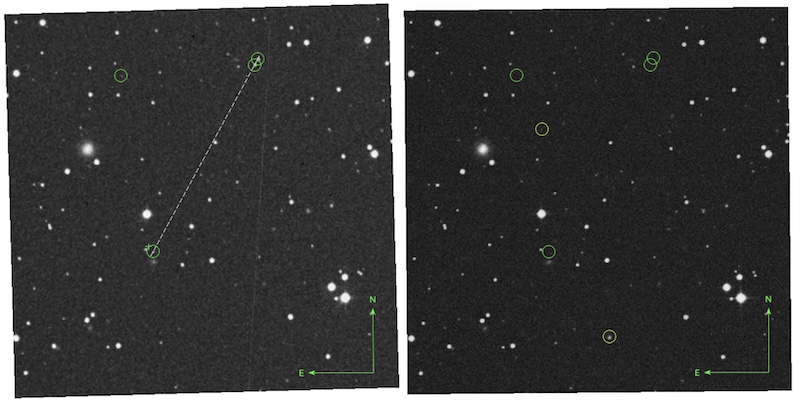 View larger. The Candidate 1 set of transients as seen in a digitized astronomical plate image from the Palomar Observatory. The transients, marked in green circles, appear in the 1st image and disappear in the 2nd image. Spots circled in yellow are defects. The long, white, dashed line shows the alignment of 3 of the transients. Image via Villarroel et al./ Publications of the Astronomical Society of the Pacific.
No transient flashes in Earth’s shadow?
Interestingly, the second study found that there was a dearth of transients in Earth’s shadow. Altogether, about 1/3 of them were “missing” in this region of space. This seemed to correlate with the previous research suggesting that these transients might be flashes of sunlight off of reflective objects in high Earth orbits, most likely geosynchronous orbit. A geosynchronous orbit is an Earth-centered orbit that matches Earth’s rotation on its axis. It is 26,199 miles (42,164 km), measured from the center of the Earth. A geosynchronous satellite is at an altitude of approximately 22,236 miles (35,786 km) above mean sea level.
But since this was well before the first satellite launch, what could those objects have been? Villarroel said:
Amidst what has been perceived as noise on the plates, there seems to be a genuine population of phenomena that correlate with, among other things, nuclear weapons tests or reports of UAP and that are missing in the Earth’s shadow. You don’t get that kind of solar reflections from round objects like asteroids or dust grains in space, which leave streaks during a 50-minute exposure, but only if something is very flat and very reflective and reflects the sunlight with a short flash.
Notably, the researchers initially calculated a 21.9 sigma significance level for the lack of transients within Earth’s shadow. The sigma significance level is a way scientists express how confident they are that a result is real and not just due to random chance. Upon further refinement of the data, the sigma significance level in these studies was subsequently reduced to a 7.6.
But that is still important, since the “gold standard” confidence level in physics is 5 sigma.
The authors state that this is the biggest argument against the plate defects or contamination explanation. Why would they “avoid” Earth’s shadow?
Connection with nuclear tests?
In the Scientific Reports paper, one of the most interesting findings is the seeming correlation with nuclear tests in the early 1950s. Overall, the researchers found that the transient flashes were 68% more likely to occur the day after a nuclear test on the ground. Co-author Stephen Bruehl at Vanderbilt University said:
The magnitude of the association between these flashes of light and nuclear tests was surprising, as was the very specific time at which they most often occurred. Namely, the day after a test. What they might represent is a very fascinating question that needs further investigation.
Does that mean the nuclear tests were the cause of the flashes? One hypothesis has been debris from the explosions lofted into the atmosphere. It’s a possibility, although as the paper notes:
These findings indicate that the chances of observing a transient were 68% higher on the day following a nuclear test compared to days unassociated with nuclear testing.
… effects in the atmosphere (rather than geosynchronous orbit) would be likely to result in a streak on the image over the 50-minute exposure. Yet all transients appear as distinct point sources rather than streaks. Moreover, this hypothesis is made even more unlikely given that transients were most often observed one day after a nuclear test. Such atmospheric phenomena would have to be sustained and remain localized in one location for approximately 24 hours to account for the visual appearance of transients.
Transient flashes and UAP sightings
There’s another aspect of the transients that is also intriguing, although more speculative. There were many UAP (UFO) sightings during the late 1940s and early 1950s. Among those were numerous reports of unusual lights or even objects over nuclear facilities. In one case, the researchers found a set of transients in an almost straight line from July 27, 1952. That’s the same night as the famous reports of UAP over Washington, D.C. Those UAP were both seen visually and tracked on radar.
In regards to UAP in general, the researchers found that the transient flashes increased 8.5% per UAP report. That is, when both the UAP reports and nuclear tests coincided, the effects were additive. Days with both nuclear tests and UAP reports had more than twice as many flashes of light as days without nuclear tests or UAP reports.
A group of astrophysicists (which does not include Avi Loeb) says they have found evidence of unidentified aerial phenomena in old photographic plates dating back to before the time of the first satellites. www.youtube.com/watch?v=5Gt-…
— Sabine Hossenfelder (@hossenfelder.bsky.social) 2025-10-22T15:10:36.048Z
Plate defects and contamination
One issue that critics have raised is the possibility of defects on the photographic plates or other contamination, perhaps even contamination from nuclear fallout particles. The researchers acknowledge this is a problem, but contend that it is more likely, based on their analysis, that the plates could have both defects and genuine anomalies rather than just defects. The paper says:
It is scientifically untenable to assume that all candidates are either authentic transients or all defects. A reasonable working assumption is that both populations are present in some unknown proportion. From this perspective, even a single authentic detection among many contaminants would validate the effort and warrant continued search.
Our overall pattern of results is clearly not consistent with the proposition that most transients are due to contamination or defects in photographic plates or scanned images, or to any other local confounds at the observatory itself. Contamination of photographic plates by nuclear fallout produces diffuse fogged spots quite different in appearance than the discrete star-like brightness profiles with point spread functions characteristic of transients.
Other background objects
The researchers also compared the older images to modern ones to try to rule out other background objects such as stars. The paper states:
Rigorous diagnostics with quantitative measurements are central to any search for genuine transients in photographic plates, as overly permissive criteria inevitably admit large amounts of noise. For that reason, we shall use carefully selected transient samples in Solano et al. (2022), which average 167 transients per plate and have been matched to several modern surveys to remove variable stars, asteroids and comets.
 Beatriz Villarroel at Nordita at Stockholm University in Sweden and The VASCO Network is the lead researcher of the investigation into the off transient flashes seen in old astronomical plates from Palomar Observatory from 1949-1957. Image via Beatriz Villarroel.
The origin of the transients remains unknown
The researchers conclude:
The origin of the transients remains unknown. One plausible explanation is that they are caused by brief light emissions from artificial objects in orbit or by objects with anomalous movements in Earth’s atmosphere; emissions so brief that they appear as point sources rather than streaks, despite the telescope tracking the stars. Alternatively, they could arise from solar reflections off flat, highly reflective surfaces at geosynchronous altitudes. The latter interpretation is further supported by our shadow test, which reveals a significant deficit of such events within the Earth’s umbra, consistent with a solar reflection origin and difficult to reconcile with many explanations, including photographic plate defects.
Noted physicist Sabine Hossenfelder in Germany has posted an interesting video about the transients on her YouTube channel. And astrophysicist Adam Frank has some curious thoughts about it. There’s also a good new article on Phys.org as well. Check them out!
Bottom line: Scientists see mysterious transient flashes of light in 1950s sky images from the Palomar Observatory. It was before the first satellites. What were they?
Sources:
Aligned, Multiple-transient Events in the First Palomar Sky Survey
Read more: 9 weird transients from 1950 still unexplained
Read more: UAP and science: Testing new methods of scientific analysis