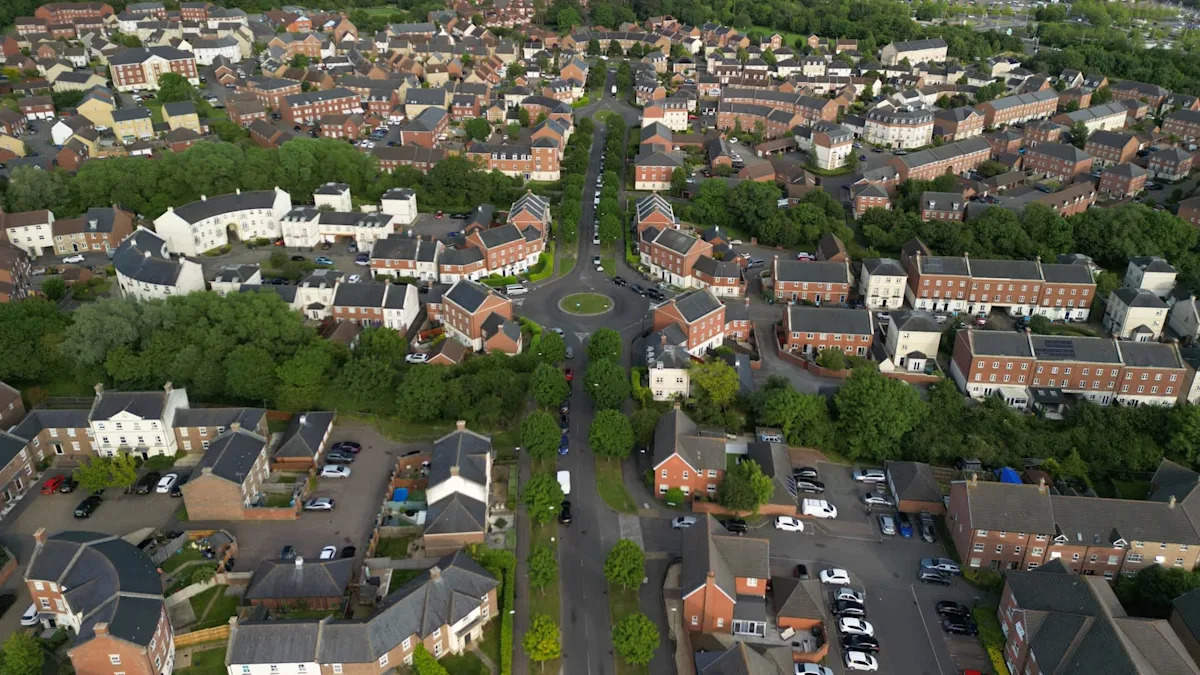
Every day, Europe converts 600 soccer fields’ worth of natural areas and cropland into developed space, The Guardian reported.
What’s happening?
A multinational investigation examined five years’ worth of satellite data across 30 European nations.
Researchers calculated that roughly 9,000 square kilometers of land, comparable to the entire nation of Cyprus, were lost over those five years.
The analysis revealed that natural areas are vanishing at a rate of 900 square kilometers per year, while farmland is disappearing at a rate of 600 square kilometers annually.
One in four development projects involved residential complexes or transportation infrastructure, though wealthy tourism ventures and manufacturing facilities consumed protected zones.
At Galé Beach in Portugal, developers removed close to 300 hectares of protected dunes for CostaTerra Golf and Ocean Club, where residences cost around $7.5 million. The course’s 75 hectares consume an estimated 800,000 liters of water each day.
In Turkey, wetlands in Izmir province, which once hosted flamingos and pelicans, disappeared under more than one square kilometer of concrete-based structures for a yacht marina serving wealthy clients.
Near Berlin, half a million trees were eliminated to expand a Tesla manufacturing plant. Greece permitted windfarm construction in the Vermio Mountains, an officially protected wild region without roads.
“It’s a slow-burning issue. It just accumulates over time,” said Jan-Erik Petersen of the European Environment Agency, per The Guardian.
Why is greenery loss and land development concerning?
Professor Steve Carver, who teaches at the University of Leeds, told The Guardian that building on undeveloped land expedites the decline of animal populations and the destruction of wild places. Urban expansion into agricultural zones also threatens food supplies and public health.
The investigation identified losses smaller than official European Environment Agency measurements, which underscored the impact of numerous minor development projects.
Turkey recorded the greatest land loss at more than 1,800 square kilometers. Poland was second at over 1,000 square kilometers.
Climate activist and Member of the European Parliament Lena Schilling cautioned that viewing nature as disposable would prevent Europe from meeting climate objectives while damaging food security and public health.
Every forest and productive field destroyed for immediate economic gain breaks commitments made to future generations.
What can I do to prevent greenery loss?
If you want to protect wild areas near you, support local organizations that advocate for land preservation, and contact your elected officials and share your support for tougher regulations on farmland and natural territories.
Pushing for dark sky regulations and green space protection in neighborhood planning decisions can also make a significant difference.
Join our free newsletter for good news and useful tips, and don’t miss this cool list of easy ways to help yourself while helping the planet.