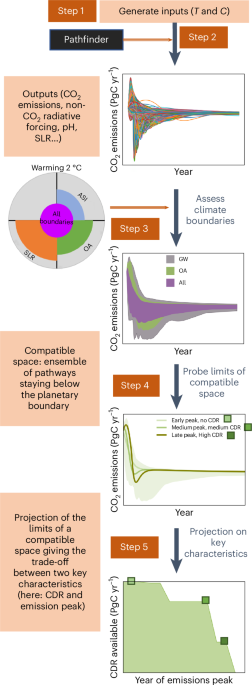
Rockström, J. et al. Planetary boundaries: exploring the safe operating space for humanity. Ecol. Soc. 14, art32 (2009).
Steffen, W. et al. Planetary boundaries: guiding human development on a changing planet. Science 347, 1259855 (2015).
Richardson, K. et al. Earth beyond six of nine planetary boundaries. Sci. Adv. 9, eadh2458 (2023).
Lade, S. J. et al. Human impacts on planetary boundaries amplified by Earth system interactions. Nat. Sustain. 3, 119–128 (2019).
Schulte-Uebbing, L. F., Beusen, A. H. W., Bouwman, A. F. & De Vries, W. From planetary to regional boundaries for agricultural nitrogen pollution. Nature 610, 507–512 (2022).
Bouwman, L. et al. Exploring global changes in nitrogen and phosphorus cycles in agriculture induced by livestock production over the 1900–2050 period. Proc. Natl Acad. Sci. USA 110, 20882–20887 (2013).
Mekonnen, M. M. & Hoekstra, A. Y. Global anthropogenic phosphorus loads to freshwater and associated grey water footprints and water pollution levels: a high-resolution global study. Water Resour. Res. 54, 345–358 (2018).
Rogelj, J. et al. Scenarios towards limiting global mean temperature increase below 1.5 °C. Nat. Clim. Change 8, 325–332 (2018).
Rogelj, J. et al. A new scenario logic for the Paris Agreement long-term temperature goal. Nature 573, 357–363 (2019).
Lamboll, R. D. et al. Assessing the size and uncertainty of remaining carbon budgets. Nat. Clim. Change 13, 1360–1367 (2023).
Lade, S. J., Fetzer, I., Cornell, S. E. & Crona, B. A prototype Earth system impact metric that accounts for cross-scale interactions. Environ. Res. Lett. 16, 115005 (2021).
Chrysafi, A. et al. Quantifying Earth system interactions for sustainable food production via expert elicitation. Nat. Sustain. 5, 830–842 (2022).
IPCC Climate Change 2021: The Physical Science Basis (eds Masson-Delmotte, V. et al.) (Cambridge Univ. Press, 2023).
Mengel, M. et al. Future sea level rise constrained by observations and long-term commitment. Proc. Natl Acad. Sci. USA 113, 2597–2602 (2016).
Pfleiderer, P. et al. Reversal of the impact chain for actionable climate information. Nat. Geosci. 18, 10–19 (2025).
Bossy, T., Gasser, T. & Ciais, P. Pathfinder v1.0.1: a Bayesian-inferred simple carbon–climate model to explore climate change scenarios. Geosci. Model Dev. 15, 8831–8868 (2022).
Gasser, T., Guivarch, C., Tachiiri, K., Jones, C. D. & Ciais, P. Negative emissions physically needed to keep global warming below 2 °C. Nat. Commun. 6, 7958 (2015).
Byers, E. et al. AR6 Scenario Explorer and Database Hosted by IIASA (International Institute for Applied Systems Analysis, 2022); https://data.ece.iiasa.ac.at/ar6
IPCC Special Report on Impacts of Global Warming of 1.5°C (eds Masson-Delmotte, V. et al.) (Cambridge Univ. Press, 2022).
Niederdrenk, A. L. & Notz, D. Arctic sea ice in a 1.5 °C warmer world. Geophys. Res. Lett. 45, 1963–1971 (2018).
Gattuso, J.-P. et al. Contrasting futures for ocean and society from different anthropogenic CO2 emissions scenarios. Science 349, aac4722 (2015).
Kvale, K. et al. Carbon dioxide emission pathways avoiding dangerous ocean impacts. Weather Clim. Soc. 4, 212–229 (2012).
Schubert, R. et al. The Future Oceans—Warming Up, Rising High, Turning Sour (WBGU, 2006).
Mastrandrea, M. D. et al. The IPCC AR5 guidance note on consistent treatment of uncertainties: a common approach across the working groups. Clim. Change 108, 675–691 (2011).
Babiker, M. et al. in Climate Change 2022: Mitigation of Climate Change (eds Shukla, P. R. et al.) Ch. 12 (Cambridge Univ. Press, 2022).
Grubb, M., Wieners, C. & Yang, P. Modeling myths: on DICE and dynamic realism in integrated assessment models of climate change mitigation. WIREs Clim. Change 12, e698 (2021).
Pindyck, R. S. The use and misuse of models for climate policy. Rev. Environ. Econ. Policy 11, 100–114 (2017).
Bossy, T. et al. Least-cost and 2 °C-compliant mitigation pathways robust to physical uncertainty, economic paradigms, and intergenerational cost distribution. Environ. Res. Clim. 3, 025005 (2024).
Tokarska, K. B. & Zickfeld, K. The effectiveness of net negative carbon dioxide emissions in reversing anthropogenic climate change. Environ. Res. Lett. 10, 094013 (2015).
Obersteiner, M. et al. How to spend a dwindling greenhouse gas budget. Nat. Clim. Change 8, 7–10 (2018).
Aengenheyster, M., Feng, Q. Y., Van Der Ploeg, F. & Dijkstra, H. A. The point of no return for climate action: effects of climate uncertainty and risk tolerance. Earth Syst. Dynam. 9, 1085–1095 (2018).
Duarte, C. M. et al. Is ocean acidification an open-ocean syndrome? Understanding anthropogenic impacts on seawater pH. Estuaries Coasts 36, 221–236 (2013).
Doney, S. C. et al. Impact of anthropogenic atmospheric nitrogen and sulfur deposition on ocean acidification and the inorganic carbon system. Proc. Natl Acad. Sci. USA 104, 14580–14585 (2007).
Visioni, D., Pitari, G. & Aquila, V. Sulfate geoengineering: a review of the factors controlling the needed injection of sulfur dioxide. Atmos. Chem. Phys. 17, 3879–3889 (2017).
Allen, M. R. et al. Warming caused by cumulative carbon emissions towards the trillionth tonne. Nature 458, 1163–1166 (2009).
Van Soest, H. L., Den Elzen, M. G. J. & Van Vuuren, D. P. Net-zero emission targets for major emitting countries consistent with the Paris Agreement. Nat. Commun. 12, 2140 (2021).
Bruckner, T. et al. Climate system modeling in the framework of the tolerable windows approach: the ICLIPS climate model. Clim. Change 56, 119–137 (2003).
Petschel-Held, G. et al. Tolerable windows approach: theoretical and methodological foundations. Clim. Change 41, 303–331 (1999).
Zickfeld, K. & Bruckner, T. Reducing the risk of Atlantic thermohaline circulation collapse: sensitivity analysis of emissions corridors. Clim. Change 91, 291–315 (2008).
Stocker, T. F. The closing door of climate targets. Science 339, 280–282 (2013).
Steinacher, M., Joos, F. & Stocker, T. F. Allowable carbon emissions lowered by multiple climate targets. Nature 499, 197–201 (2013).
Rockström, J. et al. Safe and just Earth system boundaries. Nature 619, 102–111 (2023).
Riahi, K. et al. The Shared Socioeconomic Pathways and their energy, land use, and greenhouse gas emissions implications: an overview. Glob. Environ. Change 42, 153–168 (2017).
MacDougall, A. H. et al. Is there warming in the pipeline? A multi-model analysis of the Zero Emissions Commitment from CO2. Biogeosciences 17, 2987–3016 (2020).
Ricciuto, D. M., Davis, K. J. & Keller, K. A Bayesian calibration of a simple carbon cycle model: the role of observations in estimating and reducing uncertainty. Glob. Biogeochem. Cycles 22, 2006GB002908 (2008).
Geoffroy, O. et al. Transient climate tesponse in a two-layer energy-balance model. Part II: representation of the efficacy ofdeep-ocean heat uptake and validation for CMIP5 AOGCMs. J. Clim. 26, 1859–1876 (2013).
Myhre, G. et al. in Climate Change 2013: The Physical Science Basis (eds Stocker, T. F. et al.) 659–740 (IPCC, Cambridge Univ. Press, 2014).
Strassmann, K. M., Joos, F. & Strassmann, K. The Bern Simple Climate Model (BernSCM) v1.0: an extensible and fully documented open-source re-implementation of the Bern reduced-form model for global carbon cycle–climate simulations. Geosci. Model Dev. 11, 1887–1908 (2018).
Gasser, T. et al. The compact Earth system model OSCAR v2.2: description and first results. Geosci. Model Dev. 10, 271–319 (2017).
He, Y. et al. Radiocarbon constraints imply reduced carbon uptake by soils during the 21st century. Science 353, 1419–1424 (2016).
Gasser, T. et al. Path-dependent reductions in CO2 emission budgets caused by permafrost carbon release. Nat. Geosci. 11, 830–835 (2018).
Goodwin, P. et al. Pathways to 1.5 °C and 2 °C warming based on observational and geological constraints. Nat. Geosci. 11, 102–107 (2018).
Bernie, D., Lowe, J., Tyrrell, T. & Legge, O. Influence of mitigation policy on ocean acidification. Geophys. Res. Lett. 37, 2010GL043181 (2010).
Cowtan, K. & Way, R. G. Coverage bias in the HadCRUT4 temperature series and its impact on recent temperature trends. Q. J. R. Meteorol. Soc. 140, 1935–1944 (2014).
Morice, C. P., Kennedy, J. J., Rayner, N. A. & Jones, P. D. Quantifying uncertainties in global and regional temperature change using an ensemble of observational estimates: the HadCRUT4 data set. J. Geophys. Res. Atmos. 117, 2011JD017187 (2012).
Rohde, R., Muller, R., Jacobsen, R., Perlmutter, S. & Mosher, S. Berkeley Earth temperature averaging process. Geoinform. Geostat. Overv. https://doi.org/10.4172/2327-4581.1000103 (2013).
Hansen, J., Ruedy, R., Sato, M. & Lo, K. Global surface temperature change. Rev. Geophys. 48, RG4004 (2010).
Smith, T. M., Reynolds, R. W., Peterson, T. C. & Lawrimore, J. Improvements to NOAA’s historical merged land–ocean surface temperature analysis (1880–2006). J. Clim. 21, 2283–2296 (2008).
Bindoff, N. L. et al. in Climate Change 2013: The Physical Science Basis (eds Stocker, T. F. et al.) 867–952 (IPCC, Cambridge Univ. Press, 2014).
Friedlingstein, P. et al. Global Carbon Budget 2023. Earth Syst. Sci. Data 15, 5301–5369 (2023).
Ciais, P. et al. in Climate Change 2013: The Physical Science Basis (eds Stocker, T. F. et al.) 867–952 (IPCC, Cambridge Univ. Press, 2014).
Church, J. A. et al. in Climate Change 2013: The Physical Science Basis (eds Stocker, T. F. et al.) 1137–1216 (IPCC, Cambridge Univ. Press, 2014).
Kucukelbir, A. Automatic differentiation variational inference. J. Mach. Learn. Res. 18, 430–474 (2017).
Huntingford, C. et al. Flexible parameter-sparse global temperature time profiles that stabilise at 1.5 and 2.0 °C. Earth Syst. Dynam. 8, 617–626 (2017).
Kumaraswamy, P. A generalized probability density function for double-bounded random processes. J. Hydrol. 46, 79–88 (1980).
Gompertz, B. On the nature of the function expressive of the law of human mortality, and on a new mode of determining the value of life contingencies. In a letter to Francis Baily, Esq. F. R. S. &c. By Benjamin Gompertz, Esq. F. R. S. Proc. R. Soc. Lond. 2, 252–253 (1833).
Salvatier, J., Wiecki, T. V. & Fonnesbeck, C. Probabilistic programming in Python using PyMC3. PeerJ Comput. Sci. 2, e55 (2016).
Forster, P. et al. in Climate Change 2021: The Physical Science Basis (eds Masson-Delmotte, V. et al.) 923–1054 (IPCC, Cambridge Univ. Press, 2021).
Gidden, M. J. et al. Aligning climate scenarios to emissions inventories shifts global benchmarks. Nature 624, 102–108 (2023).
Ou, Y. et al. Can updated climate pledges limit warming well below 2 °C? Science 374, 693–695 (2021).
Gasser, T. Pathfinder: v1.0.1. Zenodo https://doi.org/10.5281/zenodo.7003848 (2022).
Bossy, T. & Gasser, T. Code for ‘Spaces of anthropogenic CO2 emissions compatible with climate boundaries’. Zenodo https://doi.org/10.5281/zenodo.15235819 (2025).