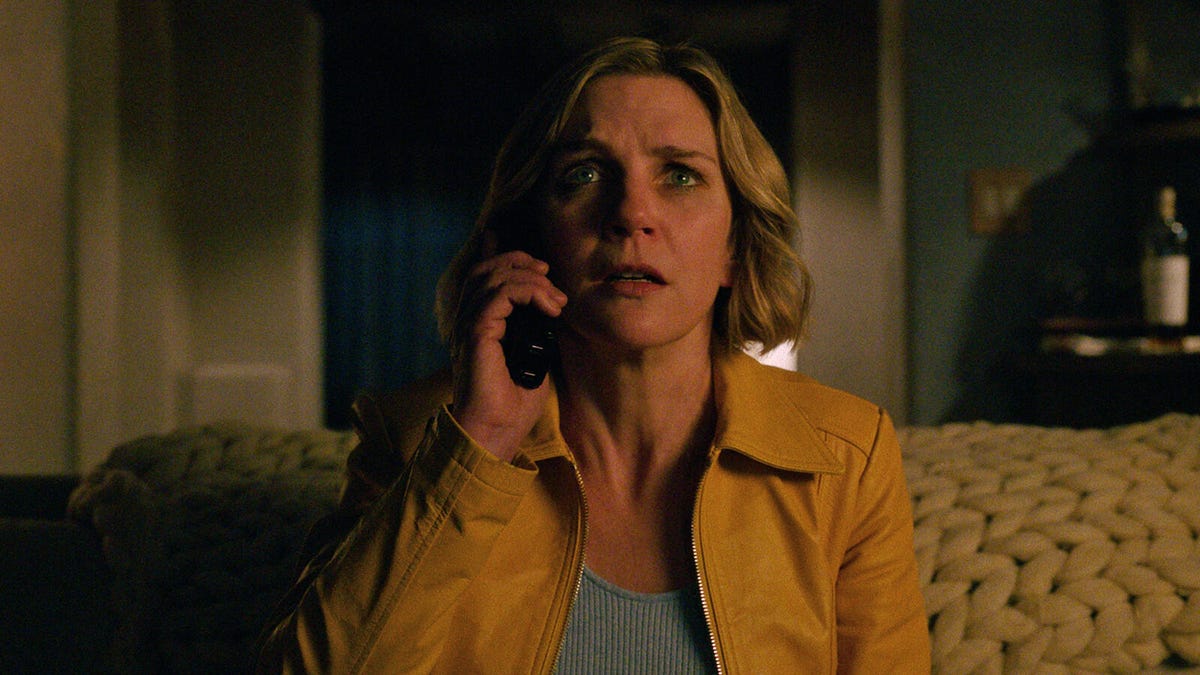
Rhea Seehorn, Pluribus
Apple TV+
[Warning: The following contains spoilers for Episodes 1 and 2 of Pluribus, “We Is Us” and “Pirate Lady.”]
Rhea Seehorn is ready for Pluribus to start conversations.
Almost everything about the new Apple TV sci-fi series has been a carefully guarded secret since it was first announced. Now, Pluribus — which marks a Better Call Saul reunion for star Seehorn and creator Vince Gilligan — is beaming down to Earth. The two-episode series premiere, written and directed by Gilligan, kicks off as a signal from space sweeps across the planet, binding humanity together into a happy hive mind. Among the handful of people across the globe who are immune is Seehorn’s Carol Sturka, a misanthropic romantasy writer whose partner, Helen (Miriam Shor), is accidentally killed in the initial chaos. A call with a chipper government official (Peter Bergman) at the White House tells Carol enough about her predicament to make it official: She is now the most miserable person in the world.
In search of solidarity — and, maybe, a way to put things back the way they were — Carol goes to Spain to meet with her fellow survivors (at least the ones who speak English). She arranges the get-together by reluctantly accepting the help of Zosia (Karolina Wydra), a member of the hive mind (or Other) who’s been chosen to reach out to Carol because she happens to look like the pirate love interest in Carol’s books. But while Carol is freaked out by the Others, the rest of the survivors are more accepting, either because they believe their loved ones are still in there or because they enjoy being surrounded by people who aim to please. One survivor, Laxmi (Menik Gooneratne), holds tight to believing that her son is still her son, while another, Mr. Diabaté (Samba Schutte) from Mauritania, takes advantage of his newly charmed existence and arrives at the meeting on Air Force One, where Carol tries and fails to rally the rest of the group to reject happiness.
If the show provokes viewers to consider how they’d handle the situation, that’s how Seehorn likes it. The star told TV Guide that she was drawn to the psychological elements of Pluribus’ sci-fi story. “It’s a world that you very much recognize, but you’re being forced to look at it through a different lens,” she said. “Vince doesn’t preach, and he doesn’t write to specific themes. He’s raising questions about human nature. And I think you’re going to bring where you’re at in your life to it.”
Seehorn spoke to TV Guide about the questions Pluribus raised for her, the logistics of filming Carol’s phone call with the White House, and carrying so many scenes in her new series on her own.
ALSO READ: Pluribus review: Rhea Seehorn is a gloriously unlikely hero in Vince Gilligan’s smart sci-fi series
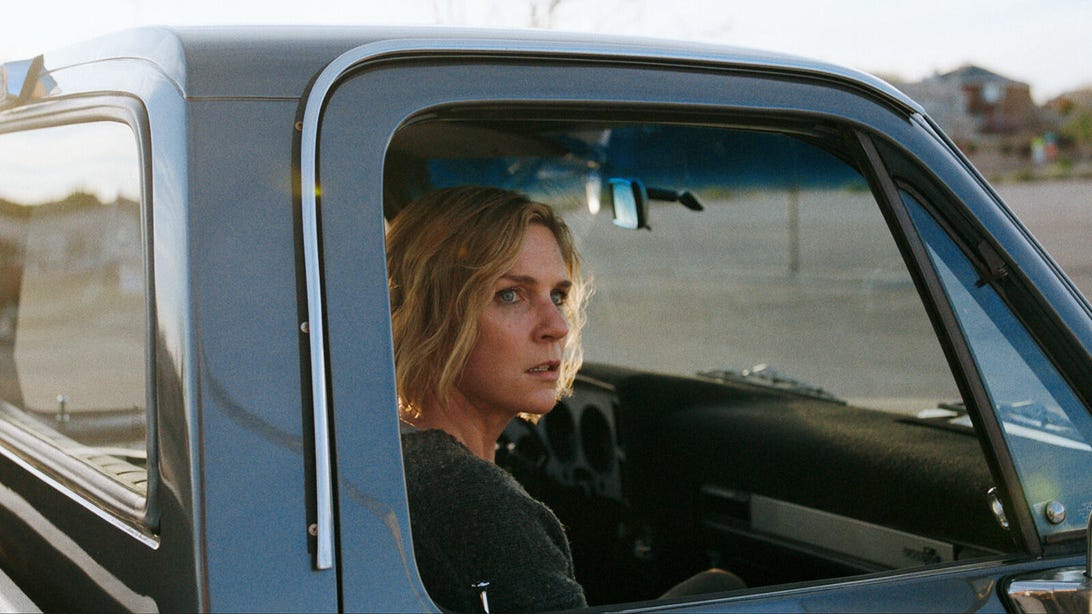
Rhea Seehorn, Pluribus
Apple TV+
You’ve had to keep so many secrets about this show. What have you been most excited to finally be able to talk about?
Rhea Seehorn: Really all of it. [The episodes] generate questions within the storyline and the characters that are just fun to unpack. And they seem to be like the concentric circles emanating from a rock thrown in a lake — they just get my brain going. So I’m thrilled to be able to talk to people about it. It very much feels like sending art out into the world, and the response to it is the other half to the art.
There are so many angles that you can take on this show. For me, it made me think about independence and the limits of independence. I’m curious what it got you thinking about.
Seehorn: That’s definitely part of it. I’m somebody that’s 50/50 introvert and extrovert, and when I don’t recharge both sides, I feel it. It was interesting thinking about those times when you feel like a real loner: Do you really want to test that? How alone can I be? It made me think also about the buffers that we all have that help us. Carol has Helen as a buffer professionally, but also she is the social lubrication with Carol’s experience of the world. Just thinking about all the things that go into making me be able to do what I do, that extended to me thinking about, well, how do you actually define success? How do you define healthy competitiveness? Because Carol’s now in a world where everybody is great at everything. That should be lovely, right? On paper. And how do you define love and happiness and contentment? Is joy joy if there is no opposite?
What were some details in the scripts that helped you understand who Carol is?
Seehorn: Vince and I were building her together. I don’t have all the scripts. … I don’t know where it’s going in Season 2. And so I try to build characters with the pieces of the jigsaw puzzle that I have at hand in each script, and connect ones if they’re missing a piece right between them, and there needs to be backstory and motivations for behaving this way or that. But I want to be open to where Vince and the story take me. And then little by little, you build this template that has its own anomalies, like that you might behave this way, but normally you behave this other way. And those become fun. What are the norms of this character? And now she’s thrust into these positions where it would be the abnorm.
What were some norms that you found for her?
Seehorn: That she really prefers that someone else handle the sticky parts of life. I feel like when Carol flies to Spain, she was hoping that she was going to basically volunteer to bring the cups and the plates to the revolution, not head it up. It’s not that she’s not self-motivated. It takes a hell of a lot of self-motivation to write a novel and get yourself up and create your own hours, and I thought a lot about the discipline it takes to do that, and to do it well, and to do it repeatedly, as she has. But pretty much all other interactions and social norms, as well as just dealing with the potholes in life, she was leaving to other people. Whether she’s self-medicating by just isolating herself, or self-medicating by actually drinking alcohol or having a rage fit, she didn’t appear to me to be someone that drills down on [asking], “What’s my side of the street here?” And now she has to.
What is it that you think makes her so much more horrified by what’s happened in the world than the other survivors she meets in Spain?
Seehorn: I think it’s something that she didn’t know about herself prior to this day. Carol definitely would have been able to speak to prizing independent thought, but she’s now being put in a position to argue the value of discontentment and the value of not being satiated all the time, not getting every single thing you want. She’s spent most of her life chasing things that she thought would eventually fill up some kind of well where you’re like, OK, now I am successful. OK, now I’m happy. OK, now everything is OK. And that day doesn’t come, and we all know it doesn’t come, and she’s now having to really think about, “Well, what is it that you are fighting for?” She distrusts blanket happiness, and she distrusts people that do anything that’s too easy. So I think she’s looking at someone like Diabaté and thinking, “This isn’t about just listening to the music while the Titanic crashes into an iceberg.” … Why don’t any of the other ones feel that way? I don’t know, and I don’t actually even know what I would do in that position, because you’re not just talking about, would we as a collective, would you and I say, “Yes, of course, I’d fight for independent thought”? On paper, I believe that all day long, but if you told me you’re going to take every single person away from me that I love and care about, and even though it looks a little creepy and weird, that if I would just do this thing, I’d at least be with them again in some capacity? I don’t know what I would do.
I’m curious whether you’ve thought about whether Carol might feel differently about the Others if Helen had lived but been one of them.
Seehorn: Yeah, would she be Laxmi and her son? I don’t think so. I do think that Carol thought that her discontentment and fault finding was something that was one of her badges of honor. Carol thinks that’s part of who she is, and if her partner just had the same thoughts as everyone else and loved her the same as everyone else — even though Helen was much less of a naysayer than Carol, she still was her own quirky, independent, interesting person, and Miriam Shor did such a brilliant job in so little time making this person real and making that relationship real. I really do think Carol would not say, “OK, fine, I’ll just take the outside shell as my partner.” It might have even been harder to be able to stare at your loved one, but they’re not really there.
I love the scene at the end of the first episode where Carol calls the under secretary of agriculture at the White House. How was that filmed? Were you having a conversation on the day with a blank TV, or did you have the Davis Taffler footage filmed already?
Seehorn: Peter Bergman is so amazing. I grew up seeing that guy on soap operas; he’s beloved. And Vince has had a longtime relationship with him, so we were so excited to have him, and he was such a champ. There was a lot of talk leading up to it of how to technically do this. There’s all sorts of issues that go into it, even if you have an earwig, which, for anybody reading this who doesn’t know, is almost like a little earbud that’s feeding you the lines from the other person, which you might use in a phone call scene so that you can hear them if it can’t come through a phone. But sometimes the mic might pick up what’s coming through my earbud, instead of just my voice, and then there’s feedback issues. Also, Carol is supposedly hearing him through a television, but speaking to him through a phone, because there are all these very nuanced rules going on where he can’t see me, and he can’t hear me unless I talk through the phone, but I can see him.
And in the end, Phil Palmer, our sound mixer, as well as his crack team of sound people and all the electrical people and engineer people — without my saying a word, they tried to facilitate and support our performances, so much so that they ended up building some system that involved Peter being on the sound stage right next to me, with the doors open, far enough away that we can’t hear each other’s feedback. But we did do it live. I watched him live on the television, and could hear him live, and he could hear me through the phone back for his performance to do his live. It was very cool. So all of our takes were coverage of both sides at the same time, which also gave you all the fun. Peter couldn’t see me, so he got to play for real that he’s not sure when he says, “Carol, are you there?” but I’m staring. His character doesn’t know if I just put the phone down and left the room.
We get presidential imagery in Episode 2 as well, when Carol is giving her speech on Air Force One and she has the presidential seal over her shoulder. Did you and Vince talk about that imagery?
Seehorn: Oh, sure. And by the way, Denise Pizzini, our production designer, did an incredible job. The inside of Air Force One was, as far as they could, built to spec, which was very interesting and very cool. I as Carol did not think about it and try to play it up, but I know that Vince wanted both the gravitas of the situation and also the comedic juxtaposition of this insanely reluctant hero who, to everyone else, appears to be a hot mess, to be the one that’s standing in a position of authority. But again, it’s because she’s like, “It’s ’cause no one else will! It’s not my fault.”
What was it like for you to have so many scenes in this show where you’re either solo or virtually solo?
Seehorn: Because of the quality of Vince’s writing and all of the writers on the show, which is just the highest caliber, I at least never had to worry about, like, “What’s interesting about me just sitting in a chair?” You’re still telling just as much of a story as if I had a scene partner and was talking the whole time. So I would go about preparing: What’s the story we’re telling in this scene, and what would Carol’s thoughts be from moment to moment? Sometimes that’s as specific as, they have me waking up on the couch and I’m thinking, “OK, so she’s not capable of sleeping in the bed that she shared with her wife.” And we would decide that she was drinking, so that affects how you wake up. And then when you wake up, I thought, “There’s got to be room in her brain where you are hoping so badly that this whole thing was a nightmare for a second.” What happens to you when you realize it wasn’t? Then I have my scene partners in my head. What’s the last thing Zosia said? What’s the last thing Diabaté said? What am I going to do now? So I do carry their performances with me. And Carol’s just trying to process as fast as she can and move towards gearing herself up to say, “I guess it’s going to be me. I guess it’s going to be me that’s got to get up off the floor.”
I know that on Better Call Saul, every pause and every “um” was in the script. Was this similar?
Seehorn: Similar, but I will say this piece has a little more contemporary lingo. There’s more slang in it and eliding for my character specifically. I just find these two characters pretty much polar opposites, Kim Wexler and Carol Sturka. So the “well”s and the “uh”s and the conversational peppering that we do in contemporary language, there was a little more room for that. But still, you’re doing the script, and you’re happy you are.
New episodes of Pluribus stream Fridays on Apple TV.