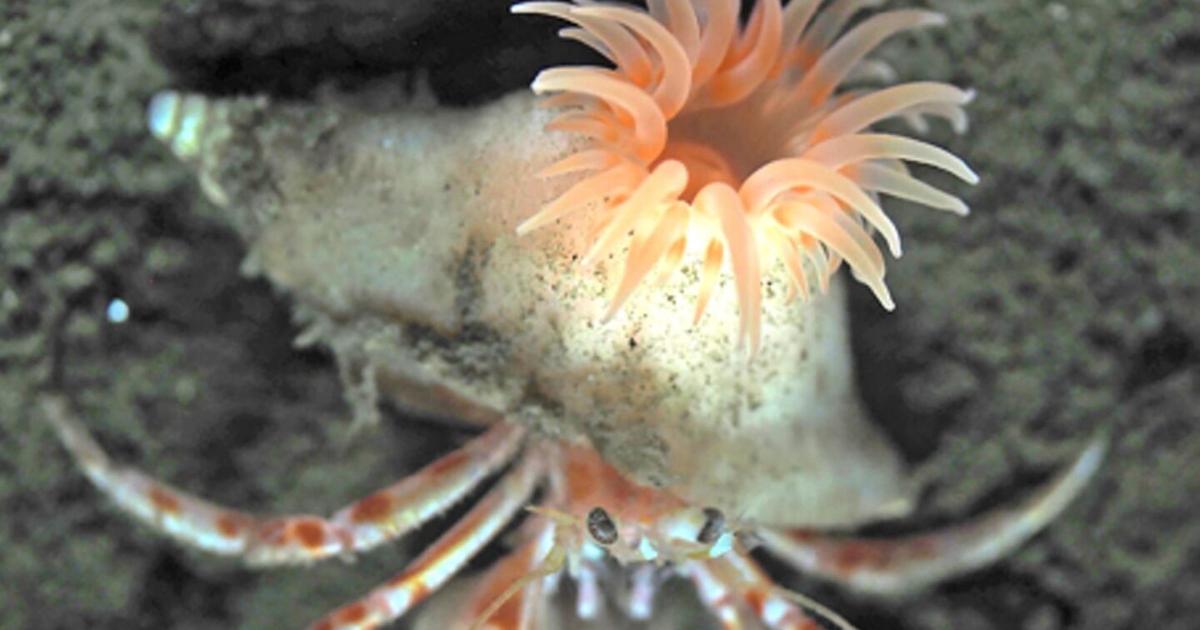

Paracalliactis tsukisome, a newly discovered sea anemone living in symbiosis with hermit crabs on the deep-sea floor off Japan. (Yoshigawa et al via SWNS)
By Stephen Beech
A pink sea anemone that “builds a home” for hermit crabs has been discovered.
The find, in seas off Japan, is a rare example of “co-evolution” in the ocean depths, say scientists.
Researchers from Kumamoto University in Japan discovered the new species of anemone that builds shell-like oceanic “homes” for hermit crabs.
(Yoshigawa et al via SWNS)
By Talker
The newly identified species, Paracalliactis tsukisome sp. nov., was found living on the shells inhabited by the hermit crab Oncopagurus monstrosus at depths of 200 to 500 metres (650 to 1,640 ft) off the Pacific coast of Japan’s Mie and Shizuoka Prefectures.
Unlike typical sea anemones, which lack hard skeletons, the new species secretes a shell-like structure – known as a carcinoecium – which expands and reinforces the crab’s shell.
Stable isotope analyses revealed that the anemone feeds partly on organic particles and the crab’s faeces – an unusual but efficient form of recycling on the deep-sea floor.
(Yoshigawa et al via SWNS)
By Talker
The research team, whose findings were published in the journal Royal Society Open Science, used 3D imaging to show that the anemone attaches to the shell in a consistent, one-directional pattern that may be linked to both feeding and shell-building behaviour.
Study lead Professor Akihiro Yoshikawa said: “The hermit crab, in turn, benefits from this partnership by achieving a larger body size than its relatives, suggesting a true mutualistic relationship between the two species.”
The soft pink anemone was named tsukisome – meaning “pale pink colour” – after an ancient Japanese word found in the Man’yÅshÅ«, Japan’s oldest anthology of poetry.
(Yoshigawa et al via SWNS)
By Talker
In ancient poetry, a “tsukisome-dyed kimono” symbolised gentle yet sincere affection – a tribute to the anemone’s delicate colour and its faithful partnership with its hermit crab host.
Yoshikawa added: “This discovery shows how even simple animals like sea anemones can evolve surprisingly sophisticated behaviours.
“Their ability to build a shell-like structure is a fascinating clue to understanding how animals perceive space and direction.”