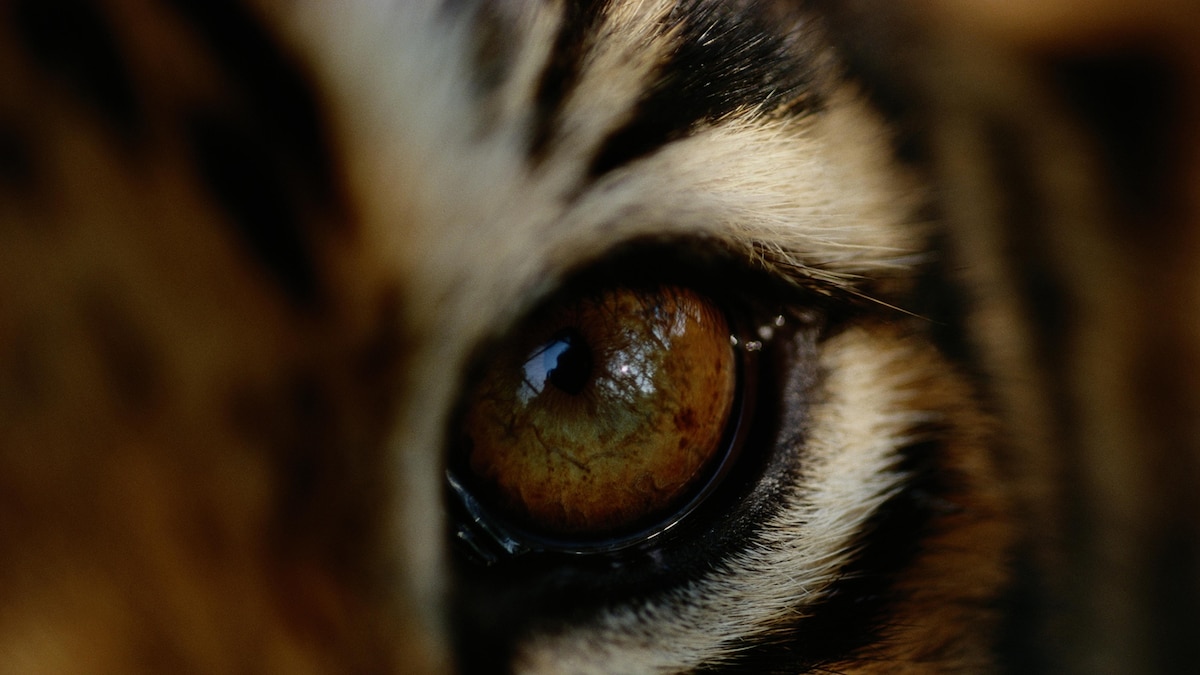
But in the past three years the situation seems to have improved dramatically. In 1995 Russian Prime Minister Viktor Chernomyrdin called for a national conservation strategy. Patrolling was intensified, the Chinese border was better regulated, and poaching was reduced.
During the winter of 1995-96 some 650 men, led by Evgeny Matyushkin of Moscow University, coordinated by American researcher Dale Miquelle, and funded largely by the United States Agency for International Development, undertook a systematic census of the entire region. Nothing so precise had ever been attempted. Tiger tracks were followed, measured, and cataloged over 60,000 square miles of snowy mountain forest. The results surprised nearly everyone—there were signs of somewhere between 430 and 470 adult tigers and cubs, nearly twice as many animals as some had estimated just a few years earlier.
The Siberian tiger seems to be slowly edging its way back from oblivion. To continue this hopeful trend, the Hornocker Institute, working closely with Russian scientists, has drawn up a master habitat protection plan aimed at saving what remains of the tiger’s beleaguered home. It calls for an inviolate core, a network of protected areas linked by corridors to allow safe dispersal of young tigers, along with careful management of the surrounding unprotected forests to ensure that logging and mining and road building do the least possible damage to tigers and their prey.
“In the Russian Far East we remain optimistic,” says Dale Miquelle. “Yes, there’s still poaching. Yes, there’s a lot of logging. Yes, there’s too much hunting of ungulates. But there’s still a big stretch of more or less intact forest. Human pressure is low—and not likely to rise. If the Russians extract timber at a sustainable rate, if hunters can be persuaded to remove prey at a rate that allows tigers as well as themselves to eat, if the need or desire to poach tigers can be eliminated, tigers will survive in Russia for the foreseeable future.”
Setting forests aside for tigers is one thing, ensuring that they remain protected is something else again. No one disagrees with John Seidensticker’s view: “Tigers won’t ultimately be safe until they’re worth more alive than dead.” But that is a tall order in countries where space is at a premium and millions of people are in need of the food and fuel forests have always provided. To meet that challenge in India, the Global Environment Facility and the World Bank are supporting a 67-million-dollar ecodevelopment scheme aimed at relieving the human pressure on five tiger reserves. And last summer, Tiger Link, a new, all-India network of individuals and organizations, persuaded 320 members of parliament representing more than 250 million people to sign an appeal to the prime minister demanding that the central government reorganize and strengthen tiger protection.

“When Rajah weighed two pounds, I held him in my palm and bottle-fed him,” recalls Gregg Lee, a six-foot-four trainer at Marine World Africa USA in Vallejo, California. Now Lee gets held as he feeds the white tiger.
More modest projects are also under way. Villagers were encouraged to reclaim and replant more than six square miles of degraded forest on the edge of Royal Chitwan National Park in Nepal and then allowed to keep half the proceeds from tourists eager to view wildlife. In the first year alone they earned $308,000 from entrance fees. Best of all from the wildlife point of view, one resident male tiger, a female tiger with cubs, and two transient males now use the area, and 12 rhinos have given birth within its precincts. Eric Dinerstein of the World Wildlife Fund, who helped guide the project, is delighted. “It helps ensure the survival of the park,” he says, “plus it adds to the area under protection. If we don’t add more forest whenever we can, we’ll end up like curators in a small museum, endlessly cataloging our old collections rather than building new ones.” Benefits like these, derived directly from wildlife, seem to offer real hope for the future, though each park and each range country will require its own distinctive solution.
Meanwhile, at Chitwan and everywhere else where tigers survive, protection requires strict policing. “It always will,” says Ullas Karanth. “There is a criminal element even in the most sophisticated cities. We must deal with it in just the same way.”
Nowhere is policing more strict than at Kaziranga National Park in the eastern Indian state of Assam. “Only God can keep people from killing tigers in other parks,” said Bhupen Talukdar, one of three range officers in charge of its antipoaching effort. He is a fierce, bearded man with bright silver rings on all his fingers. “Here we do it.”
They do, indeed, though tigers are only the unwitting beneficiaries of the officers’ primary concern: protecting the Indian one-horned rhinoceros. A long, spongy floodplain of the Brahmaputra River, Kaziranga shelters more than 1,200 of these massive, myopic beasts more than half of all the wild Indian rhinos left on earth. Like tiger bone, rhino horn is used in traditional Chinese medicine, and a single horn can bring more than $8,000 on the black market—many times the average annual income of the people who live around the park. Between 1989 and 1993, 266 rhinos in India were butchered for their horns. Kaziranga lost 49 animals in 1992 alone.
Nevertheless, Talukdar said, “The rhino is in the Assamese psyche. Lord Krishna is supposed to have brought it to Assam to fight an evil king, using it just like a tank. We are determined to protect it.” In 1994 he and his two equally tough-minded colleagues—Pankaj Sharma and Dharanidhar Boro—were given the job of waging the day-to-day struggle required if India is to save the species in the wild.