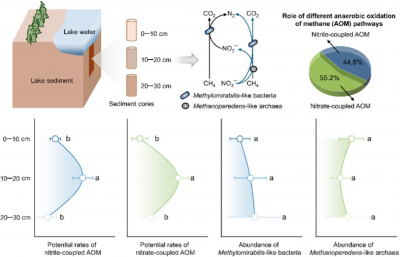
Researchers from Nanjing University of Information Science and Technology, et al. have conducted a study entitled “Depth-related variation in the activity and community structure of nitrite- and nitrate-coupled anaerobic methanotrophs in freshwater lake sediment”. This study was published in Frontiers of Environmental Science & Engineering, Volume 19, Issue 8, 2025.
Nitrite- and nitrate-coupled anaerobic oxidation of methane (AOM)—mediated by Candidatus Methylomirabilis-like bacteria and Methanoperedens-like archaea respectively—are key to freshwater carbon and nitrogen cycles, yet their vertical distribution, quantitative role in methane (CH₄) emission reduction, and environmental drivers in lake sediments remain unclear. To address this, the study explored vertical variation in the two AOM processes’ activity and related methanotrophs’ abundance, diversity, and community structure by collecting 0–10 cm, 10–20 cm, 20–30 cm sediment layers from four sites in Changdang Lake and conducting physicochemical analysis, ¹³CH₄ isotopic experiments, high-throughput sequencing, quantitative PCR, and statistical analyses. Data showed both AOM rates peaked in the 10–20 cm layer (0.41–3.84 nmol CH₄/(g·d) for nitrite-coupled, 0.32–3.88 nmol CH₄/(g·d) for nitrate-coupled), contributing equally to CH₄ consumption with a significant positive correlation; methanotroph abundance (3.34×10⁵–9.17×10⁶ copies/g for Methylomirabilis-like bacteria, 1.27×10⁶–9.46×10⁶ copies/g for Methanoperedens-like archaea) had no consistent vertical variation, and their community composition was stable by depth but differed across sites; sediment pH, NH₄⁺, and organic carbon content were key influencing factors. This study clarifies the vertical distribution of the two AOM processes, offering insights into their role in mitigating CH₄ emissions and related drivers.
For more detailed information, the full paper is available at: https://doi.org/10.1007/s11783-025-2032-5.