The US is skipping the conference, but the importance of China’s role in the talks has increased
Host country Brazil brokered an agreement on the agenda for the two-week summit in the Amazon city of Belem, fending off attempts from developing-country negotiating blocs to shoehorn contentious issues like climate finance and carbon taxes into the talks.
It was unclear whether countries would aim to negotiate a final agreement for the end of the event – a hard sell in a year of fractious global politics and US efforts to obstruct a transition away from fossil fuels.
Some, including Brazil, have suggested that countries focus on smaller efforts that do not need consensus, after years of Cop summits making lofty promises only to leave many unfulfilled.
“In this arena of Cop30, your job here is not to fight one another. Your job here is to fight this climate crisis, together,” UN Climate Change executive secretary Simon Stiell told delegates from more than 190 countries.
He said three decades of UN climate talks had helped to bend the curve in projected warming downward, “because of what was agreed in halls like this, with governments legislating and markets responding. But I am not sugar-coating it. We have so much more work to do”.
Brazil’s president, Luiz Inacio Lula da Silva, warned against interests trying to obscure the dangers of climate change.
“They attack the institutions, the science, the universities,” he said. “It’s time to impose another defeat to denialists.”
The world’s biggest historical emitter of greenhouse gases, the US, opted to skip the summit while US president Donald Trump falsely asserts that climate change is a hoax.
California and New Mexico’s governors, Gavin Newsom and Michelle Lujan Grisham, are expected in Belem today.
“What the hell is going on here?” Mr Newsom said about the US government’s absence from the talks, addressing a global investors summit held yesterday in Sao Paulo.
“We’re in Brazil, one of our great trading partners, one of the world’s great democracies. I mean, hell, home to all the rare-earth metals we need. This is the country we should be engaging with instead of giving the middle finger with 50pc tariffs.”
Germany said European countries would push for commitments to rein in fossil fuel use – a goal promoted by Mr da Silva.
“We will advocate for something strong,” German vice-minister Jochen Flasbarth said. “We don’t want to go the same way of President Trump and accuse others of being wrong. We want to listen.”
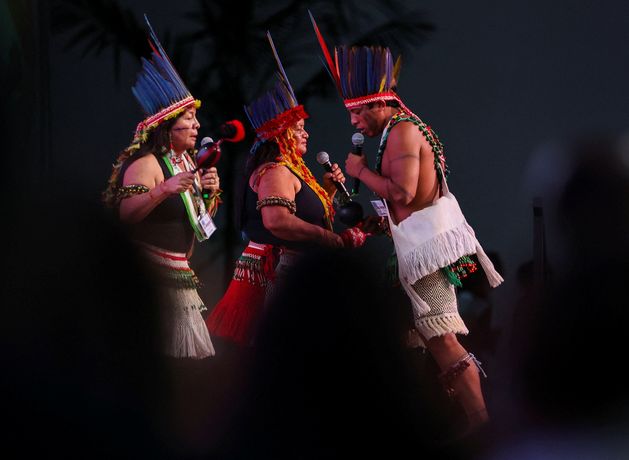
Countries were joined by indigenous leaders, who arrived on Sunday by boat after travelling about 3,000km from the Andes. They are demanding more say in how their territories are managed, as climate change escalates and industries such as mining, logging and oil drilling push deeper into forests.
“We want to make sure that they don’t keep promising, that they will start protecting, because we as indigenous people are the ones who suffer from these impacts of climate change,” Pablo Inuma Flores, an indigenous leader from Peru, said.
Scientists at dozens of universities and international science institutions also sounded an alarm over the world’s thawing glaciers, ice sheets and other frozen spaces.
“The cryosphere is destabilising at an alarming pace,” the groups said in a letter to Cop30 published yesterday.
“Geopolitical tensions or short-term national interests must not overshadow Cop30. Climate change is the defining security and stability challenge of our time.”
In an interview on Sunday, Cop30 president Andre Correa do Lago talked about the rise of China’s importance in the talks: “Emerging countries are appearing in this Cop with a different role. China is coming with solutions for everyone.”
He added that inexpensive green technologies from China were now leading the energy transition worldwide.
“You start complaining that China is moving the GDP all over the world,” he said. “That is great for climate.”
We as Indigenous people are the ones who suffer from these impacts of climate change