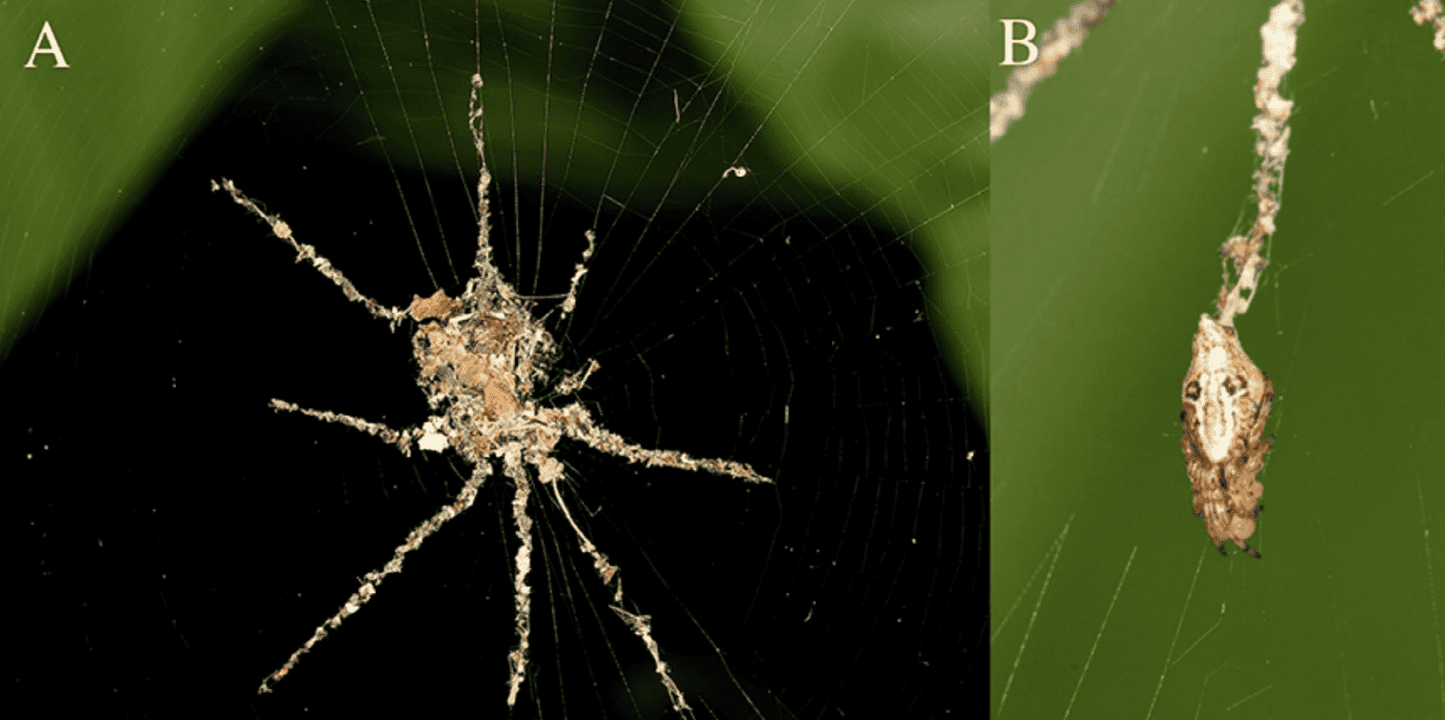
 (A) The “spider-like decoy” stabilimentum of the first individual Cyclosa sp. observed in the Philippines. (B) The Cyclosa sp. observed resting within the stabilimentum illustrated in the left panel. Credit: Ecology and Evolution, 2025.
In the dense rainforests of Peru and the Philippines, two small, unsuspecting orb-weaving spiders have unveiled a stunning survival strategy: crafting decoys to deceive predators. These spiders spin lifelike models of larger, menacing spiders to protect themselves from would-be attackers.
A ‘Scarecrow’ Made of Spider Silk
The spiders of the Cyclosa genus, found both in the Philippines and Peru, weave intricate stabilimenta — web decorations made of silk and debris — that are designed to resemble much larger, more dangerous spiders. These lifelike decoys serve to mimic the appearance of a formidable predator, directing danger away from the real, much smaller spider. The dummies can be up to about ten times larger than their creators.
Researchers, including Dr. George Olah from The Australian National University, have observed these spiders using natural materials like prey carcasses, leaves, and plant matter to create what can only be described as spider-shaped models. These decoys are arranged right in the center of their webs. In the case of the Philippine species, the spiders were seen taking refuge inside their decoys, while their Peruvian counterparts seemed to hover above, perhaps to mislead predators into striking the decoy instead of them.
 Only two species of spiders have been observed building elaborate structures to trick would-be attackers. Credit: Dr. George Olah
This decoy strategy appears to work not just on visual predators, like birds and lizards, but also on insects like damselflies, known to prey on small orb-weaving spiders.
The amount of detail and work that goes into shaping these decoys is striking. While some species of Cyclosa make simpler, linear stabilimenta, these spiders take it to another level. It’s a high-risk, high-reward strategy — more intricate decoys require more effort and resources to build, but they could offer a better chance of survival in a predator-rich environment.
To add to the realism of the imitation spiders, the real spiders sometimes shake their webs to cause movement in their doppelgängers, adding another layer of deception for their predators.
No other creature is known to create a larger decoy of itself to escape predation.
Interestingly, the spiders of Peru and the Philippines build their webs at different times of the day. In Peru, the spiders were observed constructing their decoys under the cover of darkness, when predators are less active, and completing the rest of their web at dawn.
From Camouflage to Mimicry
The decoys aren’t just a case of smaller spiders mimicking their larger cousins. Some spider-made decoys are meant to fool predators into thinking they are encountering something undesirable, such as bird droppings. This form of mimicry, as proposed by other researchers in the past, could make the webs even less appealing to predators. Imagine a bird or lizard seeing what they assume is a bird’s waste, an object they instinctively avoid. For the spider, it means the difference between life and death.
Dr. Lawrence Reeves, co-author of the study, explained that this “theater of deception” is an evolutionary trade-off. “Unlike many orb-weaving spiders that build physical retreats to hide, these Cyclosa species seem to invest their time in creating an expendable visual defense,” he said.
Future studies are likely to explore the survival advantages of these decoys. How much more likely are these spiders to survive compared to those who don’t construct such elaborate defenses? Do different predators respond differently to the decoys? And importantly, are other species using similar strategies (there may be another spider in Madagascar that makes decoys, but it’s to be confirmed)?
What is clear, however, is that these spiders are masters of deception. Nature is still full of surprises.
The findings were reported in the journal Ecology and Evolution.