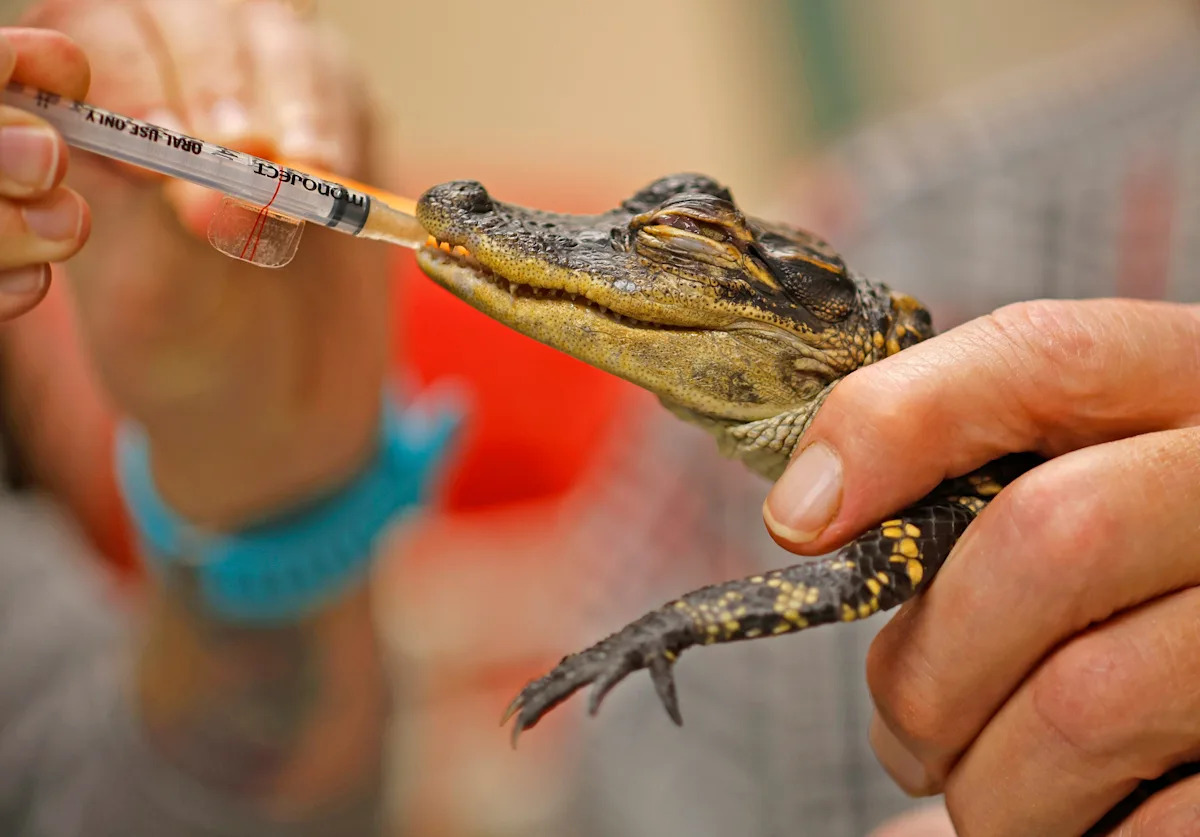
The small American alligator rescued from the Charles River was taken to New England Wildlife Center in Weymouth for an initial exam and treatment.
Dubbed “Charles” by his rescuer, the alligator rested a small green plastic tub, which was lined with a white towel and labeled “Live Animals Please Handle With Love Thank You!”
The reptile has a suspected respiratory infection and possibly pneumonia, according to Dr. Greg Mertz, the center’s chief medical and program director and also the face of The Odd Pet Vet ‒ the wildlife center’s exotic animal clinic.
“He’s a little on the weak side,” Mertz said of the animal on Thursday afternoon, more than 12 hours after it was caught in the river near Back Bay by local wildlife rehabilitator and educator Joe Kenney. “He’s just a little too quiet for us.”
Charles is just 16 inches long from snout to the tip of its tail, allowing Mertz to examine the alligator by gripping its torso with one hand. In the other hand, Mertz used a popsicle stick to open its jaws and look inside its mouth.
The reptile’s sex is not yet known, as it is a little invasive to ascertain. Based on its size, Charles is estimated to be around 3 years old.
In addition to lethargy, Charles had other signs of illness, including a pale mouth, a soft stomach and mucus in its nostrils, Mertz said. It thrashed its tail and let out a quiet chirp as it was given an antibiotic by injection.
The reptile will receive an antibiotic regiment as part of its treatment.
“He’s been through a lot, especially being out in the wild in this time of year,” Mertz said.
Where do American alligators like the one found in the Charles typically live?
The American alligator’s range is generally the coastal states between Texas and North Carolina, as well as parts of Arkansas and Oklahoma. As they are cold-blooded animals, American alligators need warmth to stay mobile and digest food. Cold temperatures can be deadly for these animals.
Alligators can survive colder spells in their normal range through a process called brumation, a dormant period when they reduce their activity. But winters in New England are too long and cold for the reptiles.
How was the Charles River alligator found?
After being interviewed by NBC10 Boston about the alligator sighting in the river, Kenney was informed of the alligator’s general location and decided to see whether he could rescue it. That evening, the low air temperature was around 34 degrees Fahrenheit.
“Alligators, as they get cold, don’t move around much,” Kenney told The Patriot Ledger. “In the Charles River, when it’s dropping into the 30s, it’s not going too far.”
It took the shine of flashlights and about 15-minutes’ worth of patience, but he spotted the alligator in 18 inches of water, three feet from the shoreline. He used a net to scoop it up and contacted state wildlife officials.
Kenney owns an Abington-based exotic animal education business called Joe’s Craz-zy Critters and serves as an animal control officer for the South Shore towns of Abington, Whitman and Hanson. It’s illegal to own an alligator as a pet in Massachusetts, but they are allowed to be kept through an educational permit, which Kenney has had for more than 10 years.
More: Vets remove baseball-sized bladder stone from pet tortoise. How the turtle is doing
He hopes to be able to care for Charles until its size necessitates its relocation to a wildlife sanctuary, Kenney said. The average size of an adult alligator is 8 to 12 feet.
The alligator went home with Kenney after the vet visit.
How did an alligator get into the Charles River?
So how did an alligator end up in the Charles River? Kenney and Mertz suspect it was likely an illegal pet.
“I would not in 100 years think that someone who had a permit would be insensitive enough to release it into the Charles River,” Mertz said.
It’s possible that the person purchased the reptile out of state and transported it to Massachusetts, Kenney speculated. It is legal to own an alligator as a pet in Florida, for example, but even so, obtaining a pet permit still necessitates one year and 1,000 hours of demonstrated experience in handling the animal, among other requirements.
“They were probably nervous to actually surrender it to someone and feared they were going to get in trouble,” Kenney said
If someone does illegally own an exotic animal, Kenney said the best thing to do is to contact an organization like the MSPCA, the Animal Rescue League or your local animal control.
“They’ll make sure that the animal gets to somewhere that’s safe,” he said. “It’s a felony to dump an animal. And it’s cruel.”
Hannah Morse covers growth and development for The Patriot Ledger. Contact her at hmorse@patriotledger.com.
This article originally appeared on The Patriot Ledger: Alligator found in Charles River treated at New England Wildlife Center