Background characteristics of participants
Table 1 provides demographic information about the quantitative study participants. A total of 57 attendants from formal private drug retail shops participated in the quantitative study: 9 from Community Pharmacies and 48 from OTCMS. The median age was 26 years (IQR = 24–42), with the majority, 40 (70.2%), qualified as Counter Medicine Assistants. Most attendants, 38 (66.7%), reported having 1–5 years of work experience. No statistically significant differences were found between community pharmacies and OTCMS in any demographic variable (all p > 0.05).
Table 1 Background characteristics of attendants in Formal Private Drug Retail Shops in the Hohoe Municipality, Ghana; April 2024
Among the qualitative participants, demographic details are provided for 7 individuals: 2 were pharmacists, 3 were Medicine Counter Assistants, 1 was a drug seller, and another was the shop owner. Ages ranged from 20 to 23 years, though four participants chose not to disclose their age. Educational backgrounds varied, with three completing secondary school, one holding a Higher National Diploma (HND), and another being a university graduate. Two participants did not provide educational details. In terms of experience, two had been working for one year, two had two years of experience, and two had over five years in their fields, while one participant did not specify their work experience. Table 2 provides more detail about the qualitative study participants.
Table 2 Detailed background characteristics of participants interviewedExisting methods of documentation and reporting tools
About 51 (89.5%) of the facilities did not have existing methods of documentation and reporting tools with only 6 (10.5%) indicating there were existing methods of documentation and reporting tools (Table 3). This difference between shop types was significant, community pharmacies were much more likely to have any tool (44.4% vs. 4.2%; p = 0.004). Among the 6 shops with tools, 5 used paper-based forms and 1 used a digital app (no significant difference by shop type, p = 1.000). Half of the 6 shops that document (3 shops) did for skin diseases and malaria, two indicated they documented for all conditions, and one was restricted to dangerous drugs only. Most (5/6) were satisfied with their tool and 4/6 had never encountered challenges.
Table 3 Existing methods of documentation and reporting tools used by formal drug retail shops in the Hohoe Municipality, Ghana; April 2024Preferred reporting tool for tracking malaria cases and reporting into the DHIMS
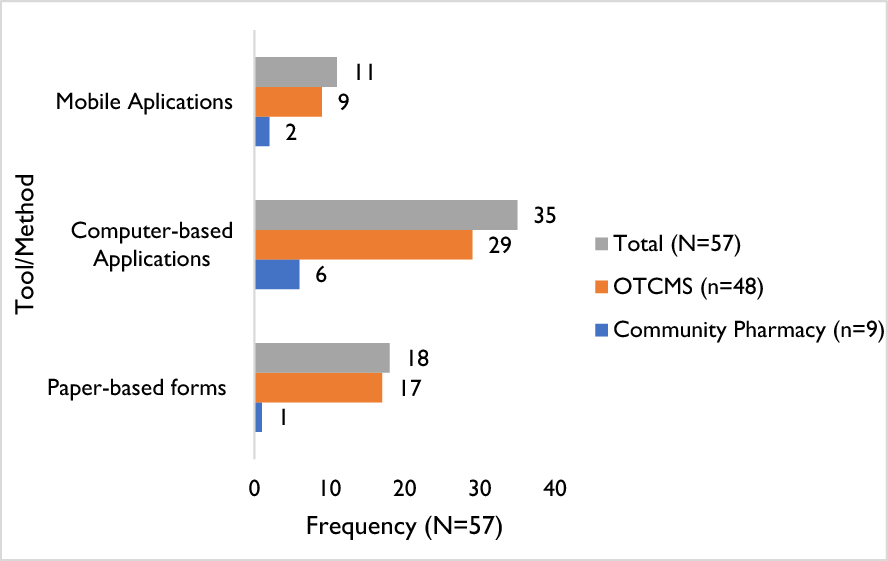
Figure 1 resents data on the preferred methods of reporting methods for malaria cases among attendants of formal retail drug shops, categorized by facility type. When asked hypothetically about reporting options, many respondents expressed a preference for digital methods using computer-based software applications overall, selected by 61.4% of respondents (n = 35). Specifically, 60.4% (n = 29) of OTCMS attendants and 66.7% (n = 6) of Community Pharmacy attendants expressed preference for digital methods followed by paper-based forms.
Fig. 1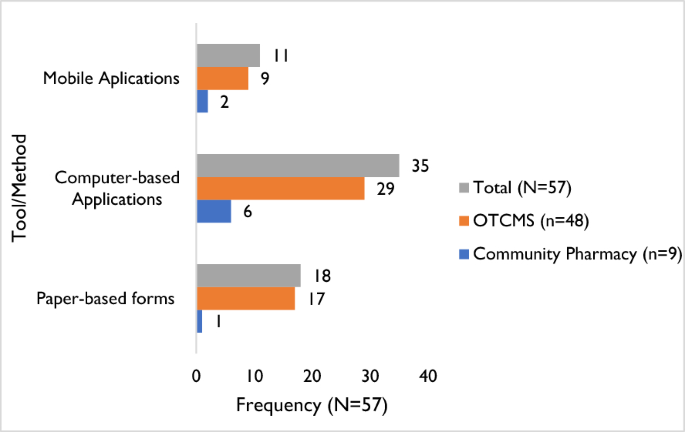
Preferred reporting tool for tracking malaria cases and reporting in the Hohoe Municipality, Ghana
Preferred features or characteristics that attendants of formal retail drug shops consider essential for a reporting tool
Figure 2 presents preferred features or characteristics that attendants of formal retail drug shops consider essential for a reporting tool. Majority of the attendants of formal prioritized a user-friendly interface (36, 64.3%) and data security measures (31, 55.4%) for a reporting tool, with real-time data submission (29, 51.8%) also being mentioned, particularly by OTCMS attendants. While few chose integration with DHIMS (2, 3.6%) and offline functionality (5, 8.9%).
Fig. 2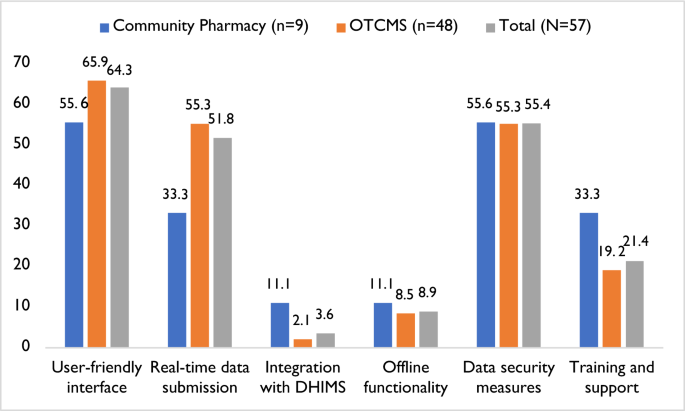
Preferred features or characteristics that attendants of formal retail drug shops consider essential for a reporting tool; Hohoe, Ghana; April 2024
Views of the attendants at the formal drug retail shops on the importance of documenting and reporting malaria cases
Table 4 summarizes the perspectives gathered from the attendants at formal drug retail shops regarding the documentation and reporting of malaria cases in the Hohoe Municipality. Five main themes emerged. These included: Understanding of Test Treat and Track (T3) strategy, documentation, accurate reporting, roles and future improvement.
Table 4 Views of formal retail drug shop attendants in the Hohoe Municipality; April, 2024Understanding of T3 strategy
Participants showed varied levels of understanding regarding malaria control strategies, particularly the 3 T (Test, Treat, Track). Their narrations revealed that some were familiar with aspects like testing for malaria, but they had limited knowledge about the comprehensive strategy, especially regarding the tracking component of the T3.
This was how some participants expressed their views.
“I know only testing.” – (OTCMS 3)
“I have not heard of it before.” – (Community pharmacy 1)
“I actually do not have any training, so I do not know.” – (Community pharmacy 2)
Documentation
This theme described generally participants’ views and current documentation practices. Seven subthemes emerged from were explored with regards to Documentation. These were tools, resources for improvement, details, processes, barriers, facilitators and importance. Participants recounted their views around this theme.
Importance of documentation
Importance of documentation was the first significant subtheme to emerge from the main theme. Participants recounted the lack of current documentation practices, although they acknowledged importance of documenting malaria cases. They highlighted benefits such as providing quality healthcare, tracking community health issues, and educating patients on prevention methods.
“It is important because in case there are other complications afterwards, you can refer to the documentation.” – (OTCMS 5)
“It will help you know the condition of the people. It will help you to know their health issues so after you know that, then you can provide the healthcare that is needed.” – (Community Pharmacy 2)
“It is good to document in order to know whether the cases are becoming more or it is becoming less.” – (Community Pharmacy 1)
Most drug retail shops lacked established documentation practices for malaria cases, primarily due to over-the-counter operations or insufficient training.
“No, I do not keep records of them”. – (OTCMS 2)
Two participants mentioned what they do as part of the documentation process.
“We have a logbook so we enter the patient’s name, telephone number then we put in our suspected diagnoses and the drug we served.” -(OTCMS 3)
“If you know the house of the customer, you can make that enquiry. We do not record them.” -(OTCMS 4)
Existing tools
Existing tool describes the materials used for documentation. Most participants did not take any records from their clients with the exception of one attendant who indicated that records of their clients were documented. Pens, logbooks, and papers were observed as these tools only served the purpose of accountability to their superiors mentioned as tools for recording information.
This was how the attendant expressed herself,
“We have a logbook, so we enter the patient’s name, telephone number then we put in our suspected diagnoses and the drug we served”. -(OTCMS 3)
Two participants mentioned that name, telephone number and residence of customers were some contact information taken during the process of documentation.
“We have a logbook, so we enter the patient’s name, telephone number then we put in our suspected diagnoses and the drug we served.” – (OTCM 3)
Barriers
Attendants anticipated that there would be some barriers in documenting and reporting malaria cases. These included electricity, and technological problems.
This was how some participants expressed themselves,
“With technology also, if the light goes off and you do not have light so you can be able to charge it, you will have to first put it on paper so that when the light is on, you will now transfer it to the device you are using. It is going to be a lot of stress.” – (Community Pharmacy 2)
Some attendants revealed that there were no barriers since they were not documenting.
“First of all, we do not document so since we do not document, there will not be any challenge”. – (Community Pharmacy 1)
“I do not see any barrier. I do not think there will be any barrier to documentation. If
I have to keep records; I do not see why I cannot keep records”. – (OTCMS 2)
Benefits of documentation
Participants highlighted that detailed reporting of cases leads to creation of awareness, enables easy tracking of cases, provides references for follow-ups, and ensures patients receive timely check-ups. The benefit of documentation identified by participants was accurate reporting.
Participants mentioned the advantages of accurate reporting of malaria cases. They emphasized that records help in easy checking and tracking of malaria patients. Additionally, some indicated that maintaining records helps in referring patients and accumulating data.
This was how they expressed themselves,
“So that we can do follow up checks if the need arises.” – (OTCMS 3)
“It can be used in the future to make comparison of the past and current cases to see whether there is an improvement or not.” – (OTCMS 4)
“Maybe when you document it and the person comes with the same complain, you can refer the person to the hospital.” -(OTCMS 5)
“It provides basic data for referencing. “- (Community Pharmacy 1)
The critical role of retail shops was highlighted by participants. They emphasized that retail shops made treatment accessible, potentially limiting the spread of malaria. This was how they expressed themselves,
“As we are here, we are also limiting the malaria pandemic or endemic. Some of the people find it difficult to go to the hospital and some are also scared that when they go to the hospital something else will happen so as we are here, they come to us and we attend to them. If it is a malaria case, we treat them and the go which is better than they going to line up at the hospital and waste their time. That is why they normally come to us here.” – (Community Pharmacy 1)
“For easy tracking. To make it easy to track any malaria case.” -(OTCMS 4)
“It is a way pf providing primary care to the healthcare.” – (OTCMS 2)
Recommendations for improvement in documentation
Participants made various recommendations for improving documentation practices, including providing training, supplying necessary resources, and addressing infrastructure challenges. These were recommendations, technology and training and capacity building.
Participants mentioned that facilitators such as booking, increasing the number of staff, and well-designed forms can improve documentation practices.
This was how they expressed themselves,
“With the booking, you will have all the details of the patient in there, including where the person stays and others so booking can help you track the malaria cases”. – (OTCMS 4)
“In my view, the number of staff here can be increased so that we can be either 2 or 3 people working here”. – (Community Pharmacy 2)
“For instance, when we have a designed form that we are to fill in your records, it will make things easier for us”. -(OTCMS 2)
Participants further highlighted the need for technological advancements, such as the use of phones, tablets, laptops, computers, mobile apps, and digital forms, as vital tools to support future improvements.
This was how participants expressed themselves.
“a mobile phone where you can keep record or keeping the records on a computer.” -(OTCMS 5)
“Because we are currently in a modern system, we need laptop and other things to use for the documentation.” – (Community Pharmacy 6).
Participants indicated that, there was a clear need for improved resources such as printed sheets, cards, recording guides, and small laptops to enhance accuracy and efficiency.
This was how some attendants expressed their views.
“Maybe they can give us some printed sheets so that we know where to put some things so that we will not be writing unnecessary things”. -(OTCMS 1)
“If we are provided with the record guide or book, it will help”. – (OTCM 2)
“With the booking, you will have all the details of the patient in there, including where the person stays and others so booking can help you track the malaria cases”. (Community pharmacy 2)
For future improvements, attendants recommended enhanced research, ensuring testing before treatment, ongoing education, and regular training.
This was how some participants expressed themselves,
“I do not know the current documentation tools and since I started working, it was only once they came to educate us on how to treat it. So, if they will be coming yearly to show us how to go about it, it will help.”- (OTCMS 1)
“I think we can do more than we are doing in terms of research. Quite often, they distribute mosquito nets as a way of preventing it and it is helping so much. We still record high cases of the disease, so we have to do more in terms of research.” – (OTCMS 2)
Participants indicated that training and capacity building would help enhance work efficiency, ease documentation processes, and improve overall knowledge among attendants.
“It is not everybody that knows how to test so if there will be a yearly training on how to test, even the training we attended, they did not do any practical. They just showed us how to go about it. So, they can show us how to do it practically and give us the questionnaire on how to do the testing. – (OTCMS 1)
“By training, you are opening the person’s mind to a lot of information so documentation will be quite easier, and you will get a lot of information on how to document.” -(OTCMS 3)