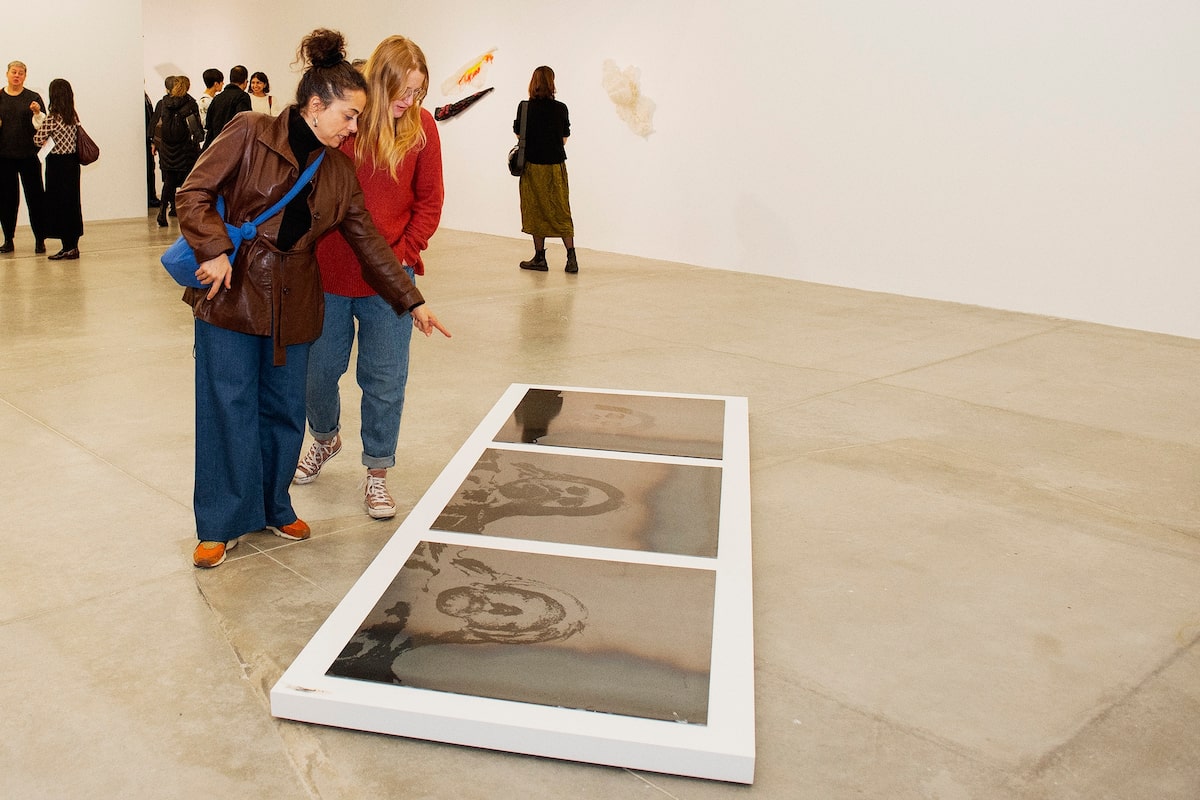
Hundreds of people poured through the doors of Toronto’s Power Plant on a cold evening this month, schmoozing, boozing and talking art in front of hot new exhibits – creating the impression of success and stability at the country’s leading contemporary art venue.
In reality, one floor above the exhibition space, staff at the Power Plant Contemporary Art Gallery have spent more than a year seeking out hundreds of thousands of dollars in savings to plug the holes in their books. The gallery’s auditors have warned for at least two years that it is at risk of ceasing operations without new money coming in, according to documents obtained by The Globe and Mail.
The national visual-arts community counts on the Power Plant both as a showcase for Canadian artists and a crucial link to the international scene, which was strengthened under former director Gaëtane Verna. The nearly four-decade-old waterfront gallery is just three years removed from a board exodus over interference from its long-time parent, the Harbourfront Centre cultural complex – which itself has faced significant financial strain and vast restructuring since the end of COVID-19 lockdowns.
Power Plant president and chair Paul Boniferro and CEO Carolyn Vesely. The gallery’s leadership says that its tumultuous recent history has also fractured its donor base.Duane Cole/The Globe and Mail
The complex’s reorganization also forced the Power Plant to become independent this year, cutting off roughly $2-million in annual funding and in-kind services from an annual budget that gallery leadership prefers to keep in the $4-million range.
But even in the gallery’s final two fiscal years of receiving Harbourfront’s support, which ended this past March, KPMG auditors warned, in both years, that “a material uncertainty exists that may cast significant doubt on the Entity’s ability to continue as a going concern.”
(After The Globe and Mail independently obtained KPMG’s 2023-24 auditor’s report and financial statements, Power Plant management shared an approved draft of its 2024-25 edition.)
The reports show that the Power Plant had a deficit of $469,000 at the close of the fiscal year that ended in March, 2024, increasing more than four times over the previous year. And while the gallery eked out a $15,800 surplus a year later, even as Harbourfront’s final contributions fell by a half-million dollars, the small windfall was due in part to slashed costs that its leadership says are unsustainable.
Attendees at a presentation of Lucy Raven’s film Murderers Baron.Duane Cole/The Globe and Mail
In a wide-ranging interview alongside executive director Carolyn Vesely and artistic director Adelina Vlas, Power Plant chair Paul Boniferro acknowledged that the gallery and its board may need assistance from governments as it rebuilds its fundraising might after 2022’s board tumult. “We need some help, transitionally, here to get on to a solid financial base to secure the financial stability of this place for the future,” he said.
The gallery’s most noticeable cut has been the reduction from three seasons of programming to two – on a schedule traditionally based on a trio of major solo shows each season – and the conversion of an upper gallery into a space for families and schools. This has reduced the number of artists shown in a typical year from 12 or more to as few as six.
This winter, the gallery is showing a video installation by the U.S. artist Lucy Raven and sculptural pieces by the Yukon artist Jeneen Frei Njootli as well as an exterior billboard by Pickering, Ont., photographer Christina Leslie. Plans for a group show next year will also increase the number of artists featured.
The programming cut was financially necessary because of surging costs after pandemic lockdowns, Vlas said. But she also defends the choice as crucial for staff’s work-life balance, which had come under scrutiny during the tenure of former director Verna, who left in 2022 to run Ohio State University’s Wexner Center for the Arts. (Verna resigned from that role last month. In August, Wexner staff sent a letter to the university administration raising concerns about her leadership. In an e-mail, Verna declined to comment on her departure.)
Vlas and Vesely said the cut in programming has not reduced the number of visitors to the gallery, which offers free admission, adding they have actually risen to 60,000 in 2025 from 50,000 the year before. In the fiscal year that ended just as the COVID-19 pandemic began, the Power Plant says it had 54,000 visitors.
The gallery’s programming cut has not reduced the number of visitors, Power Plant’s leadership says.Duane Cole/The Globe and Mail
To build back the budget and increase programming, the leaders said the gallery must both expand its fundraising network and encourage donors who fled after the 2022 shakeup. At that time, the gallery’s board of directors resigned en masse to protest interference from Harbourfront Centre, which had replaced half the board with its own candidates and had been demanding a review of Verna’s leadership. She left before that happened and, for a month, the Power Plant was left with no leader and no board.
Boniferro, a former Ontario deputy attorney-general, said that the previous relationship between Harbourfront and Power Plant “was a governance disaster just waiting to happen. It worked for 40 years because people actually made it work. And when it didn’t, it really blew up, and then afforded an opportunity.”
The entire arts sector has been reckoning this decade with rising costs and a decline in corporate sponsorship interest, plus changing tides in personal philanthropy. But the Power Plant’s leadership acknowledge that its tumultuous recent history also fractured its donor base.
Between fiscal years ending in March, 2023 and 2024, the audits say, the gallery’s corporate sponsorship and fundraising revenue fell 70 per cent, to $256,000, before more than doubling in 2025 to $603,000. Its grants from foundations dropped 63 per cent from 2023 to 2024, to $132,691, before rising to $148,000 in 2025.
Ms. Vesely at the opening party for the new exhibition season. ‘It was not easy’ to balance the gallery’s budget in 2024-25, she says, but ‘we wanted to put our house in order before going out and asking for increased investments from others.’Duane Cole/The Globe and Mail
The Power Plant’s leaders say they addressed this shortfall through the reduced exhibition costs and holding off new hiring. They’re now ramping up recruiting. They’re pinning hopes on one new hire in particular to help dig out of their financial situation: Lindsey Thomsen, most recently the National Gallery of Canada Foundation’s acting executive director, will now direct the Power Plant’s development efforts.
Beyond recovering donations that have fallen since 2022-23, and to cover for the missing Harbourfront contributions – equal to $1.7-million in fiscal 2025 and $2.3-million in 2024 – Power Plant leadership are seeking additional funding from all three levels of government. (The gallery’s annual operating grants from government arts councils were not affected in its separation from Harbourfront because it was already a separate legal entity, Vesely said.)
The gallery’s annual Power Ball fundraiser – which since 1999 was its highest-profile fundraising initiative – is set to return after being paused since 2020.Duane Cole/The Globe and Mail
Between the new network that’s opened up with the Power Plant’s now-independent board of directors, and with Thomsen heading development, Boniferro said his team feels they’re in a strong position to fundraise its way back to roughly $4-million in annual revenue.
“It was not easy” to balance the Power Plant’s budget in 2024-25, Vesely said, “but we wanted to put our house in order before going out and asking for increased investments from others.”
That will include the return of the gallery’s annual Power Ball fundraiser – which since 1999 was its highest-profile fundraising initiative, raising about $500,000 annually, but has been on pause since COVID-19 prevented the gallery from hosting a 2020 edition.
“The Power Plant is a catalyst and a vital actor in the visual arts ecosystem” said lawyer Jacques Bernier, who was chair of the 2022 board that resigned. He said he is satisfied with the new governance structure, but was sorry to see the reduction in programming at a gallery he described as best-in-class when it comes to showing boundary-pushing visual art. “How many world-class cultural institutions do we have in Canada?”