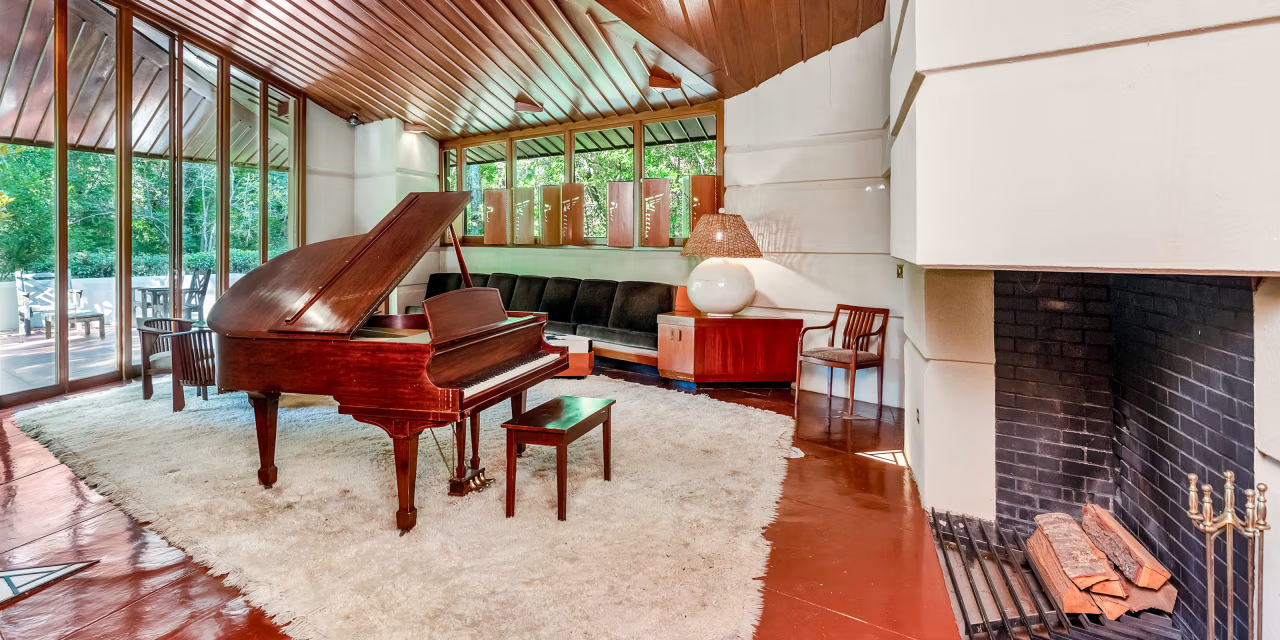
Robert Parker Adams, who died on July 3, did everything he could to make sure that his Frank Lloyd Wright-designed house in Jackson, Mississippi, ended up in the right hands. A preservation architect, Adams had owned the house, called Fountainhead, for nearly half a century (twice as long as its original owner, oil speculator J. Willis Hughes).
Adams spent the early 1980s years restoring it, with the help of his first wife, Mary, and then decades showing it off, giving tours that sometimes lasted two hours or more. As he told The Wall Street Journal earlier this year “I love educating people about Wright.” When guests asked the square footage of the house, he pointed to its many acute and obtuse angles. “There aren’t any square feet. Just triangular feet,” he said.
MORE: One of the Few Private Islands off Cape Cod, Massachusetts, Hits the Market for $10.9 Million
In June, only weeks before he died, he listed the house for $2.5 million. But the price was guesswork. “There were no comparables,” says Douglas Adams, of Crescent Sotheby’s Realty, who co-listed the house with Crescent’s David Abner Smith, of New Orleans.
Was it more like other houses in Jackson’s Fondren neighborhood, where the highest asking price recently was $445,000, or more like other Frank Lloyd Wright houses, which sometimes command more than $10 million?
It turns out it was somewhere in between. The house has sold for $1 million—just 40% of asking but enough for Adams’s widow, Sherri Mancil.
The buyer is the Mississippi Museum of Art, which plans to open the house to the public, fulfilling Adams’s dream. Betsy Bradley, the director of the museum for 24 years, says Fountainhead is the first house it has ever acquired: “This is all new territory for us.”
Mancil says she was pleased with the price because “now we know the house will be preserved in perpetuity.” She says her husband met with Bradley before he died and was hopeful that the deal would happen.
A number of things had to fall into place before it could.
First, members of the Woodland Hills Conservation Association had to vote to amend the association’s covenants, exempting the house from the requirement that it be used as a single-family residence. That permission, in effect as long as the house is owned by the Mississippi Museum of Art, required “yes” votes from 75% of the association’s members.
“We had two afternoons with wine and cheese and a notary so people could come by and sign,” says Douglas Adams, who also represented the museum.
Once the Conservation Association approved the change in its covenants, the zoning board had to approve the museum’s plan to host small tours and other events at the house. That permission was given on October 22. Finally, in mid-November, the City Council gave its stamp of approval, the last formality before the closing.
Bradley says two donors had covered the cost of the house and necessary repairs. “I am excited that the community has risen to make the resources available and eliminate the barriers to the purchase,” she adds.
But, she says, she is still in fundraising mode.
Even when perfectly restored the house will need ongoing maintenance. For one thing, Bradley says, “It sits on Yazoo clay.” The movement of that porous material caused damage that Adams repaired. “But it doesn’t only shift once,” she says of the clay. “It shifts constantly.”
It will be at least a year, Bradley says, before the house will be ready to welcome visitors. But when it does open, she says, Adams will be there. “His stories will be incorporated into the interpretive materials.”