Caretaker government can still pursue economic agenda even if House is dissolved, says Ekniti
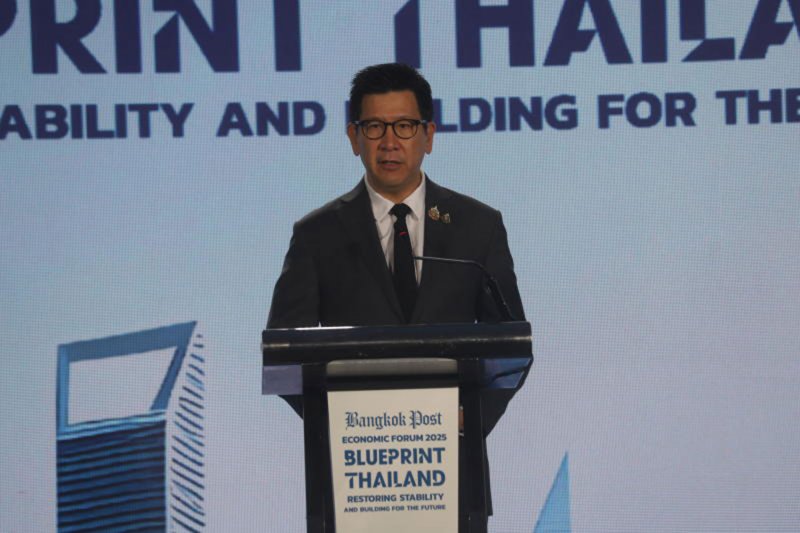
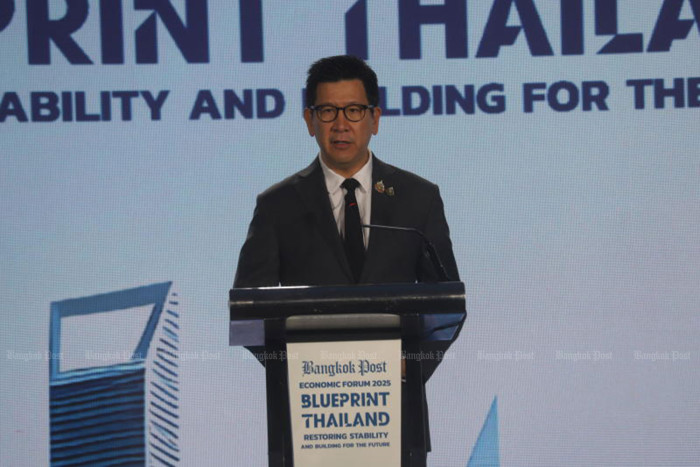
Finance Minister Ekniti Nitithanprapas expresses confidence that key policies will stay on track even if parliament is dissolved sooner than expected. Mr Ekniti, also deputy prime minister, made the remarks while attending the Bangkok Post Economic Forum 2025 as the keynote speaker. (Photo: Nutthawat Wichieanbut)
Neither trade negotiations with the United States nor the government’s economic agenda will be disrupted even if parliament is dissolved, says Deputy Prime Minister Ekniti Nitithanprapas, expressing confidence that key policies will stay on track.
Should a dissolution occur, international trade negotiations can still move forward under a caretaker government, said Mr Ekniti, who also serves as finance minister.
All planned economic measures will continue as scheduled, with the aim of completing them by December, he added.
Mr Ekniti made the remarks in a keynote address at the Bangkok Post Economic Forum 2025, “Blueprint Thailand: Restoring Stability and Building for the Future”, on Friday at the World Ballroom, Centara Grand at CentralWorld.
Questions have arisen after Prime Minister Anutin Charnvirakul said he was prepared to dissolve the House on Dec 12, the first day of the new parliamentary session, if the opposition files a no-confidence motion.
Under the agreement that the premier’s Bhumjaithai Party signed with the People’s Party, the House was to be dissolved at the end of January. That would allow time for constitutional amendments to be debated, so that a referendum asking the public if they favour a new charter could be held alongside an election.
Mr Ekniti noted that while a caretaker administration cannot sign any binding international treaties, negotiations and the pursuit of an economic agenda can continue. The government’s priority, he said, is to maintain Thailand’s competitiveness by supporting local businesses and expanding access to new markets through free-trade agreements (FTAs) and bilateral deals.
Reinforcing Thailand’s economic resilience requires fiscal and financial stability, he told the audience.
“I am confident that stability will return, as we are laying the foundations for the Thai people. And the most crucial foundation is stable national finance and [a sound] fiscal policy,” he said.
The medium-term fiscal framework, approved by the cabinet on Tuesday, plays a vital role in maintaining confidence, he said. Coupled with the Ministry of Finance repaying a 30-billion-baht debt to the Bank for Agriculture and Agricultural Cooperatives (BAAC), the move demonstrates the government’s commitment to preserving fiscal stability, he added.
Mr Ekniti said Thailand still has a strong economic foundation. Core inflation (excluding food and energy) is below 1%, with unemployment under 1%. The financial system remains robust, with a capital adequacy ratio of around 20%, while the global standard and the Bank of Thailand benchmark stand at 11%.
The country has a current account surplus, and its foreign reserves amount to $270 billion (8.8 trillion baht). If the $30 billion in forward positions is included, the total comes to $300 billion, which is three times the value of short-term external debt.
This means that even if the country repaid all existing short-term debt in full today, Thailand would still have foreign reserves equivalent to twice the amount of the short-term debt already paid off. These factors form a crucial foundation that attracts foreign investors, said Mr Ekniti.
“Thailand has a promising future, but delays in actual investments hinder competitiveness,” he said. “Although private-sector projects submitted to the BoI [Board of Investment] last year totalled over 1.3 trillion baht, many have yet to materialise due to bureaucratic red tape.”
He proposed accelerating investments via the Thailand Fast Pass initiative to streamline approvals. Of last year’s 1.3-trillion-baht worth of applications, ventures worth around 470 billion baht are ready to proceed, with 60 companies holding projects over one billion baht, representing about 300 billion baht in investment.
Once approved, Fast Pass holders will receive expedited permits from government agencies. “Investment is expected to flow next year at 200–300 billion baht in future-oriented industries,” Mr Ekniti added.