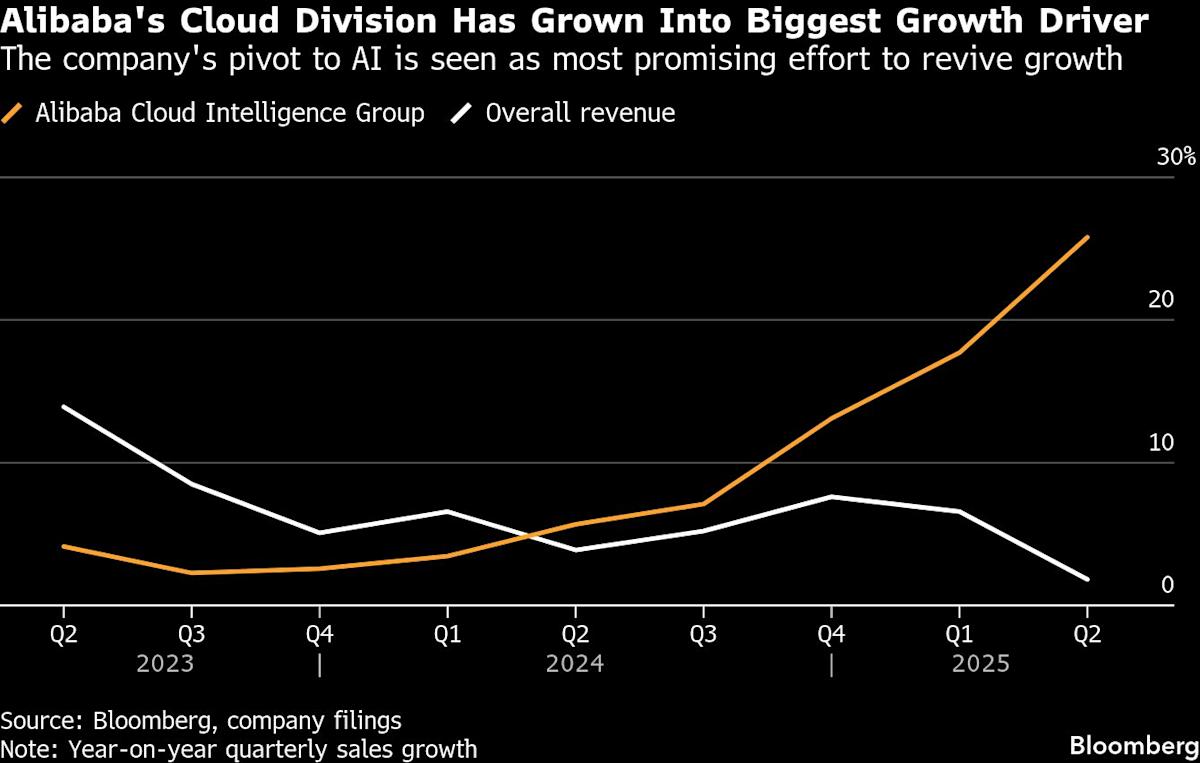

(Bloomberg) — Alibaba Group Holding Ltd. posted better-than-projected 34% growth in its pivotal cloud business, highlighting the enormous demand for computing during China’s AI boom.
That helped propel overall revenue 5% higher to 247.8 billion yuan ($35 billion) in the September quarter, just outstripping expectations. The company posted a 16% rise in Chinese e-commerce revenue for the period, suggesting it was faring well in a three-way battle with JD.com Inc. and Meituan. Its US shares gained more than 4% in pre-market trading.
Most Read from Bloomberg
The strong results are likely to encourage investors betting on Alibaba as a leader in artificial intelligence development. The company has accelerated the release of AI models, culminating in the relaunch of its flagship Qwen mobile app — an effort to replicate the success of OpenAI’s ChatGPT that got off to a fast start this month.
Alibaba joins JD.com and PDD Holdings Inc. in reporting better-than-anticipated results, boosted by Beijing’s stimulus measures and billions of dollars in subsidies as they vie for shoppers and diners. But that cut into Alibaba’s profitability: Net income dived to 20.99 billion yuan during the period — reflecting not just the discounting but also the mounting costs of AI development. Sales and marketing expenses doubled in the quarter.
WATCH: Alibaba Group Holding Ltd. reported better-than-expected quarterly revenue growth, as sales grew 5% to 247.8 billion yuan ($35 billion) in the September quarter. Tom Mackenzie reports.Source: Bloomberg
Alibaba Spends Big to Fuel AI and Quick Commerce Growth: TOPLive
The report emerges against a backdrop of growing doubt about the sustainability of heavy investment in AI infrastructure — without a clear path to profitability. The spending bubble Chairman Joe Tsai warned about in March has only grown in ensuing months, after the likes of Amazon.com Inc., Microsoft Corp. and Meta Platforms Inc. declared hundreds of billions of dollars for new data centers. Their shares have sagged over the past month as concerns mount about the return on investment.
The AI Showdown – How the US and China Stack Up: QuickTake
Chinese AI firms have weathered the global selloff better, in part because their spending plans are still comparatively modest. Yet Alibaba’s — at 380 billion yuan over three years — sets it apart from much of the domestic competition. Tencent Holdings Ltd. committed roughly $1.8 billion toward capital expenditure in the most recent quarter.
Story continues
On the surface, Alibaba’s ambitions also appear more aggressive. Its revamped Qwen mobile app attracted 10 million users within four days — one of the fastest rollouts of any Chinese AI service — and Alibaba said the plan is to build it into a full-fledged AI agent that can handle tasks like shopping on Taobao. Qwen is set to gradually incorporate features like mapping, shopping, travel booking and education, with the goal of building up a broader ecosystem.
Investors have so far cheered Alibaba’s AI ambition. The Hangzhou-based company’s shares have nearly doubled in value since the start of the year — though in the long run it’ll have to sustain rapid cloud revenue growth and fight off stiff competition from China’s entire internet sector, spanning AI startups like DeepSeek to tech giants like ByteDance Ltd.
While US players like OpenAI or Alphabet Inc.’s Google remain shut out of China, Qwen will have to contend with local rivals.
ByteDance’s Doubao chatbot already has over 172 million monthly active users, according to QuestMobile data. Tencent is leveraging WeChat to promote its own Yuanbao, while laying out plans to build the ubiquitous WeChat into an agentic AI-capable service. And consumer-facing apps have yet to show a clear path to revenue generation in China, where users have shown little appetite to pay for subscriptions.
While developing AI and cloud services is widely seen as an effective path to growth, the country’s biggest tech companies are hampered by US restrictions on the most advanced Nvidia Corp. chips. Supply of domestic alternatives is limited. That hampers AI development to an extent, though Alibaba and local firms like Huawei Technologies Co. are seeking to develop homegrown accelerators.
Alibaba Chief Executive Officer Eddie Wu in September set out plans to build a “full-stack” suite for AI development, from advanced models to the infrastructure — such as semiconductors — required to build them. The company’s chip unit, T-Head, has gained headway in efforts to compete with Huawei.
Taobao, Alibaba’s main online marketplace for Chinese users, managed to attract more users this year by integrating instant delivery functions into its app. But the fierce competition around that business segment has eroded industry-wide margins, and authorities last month renewed a pledge to rein in price wars. Alibaba’s ability to control costs around consumer services while investing in cloud operations is something investors will monitor over the long term.
What Bloomberg Intelligence Says
Alibaba’s China e-commerce profit slump likely offset the lift from narrower international e-commerce losses and higher cloud earnings. Along with steeper other losses, including the contribution from Cainiao, this is set to hurt operating profit for the second straight quarter.
– Catherine Lim, analyst
Click here for the research
–With assistance from Claire Che, Debby Wu, Yazhou Sun, Henry Ren, Zheping Huang and Ville Heiskanen.
Most Read from Bloomberg Businessweek
©2025 Bloomberg L.P.