Welcome to “On That Note,” a rock-and-roll-centered column that will dive into the big stories, hot trends, and plain-old crazy ideas coming out of the music industry.
“This show is more ambitious than anything I’ve ever done.”
Photo: Scott Legato/Getty Images
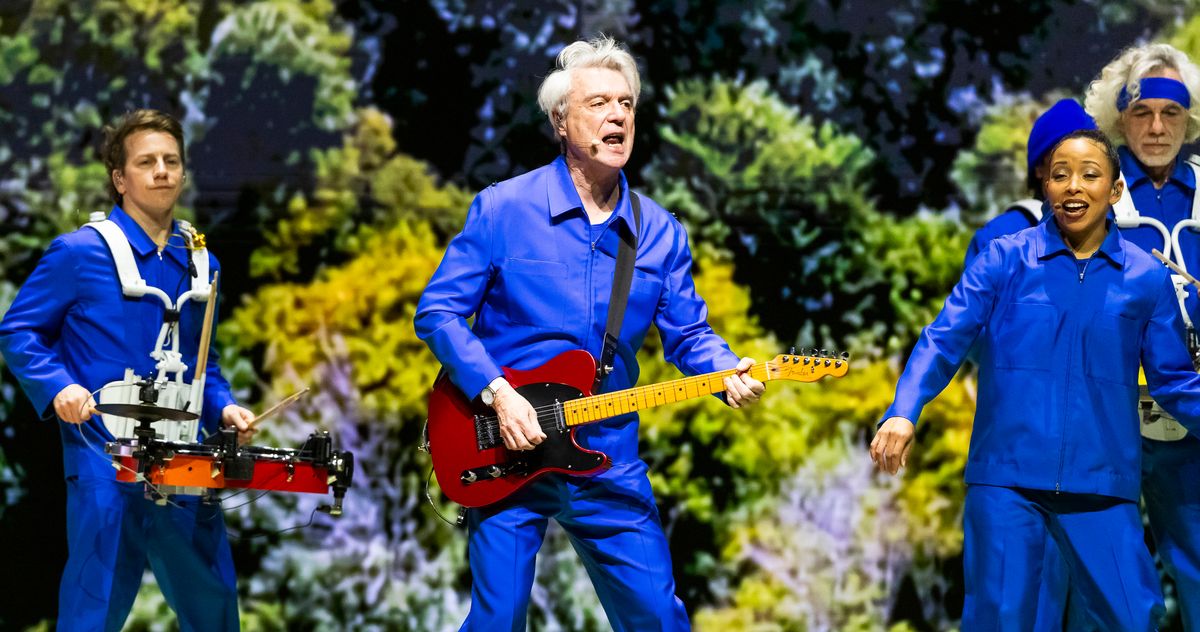
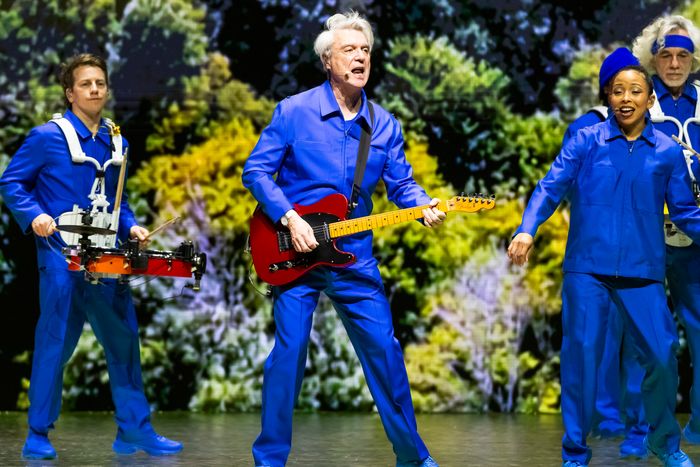
Witnessing David Byrne’s Who Is the Sky? tour is like stepping into a kaleidoscopic bubble bath for two hours. Turn the faucet hot, and you get the urgent reminder that “Life During Wartime” never really ends. Turn it again, and you can cool down with the sensual beauty known as “And She Was.” Byrne, sharing the stage with over a dozen untethered musicians — an artistic choice that he previously utilized to great effect for his American Utopia shows — alternates between performing his solo work and Talking Heads songs to create a euphoric atmosphere, something that seems more essential than ever in 2025. Large screens, too, festoon the outer edges of the stage, adding another layer of visual communication to enhance each song’s underlying message.
At least, that’s how I would describe what my concert experience was like. Byrne doesn’t want to give too much of his own thought process away. “Friends attempt to describe it to me,” he tells me with a chuckle, “but I wouldn’t be so presumptuous as to describe it myself.”
Byrne is currently in the final stretch of the American dates for his Who Is the Sky? tour, which was the relentlessly positive 12-song album he released back in September. In the new year, Byrne will be expanding the tour internationally. “This show is more ambitious than anything I’ve ever done,” he explains. “With Stop Making Sense and American Utopia, these were ambitious ways of rethinking what a music show could be. This also is, but in its own way. I honestly don’t know where I go from here.” Whether that means some sort of Broadway engagement or a concert filmed for posterity, both of which were done in tandem with American Utopia, has yet to be decided. A decision that was easier for Byrne to make, though, was excavating “Psycho Killer” and putting the hit back into his setlist for the first time in nearly 20 years. He faced up to all of the facts in our recent chat.
Between the Who Is the Sky? and American Utopia tours, you’ve consistently challenged yourself to see what form a concert can take. How would you describe what you’re doing onstage every night?
In the way that American Utopia evolved from a concert into a Broadway thing with a little more shape to it, this picks up from there and goes further. There’s more talking and it’s more theatrical as far as the scale. It’s a lot more exuberant, a lot more colorful. It’s a hybrid between a theater engagement and a concert. I don’t know if that helps people at all because there are other shows that mix like that. I saw Lady Gaga’s show and it took me to another place entirely. But for me, there’s a theme and there’s a story. Now don’t ask me to articulate it — that’s your job. But there is a theme and a feeling that runs through the whole thing. Some of that is intentional, but some of it is just what happens.
Your setlist rarely changes between nights because of the perfectly timed visual effects. How did you approach calibrating what made the final cut, given how extensive your solo and Talking Heads work is?
Yeah, the only songs we change depending on the night are “I Met the Buddha at a Downtown Party” and “Moisturizing Thing,” which are both from the new album and “story songs.” But they’re both amusing, so we swap those out with each other. Other than that, it’s consistent. We’re thinking of having more swap-outs, but the whole thing is very designed and even the transitions from one song to another are perfectly worked out. It’s an involved thing to make changes. That’s a very theatrical thing, isn’t it? Doing that is very common in theater. It’s not as common in concerts where people will say, “Oh, hey, let’s do this tonight, or let’s do that.” The hope is that in making the effort to work that stuff out, it brings something else to the table.
What was your trial-and-error period like during rehearsals? Were there ideas that just couldn’t be realized on a stage each night?
There were songs we tried to learn that just didn’t sound great or didn’t have the same feeling that matched the other selections. There was choreography that we did where I blamed myself because I could never quite get it. So we’d reworked those types of things. We use a big LED wall during the show. In the first three weeks or so of the tour, we kept refining the walls. There’s a song called “Like Humans Do” — we added an element of a projection of ourselves in animal masks dancing and doing the exact same thing as what we’re doing on the floor.
I liked when you added footage of ICE agents tripping and falling to your Chicago show for “Life During Wartime.”
Yes. [Laughs for several seconds.] In Chicago they’re totally related to that.
An overuse of screens, especially on Broadway, often hits an uncanny valley and takes viewers out of a show. How did you arrive at the artistic decision to use screens and utilize them in a way that ensured it would enhance your performance?
Often in concerts when we see screens, usually it’s closeups of the singer or band members or dancers. I said, “No, we should never do that. No exceptions.” Because then my experience when the performers are on the big screen, all you do is just watch the screen. You paid a lot of money to watch television. So I thought, We can use it another way. We can use it to put ourselves in various places. We can put ourselves on the moon. We can put ourselves in a bar or in my apartment or at a party on a New York rooftop. Not a lot has to happen. You’re immersed in us.
We realized in the early days of rehearsals that if there was too much going on with the screens, the solution was to take it out. It’s really distracting. The eye goes to whatever is happening on a screen like that. So you just have to be very careful not to overpower the real people on stage. It’s a very tricky balance. You go, No, no, no. That’s taking away from what’s going on with me! If I go into a restaurant that has big sports screens, even if I’m not even interested, my eyes go straight to the screen.
Prior to the first show of this tour, you hadn’t performed “Psycho Killer” live in nearly 20 years. What made you resistant to play that song during this time period and why did it feel right to revisit it now?
Wow, you’re right. Let me think about this. Certainly for the last American Utopia tour, that tour was about providing an alternative — as is this one, too, with what I see happening around the country and around the world. As much as people like that song, I thought “Psycho Killer” didn’t really fit into that theme. Before that, it was probably just me being willful and going, I’m tired of doing this song.
So this time I worked with our music director and said, “There’s a version that Arthur Russell arranged years ago. It’s a very different-sounding version of the song. It’s the same song, it has everything, but it has a different feeling and it’s maybe a little more interior feeling than the rock-out version.” So I figured, let’s do that one. We have a cello player, so we can get someone doing the cello parts every night. I thought that would be fun to present. Everybody recognizes it as soon as the bass line starts. But then it’s a slightly different version than the one you might be used to.
Do you have any other songs, to your point, that you’ve grown tired of playing?
“Psycho Killer” is kind of an exception because it was the first song I wrote. It was written from my point of view as a way to see, Can I write a song? And I discovered, Oh, I can. Then I kind of changed lanes and decided I’m going to write songs that are more along the lines of what I’m about rather than trying to see if I can write a song. There are popular songs that I’ve never done in a big concert setting that would go over well. “Wild Wild Life” from True Stories is probably the biggest one. My grandson loves that one. But the song was written to be almost a parody of MTV for a specific scene in that movie. So I’m kind of stuck thinking of it that way. At some point I might feel like, Oh, who cares? I’ll perform it now. Most of the audience probably never saw the movie, so they don’t see it that way. But I do.
You had been playing a fun question mark of a song about shirts throughout the tour, which hadn’t yet been released and confused people about its origin. It was unveiled last week that the song is called “T Shirt” and it’s a collaboration with your old pal Brian Eno. How did this come together?
It was done for my previous record and never made the cut. As we were starting to rehearse I realized, Actually I think this song holds up pretty well. It might fit in the show. And a good way to present it and integrate it into the show would be showing images of things that people put on their T-shirts. It’s a really catchy song. I’m glad we gave it a try and are giving it another life. When people heard it, they really reacted.
What’s the oldest T-shirt you have in your wardrobe?
Not including the ones that you just wear for workouts or the gym? I have one from a Mavis Staples show from a long, long time ago. The merchandise had the names of everyone in the Staple Singers. “Mavis.” “Pops.”
I don’t want to be the lead in The Phantom of the Opera and that’s all I do for the rest of my life.
You and Brian have worked together frequently since Talking Heads’ More Songs About Buildings and Food. What have you two understood about each other over the decades that others haven’t? I mean, you’re approaching 50 years of knowing each other.
We respect our borders. For example, there’s a record some years ago where he had a lot of music that he hadn’t quite turned into songs. I said, “I’ll leave the music alone, but let me see if I can shape them into some songs.” I may have changed the order of parts of the music, but other than that, I left it alone. What’s that saying? Good fences make good neighbors? That kind of thing has worked out for us.
There’s a vignette you tell both in your American Utopia show and new tour about the song “Everybody’s Coming to My House”: You originally recorded it as a lament about people coming over and bothering you, but after hearing it joyously performed by a youth choir, it rewired your interpretation. Has that experience happened for any other song throughout your career?
Not as extensively as that one, but yes. When A24 rereleased Stop Making Sense about a year ago, they followed that up with a record and invited a bunch of bands and artists to cover the songs that were in that movie. There were a few of the artists who completely changed the approach to the songs and how they were done. Some were kind of faithful, but a few others flipped them over. Blondshell did an interpretation of “Thank You for Sending Me an Angel” and gave it a completely different meaning that worked. Miley Cyrus did a version of “Psycho Killer” and turned it into a love song. I was like, I love the psycho killer! It sounded like an Oliver Stone movie. I like when artists find something that I didn’t know was there.
You tend to describe your work as your way of trying to better understand human behavior. What has translating Who Is the Sky? from the studio to the stage helped you understand about yourself?
My wife said to me the other day, David, the album is good, but the stage version is so much better. She doesn’t mean just with the songs. She means the overall feeling that comes across with what it’s doing. That’s great. I had no idea that would happen. I was, of course, very happy with the record, but there’s a thing with live performance that I’m always striving to — real bodies, real people, a real live audience, all these people being together, and witnessing something that’s ephemeral. That’s very special, as it was to hear my wife say that.
Do you have any interest in reformatting this tour for Broadway or having another cool and hip director film it for posterity?
I’m thinking about that, so we’ll see what happens there. Because, yes, it’s a very extensive tour and it’s not going to last forever. Taking the show to Broadway and adjusting it accordingly to what I imagined would be a “Broadway audience” — that wasn’t going to be up and dancing from the second song or something like that — was a challenge. A Broadway audience wants to be gently told or explained, This is what’s happening. This is what we’re doing. This is what it’s about before you get up and dance. It also becomes an opportunity for us to talk more. I want to start a little more gradually to introduce all the elements.
My recollection of Broadway is it got interrupted by COVID. Boy, was that a big interruption. At least a year and a half. What happened is that it made me feel, I’m doing the same material for four years now. After that I was just like, Whoa, that’s enough. I don’t want to be the lead in The Phantom of the Opera and that’s all I do for the rest of my life.
With the Special Tony you won for American Utopia, you join a small and rarified group of people who are one award away from EGOT-ing. You just need the “E.” Have you given much thought about how you’d like to accomplish this?
It’s not like, Oh, now I have to direct all my attention towards something like television. Should I turn the show into an ongoing series? Just kidding.
Lastly, what has been your reason to be cheerful today?
It’s a beautiful day in Austin, Texas. I’ve got a bicycle here in my hotel room that I travel with, and I’m going to get out and get a few breakfast tacos.
Related