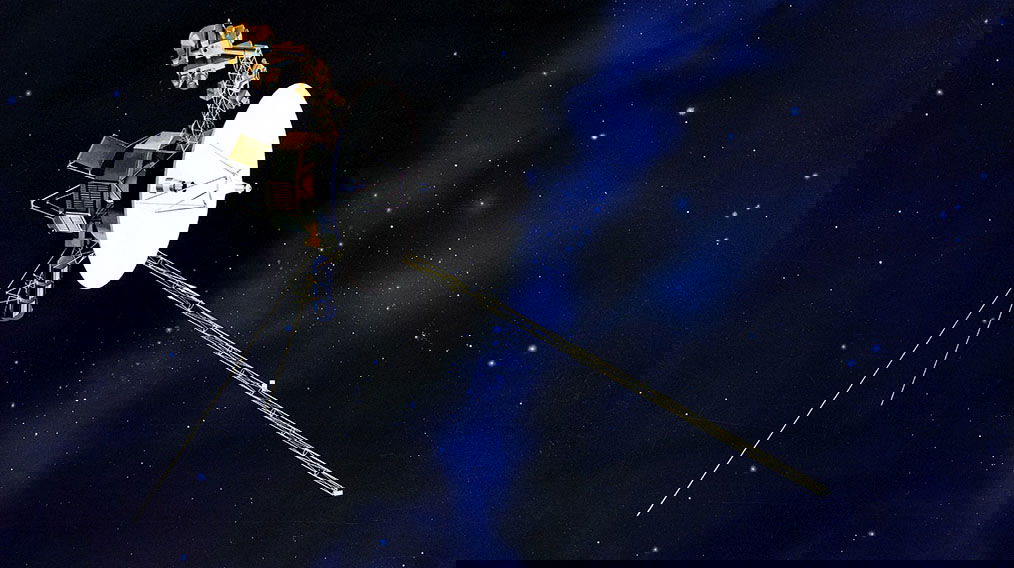
NASA’s Voyager 1 space probe will continue its almost half-century of service by delivering yet another milestone: by this time next year, it should have reached a distance of 1 light-day from Earth.
Based on the most recent estimates, the revolutionary Voyager 1 space probe is expected to achieve the feat on November 15, 2026, continuing its reign as the farthest-travelled human-made object. After flying by Jupiter, Saturn, and Titan, the spacecraft continued its journey into interstellar space.
The Speed of Light
Based on present-day physics, scientists know the speed of light is the greatest speed at which anything in our universe can travel. That astronomical rate is clocked at 186,000 miles per second. Due to the immense distances separating points in outer space, scientists have adopted the distance light travels in one year, 5.88 trillion miles, as a universal measurement scale.
Proxima Centauri is the star nearest to our own, even though that cosmic neighbor is 4.2 light-years away from Earth. Over four years of light-speed travel would be required to cross such a distance.
For shorter distances in space, scientists rely on astronomical units, which are equal to the distance between Earth and the Sun. Although humanity has yet to conquer light-speed travel, Voyager 1 still manages to zip along at the relatively quick 11 miles per second. This adds up to 3.5 AU each year as the craft continues its journey.
Communications Challenges
Somewhere in the middle of these two ends of the cosmic measuring scale is the less commonly used figure known as the “light day,” denoting the distance light travels in a single Earth day.
That distance has begun to add up and impact the effectiveness of communications with Voyager, which are maintained through NASA’s Deep Space Network. Mission engineers spent weeks last November dealing with just one episode of technical difficulties due to communications lag. At billions of miles from Earth, the commands and responses took 23 hours to travel in each direction from Voyager 1 to Earth.
During that event, silicon dioxide from a rubber diaphragm had accumulated in a fuel tank, cutting off a crucial fuel thruster tube. Thrust was drastically lowered, as the liquid hydrazine fuel was impeded from flowing freely. It took 40 small thrusts from the obstructed system to even push Voyager into proper alignment for effective communication with Earth.
In the end, the mission engineers elected to return to a set of thrusters that had themselves been turned off years earlier due to malfunctions, although of a less severe sort than those plaguing the system last year. At one point during the operation, power was so low that the mission team had to take the calculated risk of turning off Voyager 1’s heater in deep space to power the systems required to bring the old thrusters back online.
The Future of Voyager 1
Despite the challenges of communicating over such a massive distance, NASA plans to maintain contact with Voyager 1 as it crosses the monumental 16.1 billion-mile threshold to reach one full light-day from Earth.
The celebration may be bittersweet, though. Three radioisotope thermoelectric generators power the craft, which are expected to run out of energy in the next decade. Many of Voyager 1’s systems are no longer functional, as those generators are even now providing much less power than the craft utilized at launch. Over the years, many concessions have been made, reverting to backup thrusters, disabling instruments, and cutting power to keep the mission continuing long past its expected lifespan.
As such, the one light day milestone may be the last outstanding achievement for humanity’s farthest step into the cosmos.
Ryan Whalen covers science and technology for The Debrief. He holds an MA in History and a Master of Library and Information Science with a certificate in Data Science. He can be contacted at ryan@thedebrief.org, and follow him on Twitter @mdntwvlf.